Trail Head

After witnessing the motorcycle accident at the beginning of our trek to the villages outside Sapa, Vietnam, we continued our walk and before long we reached a side road that looked like the beginning of a trail head down the valley. The road turned from asphalt to gravel, and then it ended at a point where we saw a large group of local women standing around. We had a couple of local women walking with us from Sapa — they were trying to connect with Anna and Kristi and convincing them to purchase the handicrafts, and even after Anna said no, they still continued to follow us.

There were at least 20 of other local women standing at the trail head. It seemed that they knew the tourists would come through that route, so they waited there for the groups to arrive. As they saw us coming, some of the women stopping talking with their friends and started joining our group. So the group that started with five people (our tour guide May, Dave, Anna, Kristi, and me) had more than doubled when adding the local women who went with us.

Anna asked May if this was normal to have such an ‘entourage’ going with the groups, and she said yes. Many of these women came from the nearby villages and compared to the majority in Vietnam, they were quite poor economically. The handicraft business was their way to try to capitalize on the foreign visitor interests in their culture.

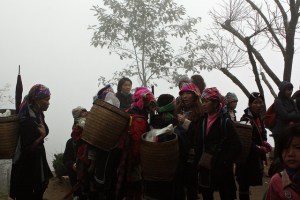
The photo below was taken as we reached the trail head. You can see the gorup of women waiting for the hikers to arrive.
Waiting for tourists

Commuter Accident

As we went on our hike near Sapa, Vietnam, we noticed that a lot of people from the villages around the town would come to the town center to do business. I think what’s interesting to note was the mode of transportation that we saw on the road. Once in a while we saw passenger minivans (Ford Transit), which seem to be used either to carry tourists on a tour, or for long distance ride to other towns (e.g., to Lao Cai). We also saw people walking. But the more common ones seem to be people riding motorcycles (small cc bikes — they are more scooters). I think what’s impressive was to think that these little scooters were probably built more for urban use (e.g. in flat city like Hanoi), not for mountainous, and in some areas, unpaved roads. Also sometimes people carry heavy load / cargo on the back, or they would have three people riding on the same scooter.

As we walk out of the Sapa town center, it started to drizzle a little bit. The grounds were already quite wet and somewhat muddy; looked like leftovers from the day before. I was glad we’re ready for it. We knew from reading about the climate that during the winter season, it could rain a lot in the area (and in higher elevation, it could even snow). So we were ready with our jackets that had hoods and with boots that could be fine even going through muddy terrains.

As we walked close to a curve on the slippery and wet road, we saw a scooter passing by with passenger on the back carrying several plastic bags. They tried to maneuver as there was another scooter coming from the opposite direction. With the slippery surface, and curving, incline road, we saw right in front of our eyes an accident happening. The driver of the scooter lost balance and control and he and his passenger started sliding on the muddy road. The scooter in the opposite direction fortunately was able to avoid crashing into them. Good news was that none of them seemed to be hurt since the whole thing happened at low speed. A couple of motorbikers stopped to help them collect their belongings, and in few minutes, they were off and continued their trip — dirty, but at least not hurt.

I took the photo below as the accident had just happened and they were trying to get back on their feet.

Accident

Hiking to Lao Chai and Tavan Villages

On our first day in Sapa, Vietnam, we signed up to do a guided hiking/trekking to a couple of nearby villages. The trip was arranged through our hotel, the Sapa Rooms Hotel. Sapa Rooms employed local guides to lead trekking trips to visit local villages and landmarks. The guides were young ladies from the minority hill tribes nearby.

After settling in our hotel room and getting a short rest in the morning, we met our trekking group at the lobby of the hotel. The guide was a young lady in her early 20s named May. She spoke English very fluently, very outgoing and quickly established good connection with our group. Other than Kristi and me, the only other members of our trekking group that morning were a couple from Melbourne, Australia, named Dave and Anna.

We introduced ourselves as we left Sapa Rooms to start our trek. Dave said that he and Anna had been in Sapa since the day before, and they had done the hike to different villages the day before on their own. They said the weather on the previous day was not great; it was very foggy and misty and they couldn’t see much. They were hoping to have better luck with the weather on our trek, as it looked like it’s a bit better. Still cloudy, but at least not foggy.

As we walked through the Sapa town center to get to the trek outside the town, several H’mong ladies with basket filled with handicrafts came to approach our group and walked with us. One of the ladies said “Hi, how are you? Where are you from?” to Anna, and Anna said, “Oh, no. I wouldn’t fall for that again…” She smiled at the H’mong lady while shaking her head and continued walking, and explained to Kristi and me that some of the local Hmong ladies would approach a foreigner and start a conversation, with the goal to eventually convince the foreigner to purchase something from them. And apparently these ladies were quite persistent, and they would follow you and find you as you walk in the town of Sapa (it was a pretty small town after all) to keep asking about purchasing the handicraft from them. While it could get annoying and perhaps was borderline to stalking, these local ladies were really only trying to make ends meet by selling their handicrafts to the visitors, they didn’t mean any harm. So that’s why Anna was saying she just tried to ignore them after saying no, and hope they got the message and leave us alone.

The photo below was taken as we started our trek through Sapa town center. You could see our guide May talking with Dave as we walked through the busy main street of Sapa.

Trekking through Sapa

Hill Tribes

In addition to the enjoying the scenery around the mountainous region, visitors are drawn to Sapa because of the unique cultural setup of the area. The villages around Sapa are home to several local tribes, each occupying certain villages in the area, and they still keep a lot of traditions handed down from their previous generations. What makes this especially unique is that there are several distinct tribes represented in the area, and each tribe could be identified from the clothes and head bands that the villagers wear. Even the tribe’s names as known to the visitors were indicative of what they wear, like the Black H’mong people wearing black outfit, and the Red Dzao people wearing red hats.

One popular activity is to hike/trek to the village to see and meet these hill tribes and see what life is like in the village. Some more adventurous visitors who want to get closer to the action can also opt to arrange a homestay with a local family. Some of the villagers learned that many visitors would like to experience first hand what it’s like to live in their village, so this created somewhat an industry where they would open up their home as a local ‘bed and breakfast’ and provide experience to foreigners to live like they do for a short period of time. Another activity that was also interesting to many visitors was to go to a weekend market in the area that was typically attended by many of these local tribesmen. During the week, each tribe stays in their own village without much interaction with others. But during the weekend market, people from different tribes would come to meet and exchange goods with each other. For tourists, this is a great time to see many of these tribesmen wearing their colorful outfit at the same time in one place.

Since we were in Sapa only for a couple of days during the weekdays, we didn’t get a chance to observe the weekend market. However, it’s pretty easy to spot the folks from the area’s hill tribes in downtown Sapa. There were many ladies from the Black H’mong and the Red Dzao tribes who walked around the town with some handicrafts that they made and tried to sell those to the foreigners they met in town. We saw them from the moment we arrived in town, and continued on to the time when we started our hike to a couple of the villages.

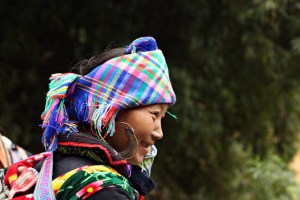
The photo below was one of the Black H’mong ladies we encountered during our hike. You could see in this case her colorful headband along witht the black garment she wore.

Black H'mong lady

Hiking in Sapa

When you visit the mountain resort town of Sapa, Vietnam, one of the activities you can do is hiking. For the serious hikers, you can hike the trail to the peak of Mount Fansipan, the highest peak in Indochina region (Vietnam, Laos, and Cambodia). For most people, the more popular hike is to visit the nearby villages where the local tribes live. Typically the hike is anywhere between 3 to 15 km in distance, and in most cases you can do the hike as a half to full day activity.

In planning to do the hike, you can also decide whether you want to go by yourself, or hire a guide. Going by yourself is obviously cheaper, and you can go at your own pace, but you need to make sure you have a good map or know the route, and you are adventurous and willing to perhaps interact with the locals who you encounter during the hike. Otherwise, it may end up with a long day (because you get lost) or you won’t learn or appreciate the culture as much as you only see the scenery without talking to the people who live there.

A more popular option is to join a tour group led by a local guide. These are either offered by tour company/outfitters if you come to Sapa as part of such tour, or you can inquire some of the hotels in town who may have arrangements with local guides who can take guests on half day or full day hiking tour to the villages. In some cases, the route taken was chosen to be less strenuous for the guests (e.g. they would go downhill to the valley, and then the guests would be picked up by minivan to go back on the uphill part), and it would include a lunch break at the village in the middle.

During our visit to Sapa, we spent our first day there on a guided hike arranged by our hotel, Sapa Rooms. They hired local girls who are fluent in English to guide the tour groups. In our case, it ended up to be only four people, so it was still feeling like a private tour. That tour took pretty much a whole day, since it was at a leisurely pace and included lunch break in the middle. On the second day, we ended up going to another village on our own. So we experienced both options for hiking to the villages.

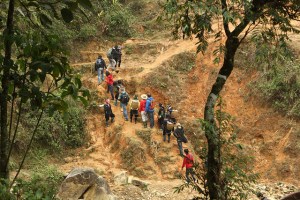
The photo below was taken during our first hike. This was around an area where we went down to the valley, and then had to go up a little bit on a narrow, muddy path. You can see here the line of hikers waiting to climb up.

Hiking in Sapa