Rest Stop in the Desert

When you’re driving from the east on the Arizona segment of Route 66 between Kingman and Oatman, the highway transitioned from a drive on a flat plains of the Sacramanto Valley from Kingman to a treacherous climb up through the Black Mountains near Oatman. In the old days, this was quite intimidating for the travelers as they would have to go through a narrow road with steep grades and hairpin turns. Some people even hired locals to drive their cars through these area or even tow their cars to the summit.

Just before you start the climb, there was rest stop called Cool Springs that was was opened up as a place for the travelers to check their cars or fueled up before they tackle the challenging terrain, or for those who traveled from the west, a stop to rest after going through mountainous road. A family from Indiana opened and ran the litte shop since the 1930s and handed the property over through a couple generations through the heyday of Route 66 in the 1950s. By early 1960s, however, the new alignment of Route 66 that bypassed the segment through the Black Mountains, and then later the development of the Interstate highway ended up killing the traffic through this road. And finally in the mid 1960s, a fire burned down the rest stop building reducing it to ruins.

In 1997, an Illinois man named Ned Leuchtner passed the area and was very impressed with the landscape around it. He wondered what ever happened to the place when he saw the ruins of Cool Springs, and through the help of a local real estate broker, he was able to find the owner of the property and learned the story about the place. After three years persuading the old owner to sell the property to him, he finally was able to get the property with his promise to rebuild the place. From 2001 to 2004, Ned worked to restore Cool Springs to what it was like back in its heyday, and in 2005, the restoration was complete and the place was reopened as a museum. Now travelers can see what the place looked like decades ago when this was an important stop on the old route to the West.

From Oatman, we traveled east through the Black Mountain towards Cool Springs. So in our case, we went through the Black Mountains route in reverse and it was mostly negotiating steep downhill drive through narrow roads with hairpin turns that definitely lived up to the description we read in guidebooks. Fortunately we managed to go through this segment when it’s still light outside. It was quite beautiful as well to see the sun setting in the distance as we drove through the mountainous region.

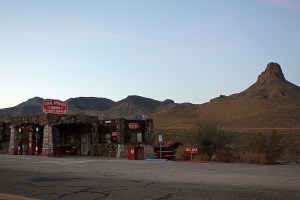
When we reached Cool Springs, the place was not open and we were pretty much by ourselves. We stopped there to admire the scenery and took some photos of the old rest stop, the restored gas pump, and some architectural details on the facility that showed the quality of the restoration that was done at the place. There was also an old Ford pick up truck parked outside the building, adding an authentic feel to the scenery. Unfortunately we didn’t get to meet some of the folks that made this happen, but it was a cool stop nevertheless.

The photo below was taken from across the street of the building. You could see the picturesque mountains behind the building.
Cool Springs

Burros at the Old West Town

Oatman is a small town in the Black Mountains in northwestern Arizona. It is located in a remote area, but the town has quite an illustrious history.

It started as a tent camp soon after two prospectors found $10 million worth of gold in nearby area in 1915. The town was named after Olive Oatman, an Illinois-native woman who was abducted by an Indian tribe, kept as a slave, traded to another Indian tribe, and later released near the site of the town of Oatman.

Later on, the Oatman Hotel in town became famous as the place where famous Holywood actors Clark Gable and Carole Lombard spent their honeymoon after getting married in nearby Kingman, AZ. Supposedly Clark Gable enjoyed spending time playing poker with the miners in the town.

During the heyday of Route 66, the town became a tourist attraction because of its colorful history and its location that is right on the old Route 66. After the Interstate 40 was opened and it bypassed the Route 66 segment in Black Mountains area, it almost became a ghost town. Today it regained its popularity as a tourist attraction as there is more interests on the Historic Route 66. There is also a nearby gambling town in Nevada that runs tourist groups to visit Oatman on regular basis.

After following the road markers on a seemingly dead end road, we started a gradual climb in the Black Mountains area. And around a bend suddenly we saw a sign to welcome us to Oatman. As we reached the main street of the town, we noticed some interesting sights. Here was an old town that looked like what you see in old wild west movie settings — except this is a real deal. That we expected already from reading about Oatman before the trip. We also saw a couple of big coach buses with tourists. I was expecting to see tourists, but not in big coach buses like that. It was quite a contrast comparing the old town with its off the beaten path road and two modern coach buses there.

The most unexpected sight was seeing several burros (wild donkeys) roaming around the town. Apparently these burros were descendants of the burros used by gold prospectors back almost a century ago. They had been released and lived in the wild, and are actually protected by law. In Oatman, they were freely roaming the main street, and apparently they knew to look for tourists with food who were willing to feed them. The local gift shop sold a bag of carrots for $1 that you could buy and feed the burros with.

My brother and I stopped and walked around the area for a little bit before continuing our journey. On some days, there were reenactment of wild west gun fight on the main street, but there was nothing going on when we were there.

The photo below was taken outside a curio shop off the main street of Oatman. You can see a couple of local shopkeepers with the burros in front of their shop.

Shopkeepers and the burros

Off the Beaten Path

After a few hours traveling on the Interstate highway from Los Angeles, we reached Needles, CA, the last exit on I-40 east bound before entering Arizona. Most people would pass this exit unless they need to stop for fuel at the gas station nearby. We exited the Interstate highway here because we wanted to take an alternate, ‘scenic route,’ the old Route 66 between Needles and Kingman, AZ.

We decided to explore this segment of Route 66 because it’s among the best representation of old, historic route that ended up getting bypassed and replaced by the modern Interstate Highway. The old route goes through a winding road on the Black Mountains area. It’s scenic, but not the fastest way. The Interstate highway cuts through another part of the mountainous region and provide a shorter and faster route for those who need to speed up to get through the area.

Another reason why this old route was interesting to us is because it passes two points of interests, a ghost town called Oatman, and a restored rest stop called Cool Springs. Again, more historical look at what Route 66 looked like back in its heyday.

After we passed the town of Needles and entered into the state of Arizona, we followed the road sign to Oatman. Gradually we went from driving on a busy four-lane highway to a smaller two-lane road that led towards the mountain. It felt like we’re alone in the middle of nowhere and heading to a dead end, until we saw a sign indicating we’re on the historic stretch of Route 66 and we’re only few miles away from Oatman.

The photo below was taken as we’re getting closer to Oatman. You can see that the road is not much traveled anymore, and there is the historic Route 66 marker.

Off the beaten path

Life is a Highway

We started our coast-to-coast road trip with a visit to the Santa Monica Pier to find the official west end of Route 66. We found the official plaque that marked the end of the road. The actual Route 66 itself now only exists in segments, so we used a couple of books on Route 66 that traces the route along today’s modern highway.

Before leaving LA area, we made a couple of stops, first in Beverly Hills area to attend a service at Mosaic, then on the way out of suburban LA we stopped in Monterey Park to eat lunch in the Chinatown area. After lunch, we’re off for our first day of the trip.

We had roughly five days to complete the journey from Santa Monica to New York City. So, on the first day, our target was to reach somewhere in northeastern part of Arizona. Along the way, we wanted to take a segment of the old Route 66 in Arizona that according to the books on Route 66 still provided good representation of what it was like in the heyday of the Mother Road. Since the route supposedly went through pretty steep incline/decline grade on the mountains, we thought it would be a good idea to try reaching the area before it gets dark.

The road we took that afternoon consisted several segment that were pretty much a straight shot drive. It could get boring after a while and I found myself keeping myself alert by listening to songs, observing what’s around, or thinking about something. The first part of the trip in the eastern California towards Arizona reminded me to the song Life is a Highway by Rascal Flatts. The first part of the song went like this:

Well, life’s like a road that you travel on
There’s one day here and the next day gone
Sometimes you bend, sometimes you stand
Sometimes you turn your back to the wind

I did think about the lyrics of the song above and how that might be a good metaphor of what life is like as the song suggests. I think there is some good pictures there.

When driving on a highway, at times we go through straight segment where we can go fast, and then we encounter curves where we have to slow down. Life also goes like that. At times, things go well and we can progress fast. At other times, we face obstacles or challenges and we have to slow down the progress or even take a step back.

On the highway, we might pass other automobiles with people going to different destinations and with different reasons of traveling — some for leisure, others for business, and yet others for other different reasons. Some are still in the early part of their journey, others are already close to the end of theirs. Similarly, with life we encounter different people who are in the middle of life journey to achieve certain goals (studying at school, building a career, starting a family, retiring, etc.), and they might be at different stages of getting towards their goal.

Another interesting metaphor is to think about how one goes through the journey. On the highway, you can focus on getting to the destination in the shortest amount of time, and end up seeing the journey as the necessary means to reach the end (the travel experience becomes a blur or, worse, an exhausting experience you just want to get over with). Or, you can also have a destination and a plan / route to get there, but consider the journey as part of the experience to remember and even look forward to. It may not get you to the end in the fastest way possible, but you enjoy the journey more.

That was essentially the theme of Pixar’s animated movie Cars. As I did my planning before the trip, I came to learn that the inspiration for the movie was Route 66, its history, and many people who live along the road. Behind the great animation and funny characters there was a great story and message about cherishing life’s journey and the people you share it with.

I took the photo below during the drive on one of those long, straight stretches on I-40 eastbound. You can see the straight road, and other cars around us. One car in front of us had a U-Haul trailer on the back; it’s likely someone who was in the middle of a journey to move to new place, just like my brother.

Life is a highway

A Community of Faith, Love, and Hope

One of the hardest things about moving to a new city is that you have to adjust to the new place and find things that can help making it feel like home. This is even more challenging when you don’t know anyone in the new city; relationships have to be established if you don’t want to be lonely in your new place. When my brother moved to Los Angeles area, he practically didn’t know anyone there. One thing that was helpful for him however was being plugged in to Mosaic, his church community there.

Mosaic called itself a community of faith, love, and hope. It is unique as it emphasizes outreach to the community in Los Angeles area in a relevant manner. They recognized that many people like my brother come to LA area from everywhere around US and even from other countries, looking to make a living in this sprawling city. For these newcomers, Mosaic provides a community that these newcomers can belong to where they can be respected and cared for regardless of where they came from. They also see many people coming to LA to be involved in creative fields (visual arts, performing arts, fashion, etc.), so there is also a thriving artist community within the church body that encourages people to use their art as means to worship. All of these were provided to reach out and build a community of people who share (or seek to learn about) the faith, caring and loving for others in the community, and help providing message of hope to those who might be living in what seem to be a dead-end, meaningless life.

Before my brother moved to LA, I had heard of Mosaic because of its outreach to various ethnic groups in LA. But my appreciation for its ministry increased as I experienced the community when attending their Sunday service / meeting. It really felt like a home away from home. You could tell that most of the attendees were ‘transplants,’ but for that one hour, it felt like you’re among friends and family, and you’re welcomed even if it’s your first time attending.

Before we left Los Angeles to start our coast-to-coast trip, we decided to attend the Sunday morning service at Mosaic. One last service, fitting for my brother to say goodbye to the community that was his family away from home during his couple of years living in LA. I took the photo below during that service. This was Erwin McManus, Mosaic’s leader and principal teacher, giving his message during the service.

Erwin McManus