Imitation

There is a saying that ‘imitation is the sincerest form of flattery.’ While this might be the case in the context of someone imitating the behavior of others, in the case of commercial products especially in the western world you may end up with lawsuits and complex intellectual property issues. No matter how flattering it is to have one’s design imitated by others, if this meant market share erosion or others profiting from one’s design without attribution, one would feel violated and there is law that can help enforcing the right to the intellectual property. When you go to developed countries, however, this becomes harder to enforce, and sometimes it may not be worth the effort trying to seek protection from local law.

When traveling in Southeast Asia, we saw such violation in many places, especially with brand name clothing or footwear. It ranges from something that imitates the design but has different brand (e.g., the three stripes design from Adidas that were imitated by local clothing manufacturers), some that has similar look and feel as the original and even has brand name that is similar to the original (I had seen shoes with brand ‘Rebok’ with one e), or others that looked exactly like the original, and even had the original brand’s name, but with price that is a fraction of the original merchandise.

One thought that came to my mind was how to react to this as a consumer. Should we be avoiding buying these merchandise and only purchase the original articles (that might be much more expensive), or should we take advantage of the lack of enforcement and purchase the merchandise there? For clothing or footwear, sometimes it’s more difficult decision to make when you find out that even when you purchase the merchandise at the official company store in the US, you would find that the merchandise was made in the developed country anyway.

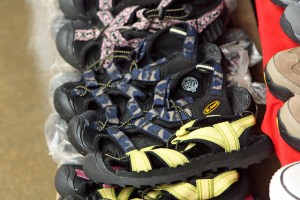
The photo below was taken at a store in Sapa, Vietnam, where Kristi and I stopped by to look for souvenirs. They had these sandals on display. They looked very much like the unique Keen sandals design (with the toe protector and all), but if you pay a close attention, you see that the brand was actualy 5-ten (but from far away, it looked very much like Keen logo). Would I buy these? Probably not, as I purchased my original Keen sandals not because I care for its looks, but more for the reliability of the original product (so getting something that looked the same at cheaper price but wouldn’t last long was not really an option I considered).
Keen knockoffs

Toddlers

At home in the United States, I help out with the Childrens Ministry at my church on Sundays. The age group that I work with is the preschool age (ages 3 and 4 years old). While I don’t have a child of my own, I get to observe these kids every week when they’re learning, playing, and interacting with others in class. I also get to see them interacting with their parents when they were dropped off or picked up before and after the class; some were more attached to the parents than the other, and some parents were more protective of their children than the other. It’s interesting to compare this to what I saw in other countries / cultures, especially those that may not have as much resources as the United States.

When I was traveling in Southeast Asia, especially as we went to villages in Cambodia and Vietnam, we encountered local children there. Some were a bit older (around 10 years old), but we also encountered kids that were in toddler age (5 years old and younger). I thought what’s interesting was to see these kids running around freely without much supervision from their parents. I suppose from one perspective, when you live in small village, you know everyone who lives there, so it’s probably okay for the kids to go around on their own. However, there are places around the village where it seemed to be dangerous for these kids to go (mountain cliffs, streams, even rice fields). I know if I had my own child with me I would be very careful and don’t want them to go to these places lest they hurt themselves. However, it seemed that the kids were going around fine and no one was worried they would get hurt. Compare this to the United States, where I saw many parents were very protective and for legal reasons we even have to have a strict policy for checking in and checking out kids (even simply to go to rest room, a volunteer cannot take a kid alone due to the worry of child abuse or potential issue around that).

Another aspect that was interesting to note was to see how everything in the United States seemed to be clean and sterilized. Children from young age were taught to wash their hands, use hand sanitizer, etc. All good behaviors to have, but sometimes I wonder if we’ve gone too far in the direction of being dependent on chemical substance that the children’s body were never trained to build their own immunity. Compared to the kids I saw in Vietnam, they pretty much run around, play in dirt, etc. I’m sure when they get home their parents tell them to clean up as well, but I doubt they have all kinds of cleaning supplies like what we have in the more developed country to clean up everything. One thing I noticed from the children in my class was that many these days also have allergies (to peanuts, lactose/milk, eggs, etc.) that even when we want to give them snacks during the class we have to be very careful and only give them a certain brand and kind of snacks that we know is safe from the allergies. This was unheard of in the developed countries — you’re very happy if you can even give kids snacks. So I wonder, is this problem existing everywhere, but only detected in ‘sophisticated’ countries like the US, or has the sterilization of everything caused the immune system of the children in the US to be worse than their counterparts in developed countries?

When Kristi and I were enjoying our little snacks at the food stand during our trek to the Cat Cat village near Sapa, Vietnam, we saw several kids (likely in toddler age) coming by. It doesn’t matter where you are or what culture you’re in, seeing young kids like that makes everyone smile. I wonder, what do these kids think of the foreigners going through their village on daily basis. One thing I learned from my preschool class was that at this early part of their lives, the kids grow and learn quite exponentially. I wonder how seeing these foreigners going through their village at such early age affect their perception of the world as they grow up.

Toddlers

Condiments

Condiments are spices, sauces, or some concoction served with dishes to enhance the flavors. They are usually served on the side, and the diner would apply as little or as much of the condiments to enhance the taste. I think what’s interesting to note when visiting places in the world is the variety of condiments used. Various cultures have diverse taste in their cuisine, but very likely each has something they use as condiments, and typically the presence of the condiments is so integral to the dining experience that the diners would always look for those condiments and you would see them everywhere you go within that culture.

The condiments used in Vietnam is very similar to those used in nearby countries like Thailand, Cambodia, and China. The ubiquotous condiments are soy sauce, nước mắm (fish sauce), hoisin sauce, and chili sauce. With nước mắm, there are different grades of quality that some very discerning people could taste and rate the quality just like a sommelier would with wine. The chili sauce is often home made, though there are some widely popular bottled brands that you would find virtually everywhere you go.

When we stopped by at a food stand during our trek to the Cat Cat village near Sapa, Vietnam, we noticed the bottled chili sauce below that was as ubiquotous as Heinz ketchup bottles in the American restaurants. The brand was called Chin-su, and we tried a little bit of it with our grilled skewered meats. It was good, nothing special to me, but I’m sure for the locals who are used to its taste, they couldn’t have a meal without it.

Chin-su

Grilled Snacks

No matter where you go, the sight and smell of food at the place where you’re sightseeing sometimes can be very attractive, even though you probably would just ignore those if you come across them on daily basis. Such was the case when we were in the middle of our trek to Cat Cat village near Sapa, Vietnam.

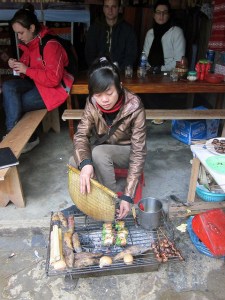
As we’re getting closer to the waterfall on the trek, we noticed the aroma of grilled meats in the air. There was a little stand with a lady sitting on a small stool grilling a variety of skewered meats on a charcoal grill, and there were a few trekkers who sat and waited patiently for her to cook the grilled meats they ordered. Normally I wouldn’t care as much for this — in Jakarta (or even in Washington, DC) you pass street-side vendors all the time, and I could refrain from snacking. But this time, we had just walked a good 1.5 miles down from Sapa, it’s around lunch time and we had not had food since the morning, and it was wet and a bit cold. Seeing several other trekkers sitting enjoying their snacks and drinks was enough to draw us to join them.

I had a little apprehension at the beginning, since we still need to walk back to Sapa, and later than day we would go on an overnight train ride back to Hanoi. The last thing I wanted to happen is to risk either Kristi or I getting stomach upset because of the food we eat. But Kristi convinced me that it should be okay if we just have a little bit to taste. So she ordered a couple kinds of skewered meats, some roasted chestnuts, and a little cup of home-brewed apple wine to share. We also got a can of Coke and a bottled water to wash the food down.

The food was pretty good. The taste of the food was not the memorable part of the experience; the setting was. And we didn’t have any indigestion problems afterwards.

The photo below was taken as we waited for the lady to cook our order. You can see the various things she had to offer, and the other trekkers sitting in the background waiting for their order as well.

Snack stand

Bamboo

After walking through the center of the Cat Cat village near Sapa, Vietnam, we continued our trek on the loop path. It was a continued descent to the lower part of the valley, and before long we walked through a bamboo forest. Going through the bamboo forest in a misty and foggy day on a mountainous region — it felt like we’re in a scene of a kung fu movie…

Bamboos are plants that are perhaps identified with the Asian culture, even though they are grown in more regions of the world. This is because in many parts of Asia bamboos are widely used for various purposes due to its versality. You can find bamboos as food (bamboo shoots are used in many Chinese dishes), cooking instrument (there are dishes in Asian culture that are cooked inside the bamboo), construction material (in some places like Hong Kong you could even see bamboos used as scaffolding in the construction of tall buildings), weapon (one famous weapon used by the Indonesian freedom fighters during the war with the Dutch colonialists was the ‘bambu runcing’ — sharpened bamboo made into a spear), and even musical instrument (a national musical instrument in Indonesia is angklung, which is also made with bamboo tubes as material). Some of the reasons why bamboos are so widely used are because it’s among the fastest growing plants in the world (it can grow 100 cm / 36 inches in 24 hours) so it’s easy to cultivate, and it’s strong but also somewhat flexible property that makes it suitable as raw materials for many products.

As we walked through the villages near Sapa during our visit, we did see patches of bamboo forests in many places, and we could tell that it’s an important part of the local daily life just like what you hear or might expect from an Asian cultures.

The photo below was taken as we walked down through the last descent of the trek through the bamboo forest. I had to stop walking to take this photo as the steps down were getting quite steep and I was afraid of falling down due to a misstep. These were a couple of other tourists who were walking slightly in front of us. You can see the bamboo forest around and the foggy atmosphere that gives this photo its sense of place.

Walking through a bamboo forest