Rest Stop in the Desert

When you’re driving from the east on the Arizona segment of Route 66 between Kingman and Oatman, the highway transitioned from a drive on a flat plains of the Sacramanto Valley from Kingman to a treacherous climb up through the Black Mountains near Oatman. In the old days, this was quite intimidating for the travelers as they would have to go through a narrow road with steep grades and hairpin turns. Some people even hired locals to drive their cars through these area or even tow their cars to the summit.

Just before you start the climb, there was rest stop called Cool Springs that was was opened up as a place for the travelers to check their cars or fueled up before they tackle the challenging terrain, or for those who traveled from the west, a stop to rest after going through mountainous road. A family from Indiana opened and ran the litte shop since the 1930s and handed the property over through a couple generations through the heyday of Route 66 in the 1950s. By early 1960s, however, the new alignment of Route 66 that bypassed the segment through the Black Mountains, and then later the development of the Interstate highway ended up killing the traffic through this road. And finally in the mid 1960s, a fire burned down the rest stop building reducing it to ruins.

In 1997, an Illinois man named Ned Leuchtner passed the area and was very impressed with the landscape around it. He wondered what ever happened to the place when he saw the ruins of Cool Springs, and through the help of a local real estate broker, he was able to find the owner of the property and learned the story about the place. After three years persuading the old owner to sell the property to him, he finally was able to get the property with his promise to rebuild the place. From 2001 to 2004, Ned worked to restore Cool Springs to what it was like back in its heyday, and in 2005, the restoration was complete and the place was reopened as a museum. Now travelers can see what the place looked like decades ago when this was an important stop on the old route to the West.

From Oatman, we traveled east through the Black Mountain towards Cool Springs. So in our case, we went through the Black Mountains route in reverse and it was mostly negotiating steep downhill drive through narrow roads with hairpin turns that definitely lived up to the description we read in guidebooks. Fortunately we managed to go through this segment when it’s still light outside. It was quite beautiful as well to see the sun setting in the distance as we drove through the mountainous region.

When we reached Cool Springs, the place was not open and we were pretty much by ourselves. We stopped there to admire the scenery and took some photos of the old rest stop, the restored gas pump, and some architectural details on the facility that showed the quality of the restoration that was done at the place. There was also an old Ford pick up truck parked outside the building, adding an authentic feel to the scenery. Unfortunately we didn’t get to meet some of the folks that made this happen, but it was a cool stop nevertheless.

The photo below was taken from across the street of the building. You could see the picturesque mountains behind the building.
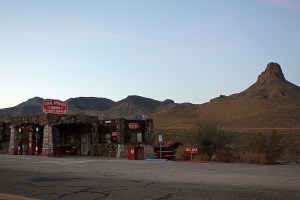
Cool Springs

Burros at the Old West Town

Oatman is a small town in the Black Mountains in northwestern Arizona. It is located in a remote area, but the town has quite an illustrious history.

It started as a tent camp soon after two prospectors found $10 million worth of gold in nearby area in 1915. The town was named after Olive Oatman, an Illinois-native woman who was abducted by an Indian tribe, kept as a slave, traded to another Indian tribe, and later released near the site of the town of Oatman.

Later on, the Oatman Hotel in town became famous as the place where famous Holywood actors Clark Gable and Carole Lombard spent their honeymoon after getting married in nearby Kingman, AZ. Supposedly Clark Gable enjoyed spending time playing poker with the miners in the town.

During the heyday of Route 66, the town became a tourist attraction because of its colorful history and its location that is right on the old Route 66. After the Interstate 40 was opened and it bypassed the Route 66 segment in Black Mountains area, it almost became a ghost town. Today it regained its popularity as a tourist attraction as there is more interests on the Historic Route 66. There is also a nearby gambling town in Nevada that runs tourist groups to visit Oatman on regular basis.

After following the road markers on a seemingly dead end road, we started a gradual climb in the Black Mountains area. And around a bend suddenly we saw a sign to welcome us to Oatman. As we reached the main street of the town, we noticed some interesting sights. Here was an old town that looked like what you see in old wild west movie settings — except this is a real deal. That we expected already from reading about Oatman before the trip. We also saw a couple of big coach buses with tourists. I was expecting to see tourists, but not in big coach buses like that. It was quite a contrast comparing the old town with its off the beaten path road and two modern coach buses there.

The most unexpected sight was seeing several burros (wild donkeys) roaming around the town. Apparently these burros were descendants of the burros used by gold prospectors back almost a century ago. They had been released and lived in the wild, and are actually protected by law. In Oatman, they were freely roaming the main street, and apparently they knew to look for tourists with food who were willing to feed them. The local gift shop sold a bag of carrots for $1 that you could buy and feed the burros with.

My brother and I stopped and walked around the area for a little bit before continuing our journey. On some days, there were reenactment of wild west gun fight on the main street, but there was nothing going on when we were there.

The photo below was taken outside a curio shop off the main street of Oatman. You can see a couple of local shopkeepers with the burros in front of their shop.

Shopkeepers and the burros

Off the Beaten Path

After a few hours traveling on the Interstate highway from Los Angeles, we reached Needles, CA, the last exit on I-40 east bound before entering Arizona. Most people would pass this exit unless they need to stop for fuel at the gas station nearby. We exited the Interstate highway here because we wanted to take an alternate, ‘scenic route,’ the old Route 66 between Needles and Kingman, AZ.

We decided to explore this segment of Route 66 because it’s among the best representation of old, historic route that ended up getting bypassed and replaced by the modern Interstate Highway. The old route goes through a winding road on the Black Mountains area. It’s scenic, but not the fastest way. The Interstate highway cuts through another part of the mountainous region and provide a shorter and faster route for those who need to speed up to get through the area.

Another reason why this old route was interesting to us is because it passes two points of interests, a ghost town called Oatman, and a restored rest stop called Cool Springs. Again, more historical look at what Route 66 looked like back in its heyday.

After we passed the town of Needles and entered into the state of Arizona, we followed the road sign to Oatman. Gradually we went from driving on a busy four-lane highway to a smaller two-lane road that led towards the mountain. It felt like we’re alone in the middle of nowhere and heading to a dead end, until we saw a sign indicating we’re on the historic stretch of Route 66 and we’re only few miles away from Oatman.

The photo below was taken as we’re getting closer to Oatman. You can see that the road is not much traveled anymore, and there is the historic Route 66 marker.

Off the beaten path

May

As we continued our trek to the villages in the valley near Sapa, Vietnam, we walked through a portion of the trek that looked like a dirt road that was in the middle of construction. Our tour guide May said that this was the new route to the village that the Vietnamese government is building, hopefully providing easier access to the remote mountainous villages.

As we walked there, a man on a motorbike came from behind, and when May saw him coming, she smiled and starting chatting a little bit with the bike rider before he continued on his ride and left us. Then May told us that the bike rider was her husband — he works as a motorcycle driver who shuttles people between the town of Sapa and the surrounding villages.

During our trek, May told us about the culture within the minority groups in Sapa, including her own tribe, the H’mong. She told us the story of her own life experience as a H’mong girl who ended up marrying a Vietnamese man and now working as a tour guide. She said the culture was still quite strong within the community.

She was then 23 years old, but she had quite a life story already. When she was 18, a young man in her village wanted to ask her hand in marriage, and since he came from wealthier family than hers, her parents wouldn’t object to that request. In the H’mong culture, in fact typically marriages were traditionally arranged by the parents, and the girls didn’t have much say in the matter. In May’s case, however, it was different. She didn’t want to be married to this young man, so she decided to run away and leave her family and village. Somehow she figured out a way to make a living, met her husband, got married, and then returned back to Sapa area. She faced several oppositions as she came back. The local girls whom she knew when she was young didn’t want to associate with her anymore because of what she did (running away from the village) and because she’s working as a tour guide, which meant she’s making more money than her peers. Her own family was slowly warming up to accept her back, though it was still difficult situation due to the hurt feelings. Since she married a Vietnamese, her husband’s family also at times looked down on her given that she’s from a minority tribe. Then she had a young baby girl, two years of age, who during the week stayed with her in-laws in Lao Cai. She and her husband got to see their daughter during the weekend.

Despite of all of those hardships, it was pretty neat to hear her talking about her life experience without any regrets or any ill feelings towards others. And she sounded very optimistic, and still looked forward towards the future with some potential side business ideas that she wants to pursue. It was quite impressive to hear her story, and I think it provided us with a good perspective of what it’s like to live within a minority group in the increasingly diverse world that is looking for more cultural integration.

I took the portrait photo of May below as we walked through our trek. I think this was a good snapshot that summarized her attitude, always optimistic, and full of smile.

May

Sapa

Sapa is a town in the northwest region of Vietnam, close to the border of China. It’s about 350 km northwest from Hanoi. It’s up in the mountainous region in the Lao Cai province, so to get there from Hanoi typically travelers would take a train ride from Hanoi to the city of Lao Cai, then continue on with a drive to Sapa. The area became popular as a resort town for the French colonist given it’s cooler climate. Today it is becoming a popular tourist destination in Northern Vietnam since it is one place that you can see encounter several indigenous tribes in Vietnam (the Hmong, Dzao, Tai, and Giay) and also see the village life and the terraced rice fields. Mount Fansipan, the highest mountain peak in Indochina at more than 10,000 ft high, is also nearby, so it’s also a good place to go for hikers.

When we’re planning for the trip to Northern Vietnam, the idea to visit Sapa as part of the iterary came after talking with some friends who had been in the area and also watching Travel Channel program about Vietnam. I have a couple of friends who used to live in China, and one time they took the land route through Vietnam on the way to a conference in Thailand. During that trip, they went through Sapa, and they absolutely loved the place because it offered two things they loved, hiking the mountains and immersing themselves in indigenous cultures. Then as I looked for more information to learn about Vietnam, there was a featured program on the Travel Channel where one of its hosts, Samantha Brown, visited Vietnam. One of the experiences she had, visiting Sapa and staying with a local family. Kristi and I were both sold after that, as this would be a little ‘off the beaten path’ experience and it’s definitely unique during our Southeast Asia trip.

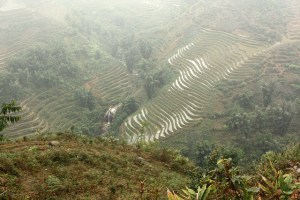
The photo below was taken during our hike. You can see the terraced rice fields down in the valley, seen from the mountain-side path we passed during our hike.

Terraced rice fields