Battle Planning

My visit to Colonial Williamsburg started with an orientation by a staff dressed in the era’s costume, providing the lay of the land of the area and giving us pointers to interesting things to see and programs to attend during the day. After the orientation, I continued with attending the first program of the day, a retelling of the history by a resident historian.

I was not expecting to attend a lecture, but listening to the historian providing the background about the events that led to the particular event we were commemorating (the battle of Yorktown) provided an excellent context to understand the historical event reenactments throughout the day.

One of the unique things you can do at Colonial Williamsburg is to locate an actor playing a historical character and interacting with him/her as if you were talking to the real character during the Colonial period. The actors not only dress up in periodic costume, but also talk like those from that era. They are also very knowledgeable about the historic character they represent, and can answer questions about the character that may not even be directly related to their relation to Williamsburg.

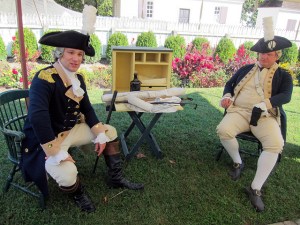
After the lecture, I went to one of the houses in the middle of the old town where the Continental generals spent time planning before their march to Yorktown. It was pretty neat to listen to a couple of actors who played the role of two prominent generals during the war, General Anthony Wayne and General Henry Knox, talking with each other and also interacting with a couple of visitors who seemed to know a lot about the history behind these two characters. They asked them some trivia questions about these characters’ personal lives, and the actors answered the questions with ease that you could have thought for a moment you were transported back in the history and listened to the real characters talking about themselves.

Here were the two generals sitting near a make shift discussion table and talking with audience about their plans to attack the British in Yorktown.
Battle Planning

History Triangle

The area around Williamsburg is also known as the History Triangle as there are three places where important events in the American history happened. Jamestown is the site of the first British settlement in the new world. It was the first capital of the colony of Virginia until it was moved to Williamsburg. Williamsburg then served as the capital of the colony for several years. Yorktown entered the history due it’s strategic location from maritime perspective, and it was the place where the British troops surrendered that led to the end of the American Revolutionary War and the United Stated became gaining recognition as an independent nation.

Today history buffs can come to the area and spend some time to learn and relive history by visiting these three places. They are connected through a route called the Colonial Parkway, so you can easily drive between the places. Alternatively, you can also park your car at the Colonial Williamsburg Visitor Center, and take shuttle bus to visit the three places.

During my day trip to the area, I arrived at the Colonial Williamsburg Visitor Center right before it opened around 9 am in the morning. I considered trying to visit the other sites on the same day, but later I decided to just spend the day in Williamsburg and attend the special events that went on throughout the day as part of commemorating the siege of Yorktown.

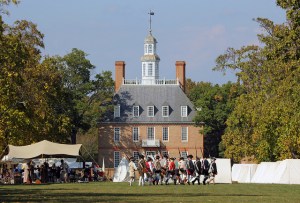
The photo below was taken right at the heart of Colonial Williamsburg. You can see the governor’s palace at the end of the grassy area, and a reenacted encampment of the Continental Army to commemorate their stay in Williamsburg prior to going to Yorktown.

Governor's Palace

Day Trip to Colonial Williamsburg

Williamsburg, Virginia, is a city located about 3.5 hour-drive away from Washington, DC. The city was the capital of the Colony of Virginia before it was moved to Richmond. It is the home of the second oldest college in the United States, the College of William and Mary. Part of the city is known as Colonial Williamsburg, where an area consisting around 50 buildings has been preserved from the Colonial era. It serves as a living interactive museum as life from that era is reenacted by actors daily.

I had heard of the Colonial Williamsburg since a long time ago, having lived in Virginia for several years. However, I had never visited the place until earlier this fall when I made a last minute trip on Saturday. I found out that during that particular weekend, they were going to commemorate the preparation before the American troops went on to nearby Yorktown to attack the British under General Cornwallis. The siege that happened in Yorktown was an important event during the American’s fight for its independence as it marked the surrender of the British troops during that war.

I did not grow up and go to primary or secondary school in the US, so I never really learned about the US history. During this visit to Colonial Williamsburg, I learned some interesting historical facts and about some important figures from that era. So in the next few posts I will write about that day trip to Williamsburg.

The photo below was taken in the Colonial Williamsburg area. You can see here the actors and volunteers reenacted the American troops marching into Williamsburg following General George Washington, on their way to Yorktown. For a moment, you can be transported to that era and feel that you are reliving the history.

Colonial Williamsburg

New York State of Mind

After a lunch stop near Toledo, Ohio, we continued on our coast-to-coast road trip east bound. We considered driving straight through to New York City, but it would’ve been quite exhausting and logistically then I would have to figure out a way to get back home to Washington, DC. So we decided to take a little detour and end our fourth traveling day in the suburb of Washington, DC, where I live, and to continue on the next day with the last leg of our trip. From home, I would drive my own car separately from my brother and then I would continue on with a couple more days of road trip to New England on my own.

So on the last day of the trip, we got up early again to start driving on the last leg of our coast-to-coast road trip. Each of us drove a car and we tried to keep close to each other since I had GPS and traffic notification in my car. We used the Motorola Talkabout two-way radios to communicate between the two cars.

The drive from DC to New York was not that memorable, partly because we were driving with only few hours of sleep the night before, and because we were focused on getting back to New York as soon as possible. We had to return the car that day, and before that, we would have to unload my brother’s belongings first, so we thought we didn’t have much time to spare.

We finally reached New York City, and after unloading my brother’s belongings in his apartment in Brooklyn, we went to Midtown Manhattan to return the rental car that had served us well during the coast-to-coast road trip.

After returning the car, we went for a late lunch in Chinatown at a restaurant that had become one of my brother’s favorite restaurants in New York City. Then we went to the South Street Seaport area to find a place where I could take another photo to bookend our trip. We started with at the Santa Monica Pier on the West Coast, so I thought it would be appropriate to finish at the Pier 17 near the South Street Seaport with the iconic Brooklyn Bridge and the Brooklyn area, my brother’s new home, to finish the trip.

While writing about this last part of the trip, I couldn’t help to remember how much our view of New York City had changed over the years. I remembered when I visited New York City with my brother for the first time how after half day of sightseeing on the Grayline double-decker bus, my brother commented that he didn’t like New York and wouldn’t want to live there. Not long after, I also spent a couple of months working on a work project at my company’s New York office. I enjoyed visiting the city, particularly going to the Broadway shows, but I didn’t really think it’s a place I would like to live in.

Several years later, my brother was ‘forced’ to move to New York City to pursue his graduate degree. Then he got a job that allowed him to stay in the area, and along the way, he came to love the city and its unique lifestyle. After I moved to Washington, DC, I could visit my brother more frequently, and during those visits, I came to see and appreciate what it was like to see and experience New York City from the perspective of its resident. Now my brother lives with his family in Brooklyn, very much a New Yorker. I still don’t think I could live there (for the same reason I wouldn’t like to live in downtown DC either — I rather live in a suburb with easy access to the city than live in the heart of the city itself), but it’s becoming a place that I do like to visit.

Brooklyn Bridge

The End (or the Start) of the Route

After three long days of driving, we finally reached Chicago. We had a great time catching up with my brother’s old college friend, but we were quickly reminded to get at least a few hours of sleep before we had to leave again in the morning to continue our journey.

We left quite early in the morning as we’re planning on meeting up with some more friends in the suburb of Toledo for lunch. I wanted to make sure we could get out of Chicago without getting caught in morning commute, and we also wanted to make one more stop to complete our Route 66 journey. We started the journey three days before at the plaque near the beach of Santa Monica, CA, that marked the west end of Route 66. We thought it would be appropriate to also stop at the east end of Route 66 in Chicago.

Both my brother and I had been to Chicago many times, and we were somewhat familiar with the downtown Chicago area. But neither of us ever noticed seeing any sign there that marked the east end of Route 66. I looked through guidebooks about Route 66, and I found information about either it’s located at the intersection of Michigan Avenue and Jackson Street, or it’s somewhere near the nearby Grant Park. So we decided to just drive to that area, park our car, and perhaps walk around a little bit to find the marker.

We parked at the underground parking on Michigan Avenue nearby our destination, and we were greeted by something unexpected that we should’ve known and anticipated better. When we got out of the elevator from the parking garage, we were greeted by a cold and windy Chicago autumn weather. Here we were, wearing light jacket and sweat and sandals. That was fine when we were traveling in California and the Southwest, but not in Chicago. So my brother’s comment was about finding this Route 66 marker quickly and then perhaps get hot coffee and leave.

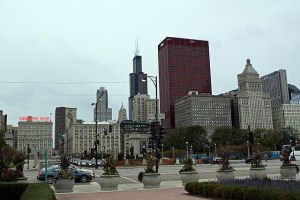
We reached the intersection of Michigan Avenue and Jackson Street, and we couldn’t find that end of Route 66 sign. The only other info I had said the official east terminus of Route 66 was the Grant Park. Well, that’s not really helpful as Grant Park was quite a large park. I told my brother, ‘how about walking around the park a little bit to look for the Route 66 sign’. My brother said, ‘why don’t you go ahead and do so; I’ll just wait at the coffee shop around the corner because it’s way too cold to walk around outside.’ So I did go to Grant Park and walked around looking for the Route 66 sign, but couldn’t really find it. Finally I ran out of time (and it was getting too cold out there), so I decided to just cut my losses and took the photo of the Chicago skyline to show that we did reach the east end of Route 66. It would’ve been nicer to bookend the trip with another photo of a Route 66 plaque, but unfortunately this one would have to do.

Grant Park