Van Ride to Siem Reap

The van ride we decided to take from Phnom Penh to Siem Reap turned out to be an interesting experience. We wanted to see the Cambodian countryside and experience travel like the locals, and the trip didn’t disappoint. It took about five hours to get from Phnom Penh to Siem Reap, including a fifteen-minute break in the middle in a town called Kampong Thom. The tour company that arranged our trip was right; taking the passenger van, though it’s about the same price as taking the bus, was actually faster because the passenger van is smaller and can move faster and navigate around slower traffic better than the bus.

During the ride, it was interesting to observe the passengers inside the van. On the front row, next to the driver was a British older gentleman who was traveling alone. Next to him was a Cambodian man who seemed to know the driver as they had talked with each other like friends during the trip. I sat in the middle of the second row. On my left was a Japanese gentleman who carried his Canon DSLR with him. We picked him up at a hotel just after the van picked us up at our hotel. Before he left, we saw him giving a local person a hug — seemed to be someone who had helped him during his travels so far. During our trip, I saw him uploading the photos from his camera to his laptop, then he spent some time reviewing the photos. He had many portraits of local Cambodian in rural areas; beautifully taken and seemed to have one theme: showcasing the people of Cambodia (many if not most were smiling — wonderful to see in a country that many considered as among the poorest in the world). On my right was my cousin Kristi, who spent most of the time during the trip taking a nap.

Behind our row there were two more rows of passengers (5 more people). One of the passengers was the American girl who was a teacher in Phnom Penh (as I gathered from listening to her talking to a couple of other foreigners right after our pick up from the hotel). The rest of the passengers were local Cambodians. The American girl also spent most of the trip taking a nap. One Cambodian gentleman who sat in the back row provided an interesting ‘entertainment’ during our ride. Apparently he was conducting business during the ride. His mobile phone must’ve received calls every 5-10 minutes, and he talked to his colleague over the phone. Some calls were in Khmer, some were in English. Quite interesting to observe…

The scenery varied as we passed towns and rice fields. Once in a while I noticed roadside stands with people selling what looked like glass bottles of drink (brownish in color, looked like alcoholic drink). I wasn’t really sure what that was — later on I found out that it was people selling gasoline for motorcycles (unless you’re in big city like Phnom Penh and Siem Reap, you rarely see gas station). As I mentioned in my post about National Highway 6, we passed people with various modes of transportation that are slower (oxcart, bicycle, etc.). Our driver didn’t slow down much, driving between 60-100 kmh and honking his horn to get people to notice that we’re about to pass them.

The photo below was taken when we stopped in Kampong Thom for a break in the middle. Here you can see our passenger van getting refreshed during the trip. It was quite a new Ford Transit, which we saw quite a bit in the Southeast Asian countries we visited (Thailand, Cambodia, Vietnam). Ford seemed to do quite a good business in the region to supply the vans for intercity travels.

Passenger van

National Highway 6

The National Highway 6 is one of the main highways in Cambodia that connect major locations in the country. Many of the highways connect the capital city of Phnom Penh either with major cities/towns in the country (e.g., Siem Reap, Sihanoukville, Battambang), or with the borders to the neighboring countries (Thailand, Laos, Vietnam). National Highway 6 specifically is one of the busiest highways as it connects two of the largest cities in Cambodia, Phnom Penh and Siem Reap.

Since we decided to travel overland from Phnom Penh to Cambodia, this was the route that we took. Driving through this highway reminded me of driving through the intercity highways in some regions in Indonesia. The highway is not a divided, high-speed highway like what you find in many countries. It was more a regional, undivided highway that passes through towns and villages, and though it’s paved all the way, there were areas where the road condition was not as good and our passenger van would have to navigate around that. We also shared the road with people using other means of transportation (motorcycle, bicycle, ox cart, pedestrian on foot), so the horn was an important equipment on the passenger van as our driver would simply honk the horn to warn others on the road that we’re about to pass them, and we wouldn’t slow down much. It made the trip somewhat interesting to observe what’s in front of us.

The photo below was taken from my passenger seat just behind the driver. You can see we’re about to pass a bicycle, there is an incoming vehicle coming on the other side of the road, and a little bit in front of us there is an ox cart, pedestrian, and motorcycle.

National Highway 6

Leaving Phnom Penh

After a good night rest following an emotionally exhausting day in Phnom Penh, we got up early to pack up and get ready for our trip from Phnom Penh to Siem Reap. This part of the trip was one that I was a bit worried about. According to the tour company that arranged our trip, we were supposed to be picked up by a tuk-tuk that will take us to the van terminal, where we would switch to the van that would take us to Siem Reap. After the false start that happened the day before, I was even more worried that if there is any miscommunication in terms of the pick-up, we might miss our scheduled van and end up having to wait for the next available departure to Siem Reap.

Our passenger van was scheduled to leave its terminal in Phnom Penh at 7:30 am, so our tour company scheduled to have someone picking us up at our hotel at 7 am. We were ready to go few minutes before that. The night before, I had already taken care of the checkout so all we had to do was to leave our room key at the front desk before we left. We also asked for take-out breakfast so we had something to eat in the morning even before the hotel restaurant opened.

Unlike the day before, to my relief this morning everything seemed to work like clockwork. We had our breakfast take out boxes ready to pick up at the hotel restaurant, and before we even finished eating our breakfast, a passenger van showed up and a gentleman asked if we were waiting to go to Siem Reap. I confirmed the name of the van operator, and off we went.

There were already three other passengers on the van when we were picked up. It looked like they went around to various hotels or guest houses to pick up some passengers before we depart for Siem Reap. I overheard the conversation among the passengers on the van. They all spoke English; from the accents I could tell that one person was American, one person was Australian, and the other person was European (not sure what country). This was the first trip to Siem Reap for all of them, and they were all quite excited to go (so did we) given that it’s close to New Year’s Eve. As I listened to their conversation, I figured out that the American girl was teaching English at a school in Phnom Penh. The other two passengers were backpackers. We stopped at another hotel not far from ours to pick up another passenger, a Japanese man who traveled alone. He had his backpack and a camera bag with him — looked like a serious photographer.

We stopped at the van company’s office near Psar Kandal. We got out of the van briefly to sort out which van each passenger would go into; there were apparently two vans that would be going to Siem Reap approximately at the same time. Kristi and I went into one van with the American girl and the Japanese man; the other two passengers went to a separate van. The passenger van had four rows of seats, and ours was almost full to the capacity with eleven people including the driver. Kristi and I sat on the second row with the Japanese man. Once we were seated, a lady came out from the van operator’s office with plastic bags full of snack boxes and bottled water. Each of us got one – that was our ‘in-flight snacks’ for the trip. Nothing fancy, but it’s actually better than what you get in American domestic flights these days.

We left pretty much on time. On the way out of Phnom Penh, we made one more stop at a guest house to pick up the last passenger, a British man, who took the last seat available on the front row next to the driver. After that, off we went on our trip to Siem Reap. So long Phnom Penh…

The photo below was taken from my seat on the second row, as our van was slowly navigating its way through downtown Phnom Penh on the way northeast towards Siem Reap.

Leaving Phnom Penh

Transportation to Siem Reap

After visiting Phnom Penh, the next destination in our Southeast Asia trip was Siem Reap, another area in Cambodia where Angkor Wat and other temples are located. To travel from Phnom Penh to Siem Reap, we considered several transportation options. The first option was to fly. This would be the fastest way to get there, but it’s also the most expensive, and there wasn’t much to experience on the way there. The second option was to take a boat. This was an intriguing option to consider, as it would definitely be a new experience for us. You could also see some village life on the river banks along the way. The cost was much cheaper than the airfare. However, some people who had traveled this route said being on the boat for four hours could get boring after a while, and the boats were not necessarily the most comfortable environment to be for that long of period. That brought us to consider the third option, traveling by land. This was the typical option taken by locals as it’s the cheapest and there were many options of operators to consider. Some travelers recommended this option because it also allows the travelers to mingle with locals, and you get to see countryside scenery along the way. There was also a stop in the middle so you could stretch and rest for a little bit before continuing the journey. It took around four hours to drive to Siem Reap, so time-wise it’s roughly the same as taking a boat.

Once we decided to travel overland to Siem Reap, then we had to decide which travel operator to use. We could either hire a private car, ride a passenger van, or ride a bus. The private car option was obviously the most expensive, and you get the whole car for yourself. It’s nice, but we wouldn’t get to mingle with locals as much. So we initially thought we would go by bus, as some of them had pretty extensive schedule, and supposedly they had restrooms on board, and even attendants. In the end, we ended up going with a passenger van as recommended by our tour company. They said the cost of going by bus was roughly the same as going by passenger van. The difference was that passenger vans typically end up traveling faster because they are smaller and nimbler than the buses.

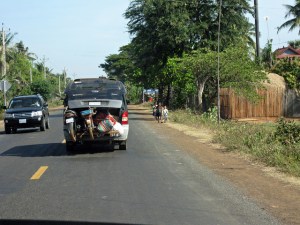
The photo below was taken during our van ride to Siem Reap. You can see in front of us another van / minibus going the same direction — that particular one had full cargo that included two motorbikes.

Travel to Siem Reap

Hope for Cambodia

As I mentioned in my post yesterday on Writing About Phnom Penh, it was quite challenging to write about my experience and thoughts after visiting the sites in Phnom Penh. It’s very easy to end the story at the negative side. However, during the process of learning more about what the Cambodians had gone through, I also found out about some Cambodians whose life stories provide inspiration and hope in creating a better future for Cambodia. I thought it would be good to finish the series of posts on Phnom Penh on a high note by providing pointers to their stories. Check them out; I think you would be inspired by them.

Sophal Ear
Sophal Ear is a professor at the US Naval Postgraduate School who works on economic development in post-war countries like Cambodia. He was born in Cambodia, and when he was young, his mother took him and his siblings out of Cambodia to escape the Khmer Rouge. I found out about him and his story when I was looking to learn about how the genocide victims deal with the topic of justice and forgiveness.

Check out his TED 2009 presentation about his family’s escape from the Khmer Rouge, his Oslo Freedom Forum 2010 presentation about the genocide in Cambodia, and his New York Times Opinion article about the Khmer Rouge Tribunal.

Kounila Keo
Kounila Keo is a young Phnom Penh-based journalist who uses her blog (the blue lady blog) as a means to speak up her mind about some contemporary topics in Cambodia. I came across her blog as I was reading articles about Sophal Ear. I think she has some interesting postings in her blog that gives us a look at Cambodia from the perspective of one of its young, educated people.

Check out her blog postings with her thoughts about what young Cambodians can do for their country, her thoughts after visiting Germany about what the Cambodians can learn from the Germans about reconciliation after genocide, and her impressions after her first visit to the United States.

Ponheary Ly
Ponheary Ly is a teacher and tour guide in Cambodia who used her earnings to educate poor children in the rural area. I first learned about her and her work when reading a travel blog of an American lady who met Ponheary during her first visit to Cambodia and had come back a couple of times to volunteer.

Check out a CNN Hero of the Week profile honoring her work on improving the welfare in Cambodia through education.

The photo below was taken at Choeung Ek as I rested after an emotionally exhausting visit. We were sitting under the shade of a couple of trees, with nice breeze gently blowing. In front of us we saw the memorial stupa in the background, and a Cambodia flag flying in front. I thought that was a wonderful symbolism of the hope for a peaceful future for the people of Cambodia.

Hope for a peaceful future