Faces of Tuol Sleng

Building B of the Tuol Sleng Genocide Museum in Phnom Penh, Cambodia, contained photo displays, most were from the documentation archive that the Khmer Rouge meticulously kept during their reign. The first part of the photo displays showed photos from around the time the Khmer Rouge took over Cambodia. The Khmer Rouge regime had the goal of converting Cambodia into an agrarian Marxist country. To do so, right after they gained power in Cambodia, they essentially ‘hit the reset button’ on the life in Cambodia to start a new one. The start of the Khmer Rouge regime was called ‘Year Zero’; all culture and traditions in Cambodia as they knew it were destroyed or discarded, so a new one could be started. Monetary system was abolished. Most Cambodians were forced to relocate to the rural areas to work in the rice fields that were to become the base of the new Cambodian culture.

The Khmer Rouge regime recruited young Cambodians, mostly uneducated, to be part of their army to enforce their ideology. These recruits were essentially brainwashed and they became the feared army and prison guards in places like Tuol Sleng. The photo display included rows of mug shots of these Khmer Rouge cadres. From looking at the photos, you could tell that they were all very young, and given that they were mostly uneducated, they were possibly easy to influence.

To avoid any opposition, the Khmer Rouge regime arrested and executed those who they viewed as potentially dangerous, such as any educated people or community leaders that didn’t agree with the Khmer Rouge ideology. These were the people that were brought to prisons like Tuol Sleng (there were 196 of them all throughout Cambodia). When they arrived at the prison, they were forced to write an autobiographical account of their lives from their childhood to the time they were arrested. They were also forced to give the names of any relatives or friends, which subsequently were arrested as well.

The second part of the photo displays moved on to show the photos of the prisoners at Tuol Sleng. Each person was photographed at the time of their arrival, and each had a number pinned to their shirts. From the expressions on the faces, you could see the fear and hopeless feeling that these prisoners had.

The last part of the photo displays was very difficult to see as they showed some of the prisoners after they were being interrogated and tortured. The Khmer Rouge photo documenter took these photos as if they were used to show to their superior that they had done their job in the interrogation process. There were some photos that were so graphic that would make most visitors very disturbed leaving the place.

The photo below was one of the many Tuol Sleng prisoners that I saw lining up the walls of the Building B. This particular one captured my attention as it showed a young girl that’s clearly not a prisoner that was arrested because of what she knew, but very likely because she was associated to someone whom the Khmer Rouge considered as potentially a threat to their regime (e.g., someone educated/intellectual, or a leader in the community that might oppose the regime). You could see that she was perhaps scared, confused, or afraid of what’s about to happen to her after this photo was taken. Very likely she was one of the victims who ended up buried in one of the mass graves at the Choeung Ek Killing Fields outside Phnom Penh.

Tuol Sleng victim

Interrogation and Torture

The first building we visited in the Tuol Sleng Genocide Museum is the southernmost building called Building A. Right outside the building, the first thing we saw was the courtyard that was turned into a small gravesite. There were 14 tombs there for the victims whose bodies were found in Building A when the prison was discovered.

The former high school was converted by the Khmer Rouge into an interrogation center and prison in 1975, but it was kept a secret to the outside world, and it was not discovered until 1979 when the Vietnamese Army came to liberate the city of Phnom Penh. The classrooms in Building A were converted into interrogation and torture rooms. The rooms were emptied out, and in place there was a metal bed frame with car batteries, and some metal instruments used for torture in each of the room. When the Vietnamese Army first discovered the prison, in the rooms they also found the bodies of the victims. You could see the grisly black and white photo of what the room was like when it was first discovered on the wall of each room. Thankfully the photo prints were old and not crisp, but enough to give the visitors idea of how horrific it was finding out about the atrocities done in this place. I think the image of the interrogation room with its checkered floor tiles, metal frame and torture instruments in the middle of the room, and the black and white photograph on the wall would be one I always remember and it’s the first one that comes to my mind when I hear the name Tuol Sleng mentioned.

Right outside building A, there was a wooden bar that was used for physical education exercise back when this was a school. The Khmer Rouge turned it into another instrument of torture; it was used as a gallows. A person would be tied on a rope and hung upside down on this gallows, and told to confess until he/she lost consciousness from being upside down. Then the person's head would be lowered down into a big jar filled with dirty water and fertilizer so the prisoner would regain consciousness and the interrogation would continue. As I read the description of this torture and interrogation process, I couldn’t help thinking how human creativity could be used for evil. We often celebrate the human ingenuity and creativity to accomplish something using little resources or repurposing an instrument for other use. Here’s an example of doing so for the worst possible reasons.

I took the photo below as I walked through the Building A of Tuol Sleng. It’s interesting that from photography standpoint, these classrooms turned torture chambers with bedframes and torture equipment in the middle of the rooms were nicely lighted with sunlight through their windows, so you could take great photographs of them. I just can't imagine what it’s like to be the Vietnamese photographer who came here, saw the scenes, and took the photographs that were shown on the wall. Often time photographers say that their style is ‘photojournalistic’ as they take the photos that record the moments as they happen. Well, this takes ‘photojournalism’ to a different level…

Interrogation and torture room

Irreverent Tourists

When visiting any new place or meeting people, it’s important to be aware of the background context and the local etiquette. As a guest, you want to show the proper respect for your host and the place you’re visiting, especially those that are historical in nature. Sometimes there are tourists who are ignorant or very arrogant when they’re interacting with the locals or visiting important places, that they leave bad impression and become poor representation of the country they came from.

When we visited Tuol Sleng Genocide Museum in Phnom Penh, Cambodia, we observed some of these irreverent tourists. As we were getting ready to tour the grounds, we saw a big tourist group arriving. The group was led by a tour guide who provided information to his group in a language that Kristi and I recognized.. Indonesian. Kristi and I decided to stand near the group huddle to listen to the guide talking while we’re taking photos of the surrounding areas.

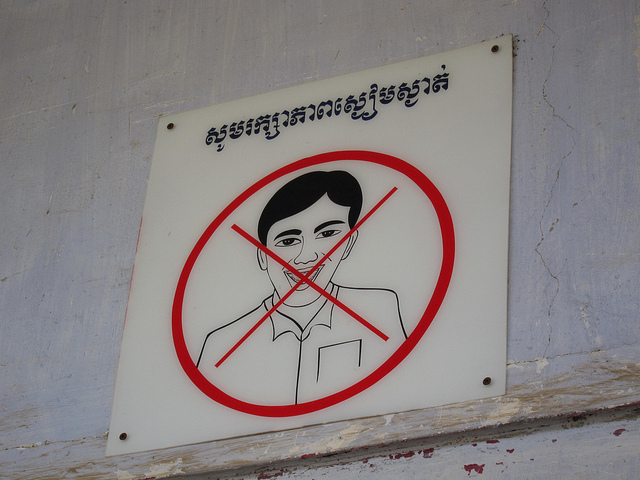
From the information given by the tour guide and the comments that some of the tourists made, it was pretty clear to us that many in this tour group did not know about Tuol Sleng and its significance. One of the tourists even loudly made a sarcastic, ignorant comment about how smart the Cambodians were for charging money and making profits from such a rundown ‘tourist attraction.’ Several others were talking and laughing loudly, oblivious to the posted sign with an image asking the visitors to be reverent given the context of what had happened at the place we’re visiting. Some others would go into the rooms that were the interrogation and torture rooms, talked loudly, and had photos taken with smiles as if they were standing in front of something scenic.

Kristi and I didn’t say anything and we slowly moved away from this group as we didn’t want to be associated with them. It’s sad, but that day I felt embarrassed to be an Indonesian after seeing the behavior of these tourists.

The photo below was taken at the grounds of Tuol Sleng not far from where the tourist group was gathering and being very obnoxious. The sign was in Khmer, but anyone could see from the picture that they asked visitors to be reverent to honor those who perished at this place.

No smile sign

Tuol Sleng

The Tuol Sleng / S-21 Prison is an old high school building turned prison right in the heart of Phnom Penh, Cambodia that now serves as a museum to remember the atrocities of the Khmer Rouge regime. In this prison, more than 20,000 people were imprisoned, and only seven prisoners survived the four years of horror at the prison.

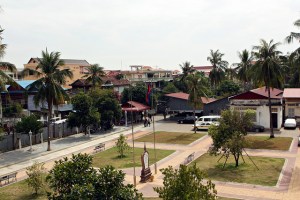
We went to Tuol Sleng after finishing our visit to the National Museum of Cambodia. When we arrived at there, my first impression of the place was that it’s somewhat different than what I had thought in my mind. While I knew that Tuol Sleng was located in Phnom Penh, I didn’t realize that the complex was right in the middle of a dense residential area. You could see people’s homes right across the street and surrounding the complex.

The building itself looked old and run down, but eerily it looked somewhat familiar to me. The building was a high school before the Khmer Rouge regime converted it into an interrogation center and prison. As such, the three-story high school buildings with their classrooms looked very similar to my junior high and high school buildings back in Indonesia. I think my school buildings were built around the same era as when the Tuol Sleng buildings were built, so it makes sense that they look kind of similar.

One part that gave a visitor a clue that this was not just an ordinary building was the fence around the complex. The fence was covered with corrugated metal sheets and barbed wires — looking more like prison than high school.

I took the photo below from the third floor of one of Tuol Sleng’s buildings. You can see the courtyard, and the surrounding dense residential neighborhood. I can’t imagine what it’s like to live in a neighborhood close to a place where thousands of people were tortured and killed.

Tuol Sleng Genocide Museum

Culture Almost Lost

Sometimes you take for granted the value of something until you realize that it was once almost lost, and that you’re fortunate to still be able to experience/see it. Such was my feeling after visiting the National Museum of Cambodia in Phnom Penh. The museum houses collection of artifacts from the rich Khmer history. Many of these were almost lost during the Khmer Rouge reign, as the regime attempted to erase the culture and history and ‘start over’ in the agrarian society that they envisioned.

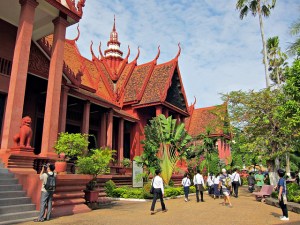
I made some observations as I walked around viewing the exhibits. There were some groups of school students in uniform listening to young tour guides explaining the exhibit to them in Khmer. I think that was nice to see the young generation of the locals also coming to the museum to learn about their own culture and history, considering that most of them were not even born at time of the Khmer Rouge reign (more than 80% of Cambodian population was under the age of 30 in 2010).

There was also an exhibit explaining about an archaeological site in rural Cambodia where they found many artifacts from the golden age of the Khmer Empire. It’s interesting to read the story how the site was initially discovered. A farmer found some of the metal artifacts, and initially collected and sold them in the market as scrap metal. It turned out that the site was one of the richest archaeological sites ever excavated in Southeast Asia. One of the purposes of this exhibit was to educate people about the importance of these archaeological finds in learning about the history, and how it’s a loss for the society when the treasures fell into the hands of looters and art dealers. I think that would be a difficult concept to get people to adopt, especially when many people lived in poor condition and the short-term gain from selling those artifacts was more appealing than the long-term gain for the society from turning over the findings to the archaeological research groups.

As I walked through another section of the museum, I overheard a tour guide explaining some artifacts to a couple of foreign visitors in French. What’s interesting to observe was that the lady who guided the tour seemed to be a Cambodian in her 50s. That means she’s old enough to have gone through the Khmer Rouge era. Given her knowledge about the art history, I wonder if she was an educated person who fled the country before the Khmer Rouge era or if she was a survivor who lived through the Khmer Rouge time and managed to avoid being identified as educated and killed by the regime. Either way, I thought that was great to have someone from the previous generation who can help link the culture to where it was before the dark times.

So there it was, a brief visit to a museum that holds a nation’s treasure. It may not be as well known as what you find in other history museums in the world, but when you consider what this nation had gone through, this is definitely a collection that should be appreciated. I hope as the country becomes more developed and more of the Cambodian people become more educated and come out of poverty, these national treasures become more known and they can appreciate the richness of their own culture and history.

The photo below was taken at the front of the museum, as we wrapped up our visit to this museum. Notice the group of young people walking out in white shirts. Those were the students that I mentioned above.

Students at the National Museum