Wall Street

Not far from the Battery Park in New York City where you can board the ferry to the Statue of Liberty and Ellis Island, you can find the center of American financial industry, the New York Financial District with its famous street, Wall Street. On 11 Wall Street you can find the New York Stock Exchange building. The NYSE is the world’s largest stock exchange by market capitalization. Inside the NYSE building is the trading floor where the day-to-day business of the stock market is being conducted. Since the September 11 attacks, the trading floor is closed to public. Today if you want see the action inside in person, you can follow one of these suggestions on eHow: go on educational program or visit as part of a college class, apply for an internship at the NYSE, get a trading license and become an actual stock trader, or start a company and take it public.

I’ve only visited the NYSE as part of a walking tour in the area outside. Just right across the street from the NYSE building, there is another building that is also historically significant, the Federal Hall. The Federal Hall was the site where George Washington was sworn in as the first President of the United States, and the building was also home of the first Congress, the first Supreme Court, and the first Executive Branches. It’s worth the visit especially given its significance in the birth of the United States of America as a country.

The photo below was taken in front of the NYSE building. It’s the pediment part of the NYSE building facade, designed by John Quincy Adams Ward. Entitled “Integrity Protecting the Works of Man,” it depicts the 22-foot figure of Integrity in the center, with Agriculture and Mining to her left and Science, Industry and Invention on her right, representing the sources of American prosperity. The waves on either extreme of the pediment symbolize the ocean-to-ocean influence of the Exchange.

NYSE Building

New York City

I finished my series of blog posts on National Historic Sites with the Statue of Liberty and Ellis Island, both located near New York City. So I thought as my next series of postings I would write about places I’ve visited in this large city. New York City is the most populous, most densely populated, and most culturally diverse city in United States. It’s one of the major metropolitan areas in the world that does not require any introduction. But your view of this city may differ when you look at the city from the lens of a visitor vs. from the point of view of a city resident.

My first visit to New York City was almost twenty years ago, as part of a high school group from the Midwest. In the early 1990s, New York City was not as ‘clean’ and safe as it is today. I remember staying in an area in Brooklyn where we were warned not to get out to the street unless we’re in a group of at least four people, and on our first trip outside the place we stayed, we saw a limousine with bullet holes on the window passing by. I also remember dining at a restaurant supposedly famous with many celebrity visitors, having a ‘chicken noodle soup’ that was basically just chicken broth with some noodles and no chicken pieces in it, and paying $8 for that small bowl. I also experienced being offered illegal drugs while walking with friends in the Washington Square Park in SoHo area.

Several years later, I visited New York City again, this time with my family. We did a road trip after attending my grad school graduation. We went for a day trip into the city, taking the Grayline bus tour around the city. I remembered my parents and my brother said they had enough seeing the big city after only a couple of hours into the trip (coming from Jakarta, Indonesia, they saw New York as just another big city with a lot of people and bad traffic problems).

Fast forward few years later. My brother graduated from college, and was going to continue to grad school. For his field, the best schools and jobs are located in the Big Apple. He wasn’t excited about the prospect of having to live in this big city, but he was admitted to a well-known school in his field and for a program that he was interested in; it was hard to turn down. He lived in Queens while going to school in Manhattan for a couple of years, then after graduation, he got a job where it made more sense for him to live in Upper East Side of Manhattan. During those years, his perception of New York City changed — it became a place that he liked to live in especially with its diversity and the opportunities it provided. During that time, I also relocated to Washington, DC, meaning I was only four-hour trip away from where my brother lived. I visited him many times, and got to see New York from the perspective of one of its residents, and I started seeing it as a place that is full of diversity and things to discover.

Fast forward again few years later to today. Since then, my brother had moved to the West Coast for a couple of years, and then moved back to New York City. Now he lives in Brooklyn, owning his own place there. So he is establishing his roots as a New Yorker. I still come to visit now and then, and I’m always looking forward to look for things to discover (especially with food!). And I’m getting familiar enough with the city layout and the subway system that I could go from place to place on my own like locals.

There are so many places in New York City to feature, and undoubtedly I will go back to visit many times in the future. For this series of blog posts, I will highlight some places I visited in the past where I have photos in my flickr archive to show.

The photo below was taken from the Liberty Island during my visit there a couple of weeks ago. It’s a photo of New York City (mostly Manhattan) skyline, with the familiar Empire State Building on the left, the new One World Trade Center still being built at the Ground Zero, the tall buildings in the Financial District, and the Brooklyn Bridge connecting Manhattan and Brooklyn on the right.

New York City skyline

Ellis Island

Ellis Island is an island on the New York Harbor area close to the Statue of Liberty. From 1892 to 1954, it was the main gateway for millions of immigrants into the United States.

Back then, immigrants arrived in ships from Europe, and the lower class passengers where taken by ferry boats to Ellis Island to be processed. Generally, those immigrants who were approved spent from two to five hours at Ellis Island. Arrivals were asked 29 questions including name, occupation, and the amount of money carried. It was important to the American government that the new arrivals could support themselves and have money to get started. The average the government wanted the immigrants to have was between 18 and 25 dollars. Those with visible health problems or diseases were sent home or held in the island’s hospital facilities for long periods of time. More than three thousand would-be immigrants died on Ellis Island while being held in the hospital facilities. Some unskilled workers were rejected because they were considered “likely to become a public charge”. About 2 percent were denied admission to the U.S. and sent back to their countries of origin for reasons such as having a chronic contagious disease, criminal background, or insanity. Ellis Island was sometimes known as “The Island of Tears” because of those 2% who were not admitted after the long transatlantic voyage.

After the Immigration Act of 1924 was passed, which greatly restricted immigration and allowed processing at overseas embassies, the only immigrants to pass through the station were displaced persons or war refugees. Today, over 100 million Americans – one third of the population – can trace their ancestry to the immigrants who first arrived in America at Ellis Island before dispersing to points all over the country.

I visited the Ellis Island a couple of weeks ago after I visited the Statue of Liberty. The ferry that goes to the Statue of Liberty makes a stop at Ellis Island before heading back to the pier. For many visitors, especially those who don’t necessarily have any ancestors who went through Ellis Island, may pass the visit to Ellis Island as just an old historical building to visit when you have extra time. My first visit to Ellis Island few years back was only to take some photos from the exterior of the building. This time I decided to actually spend some time to learn about the history behind the island.

While I couldn’t relate from the perspective of having ancestors who came through Ellis Island, I could relate from the perspective of being an immigrant who came from another country and stayed as a resident. I remembered going through the modern equivalent of the interview and inspection process; for me, it happened at the US Embassy in Indonesia when I went for interviews during the visa application process.

The photo below was taken inside the Main Hall where the immigration processing was done. The hall looked empty today, but imagine the huge hall filled with rows of seats where immigrants waited to get processed. Once the processing was done, at the end of the hall there were stairs with three lines: one line for approved immigrants who were heading to New York City area, another line for other approved immigrants who are heading to destinations outside New York City, and a third line for questionable immigrants who needed to be processed further (e.g., due to possible health issues). These were nicknamed the Stairs of Separation as some family might have members who had to stay while others were approved to leave, so they had to make quick decision whether to stay together as a family, or separate and leave someone behind.

Main Hall at Ellis Island

Statue of Liberty

The Statue of Liberty is perhaps the most recognizable monument in the United States. It is located on Liberty Island at the New York Harbor not far from Lower Manhattan part of New York City. The statue was a gift to the United States from the people of France to celebrate American’s independence. It was dedicated on July 4th, 1886. The statue has become a symbol of freedom and of the United States.

I’ve visited the Statue of Liberty several times over the years. My last visit was a couple of weeks ago during the Thanksgiving weekend. My brother now lives in New York City area, so I was in NYC for Thanksgiving and decided to spend the Saturday morning after Thanksgiving to visit the Statue of Liberty and Ellis Island again. Since I went alone and I didn’t have anything planned for most of the day, I was able to take my time and listen to the audio tour that provided the historical background behind the building of the Statue of Liberty. It’s quite interesting to hear what visitors from around the world think the Statue represents — freedom, new beginning, opportunity, the United States, and more recently after the 9/11 attacks, it became the symbol of resiliency for the city of New York and the American people in general.

The photo below was taken from the grounds of the Liberty Island as I walked around the statue and listened to the audio tour. From every angle, it seems that you can always get a majestic view of the Lady Liberty standing there holding the torch and the stone tablet.

Statue of Liberty

Independence Hall

The Independence Hall is a building in downtown Philadelphia, PA, that is the centerpiece of the Independence National Historical Park. It was the place where the United States Declaration of Independence and the Constitution were written in 1776 and 1787. Nearby you can also find the Liberty Bell (the bell that was rung to mark the reading of the Declaration of Independence on July 8, 1776) and historic buildings like the First Bank of the United States.

I visited the Independence Hall on a day trip from my home in Washington, DC, area about two years ago. I had traveled to Philadelphia area for work many times, but the travels were mostly to the suburban area of the city, and I had never visited the historic area in downtown before. So this visit was educational as I got to see the place where two of the important documents in the US history were written (you can see the original copy of these documents at the National Archives in Washington, DC). To visit the park, you can drive and park at the underground parking garage located near the Independence Visitor Center right across from the Independence Hall. To tour the inside of the Independence Hall you need to get a ticket at the Visitor Center (it’s free of charge, but you need a ticket as they have limit on the number of people that can go inside the building at a time).

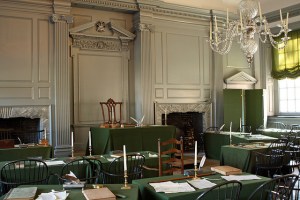
The photo below was taken during my visit. It’s the Assembly Room inside the Independence Hall building where both the Declaration of Independence and the Constitution were drafted and signed. The chair in the middle was the chair where George Washington, the first President of the United States, sat as he presided over the Congress during the deliberations and signing of the Constitution.

Independence Hall