Bakong

Bakong is another temple in the Roluos area near Siem Reap, Cambodia. This temple was the first temple built with a temple mountain design (where the temple has tower(s) that symbolizes Mount Meru in Hindu mythology). This design was then used in constructing many of the temples in the later era in the city of Angkor, including the famous Angkor Wat. Another aspect of the design is to have a moat around the temple complex, symbolizing the ocean surrounding Mount Meru.

Today Bakong is still used for worship. There is a working monastery on the grounds of the temple. When we visited the temple, unlike other temples we visited, we actually saw more locals coming to worship than tourists coming for sightseeing.

This was the last temple we visited, and by that time in the afternoon, I was already pretty tired and I didn’t really feel like climbing the steps up to the top of the temple tower. So I decided to just wait down there with our tour guide Vanna while Kristi went up to see the scenery from up there.

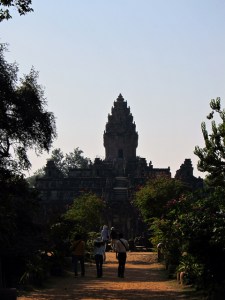
The photo below was taken on the way into the temple complex, after we passed the bridge crossing the moat. You can see the tall temple tower in the distance, and the shape of the tower is similar to what you can find at the Angkor temples like Angkor Wat.

Bakong

Preah Ko

Preah Ko is a temple in the Roluos area outside of Siem Reap, Cambodia. It was the first temple built in the ancient city of Hariharalaya, the seat of the Khmer Empire before it moved to Angkor. Similar to Lolei, the temple was built using bricks rather than sandstone. In the recent years, it had undergone restoration project. When you visit the temple, you could tell, however, the old and new bricks on the temple towers; it’s interesting to see the difference on one side seeing the original structure and on the other side seeing the new, restored structure that gives you an idea what the structure would look like back hundreds of years ago. Some of the intricate sculptures were still there. You could also see some inscriptions on the wall that helped the archaeologists to understand the ancient Khmer culture.

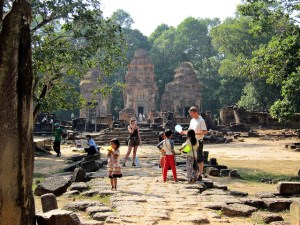
We went to Preah Ko after our visit to Lolei. When we arrived there, there were not many visitors around either. At the entrance, we saw several young children standing and waiting for visitors to come. We saw a lady accompanied by a tour guide walked in, and the children greeted the lady with a bow, saying ‘Hello’ and hoping that the visitor would give them a little cash. For us, they thought Kristi and I were Chinese (well, they were somewhat correct) and they said ‘ni hao!’ Vanna smiled and told them that we actually spoke English, so then they changed to say ‘hello!’ Our tour guide Vanna discouraged us from giving money to these kids, as that would encourage them to pursue the wrong way to earn a living.

Later on we saw a tourist doing something that I thought was pretty admirable. He knew that the poor kids would come and approach him for money. But instead of giving them money, he had balloons in his pocket that he would blow and give to the kids. In the end, kids were kids.. and they were equally happy being given balloons by this gentleman rather than money. I took the photo below as I observed the interaction between the tourist and the children when he gave them the balloons. His travel partner watched and took a photo of that interaction as well.

Tourist handing out balloons

Vanna the Tour Guide

In many of the previous posts I mentioned our tour guide’s name, Chea Vanna. Having him as our private tour guide definitely made a great difference to enhance our experience exploring Siem Reap. He was very knowledgeable about the history and cultural background behind many of the places that we visited, and he was quite personable and engaging. I thought I would write a blog post about him as I’m closing in to the conclusion of the Siem Reap part of my Southeast Asia trip.

When we started our sightseeing on the first day, Vanna introduced himself and told us a little bit about his background. He grew up in a village near Phnom Penh. After graduating from the university, he worked in an office job for a couple of years, and then decided to switch career to become a tour guide. He learned English and read a lot on the Khmer history, and then he went through the certification process to become an official tour guide (you have to be licensed in order to serve as a tour guide in the Angkor Archaeological Park area). When he guided us, he had been a tour guide for around three years, and he said he loved his job as it allowed him to meet people from around the world and learned about other cultures from his customers.

I asked Vanna if he was employed by Derleng Tours, the tour company that arranged our visit to Siem Reap. He said he did tours for Derleng quite frequently, but he was actually an independent guide. He worked with a couple of other tour companies in addition to Derleng Tours. He said he liked working with Derleng as it was a locally-owned company; he preferred that than some big tour companies that are foreign-owned.

During our tour there were times when Vanna excused himself for having to check his phone for text messages. That’s how he arranged bookings for future tours. Typical engagement was similar to ours, about three days. Sometimes it’s as short as only a day trip, or as long as a whole week. The size of the group he led varied from small group (2 people) like ours to larger group (15 people). I asked him if that pretty much made it a full-time job. He said yes, though there were days when he purposefully left open on his schedule so he could rest and volunteer teaching English at a local school. I thought that’s great that he used his knowledge and skills to help others to also improve their lives.

During the three days that we spent in Siem Reap, I enjoyed visiting to the places and having conversations with Vanna along the way and learned a little bit about life in Cambodia. In turn he also asked me about how life is like in both the United States and Indonesia, and it’s quite an interesting conversation comparing and contrasting the life and culture as we knew them.

I took the photo below when we were exploring the Terrace of the Elephants inside Angkor Thom. Here was Vanna explaining about the three-headed elephants to Kristi.

Vanna the Tour Guide

Lolei

Lolei is one of the temples in the Roluos group of temples in near Siem Reap, Cambodia. These temples were part of the city of Hariharalaya, the seat of the Khmer Empire prior to the move to the nearby Angkor area. The temples built during that era were different than those at Angkor as they used bricks as material. Currently only the ruins of Lolei’s four towers remain, though there is an active monastery still operating nearby.

We visited Lolei after our snakehead fish lunch. When we arrived at the temple, it was pretty quiet and the only other visitors we saw were a couple who happened to eat lunch at the same restaurant where we ate and sat next to our table, and a gentleman who came alone on a chartered tuk-tuk. The couple was met by several young Cambodian girls who tried to sell souvenirs to the lady. Her husband took photos of her and the girls as she peruse the goods that they offered her. The lone gentleman came by himself and went straight into the temple to observe the ruins. We went there around the same time. As we passed him, our tour guide Vanna said hi to him and asked him where he came from. He said he was from Spain, and after a short conversation, he moved on to observe the details of the temples alone.

I took the photo below from a distance. It was the Spanish gentleman looking at his guidebook and observing the ruins, and there were a couple of young Cambodian boys sitting on the remains of a naga sculpture and observing the tourist checking out the ancient ruins. I thought it’s interesting to have a tourist coming from far away to check out the ruins of an ancient civilization, and here were two boys who lived around these ruins and not caring much about the significance of the ruins, but more interested in seeing foreigners coming in.

Lolei

Snakehead Fish

I first heard of the snakehead fish about ten years ago, when it made news in Washington, DC, area where I lived. The snakehead fish, which is native of Africa and Asia, was found spawning in a pond in Maryland not far from the Potomac River. The snakehead fish is a priced delicacy in Asian countries, so someone tried to grow them in the US and then released them to the wild. The snakehead fish is known to be a ‘top-level predator’ meaning it doesn’t have natural enemies outside its natural habitat. They also have the capability of surviving out of the water for up to four days, and by wriggling their bodies and fins they can ‘walk’ on the land up to 1/4 miles. So there was fear that the fish would cause havoc to the ecosystem at the nearby Potomac River if it had made it there. The National Geographic Channel had a short video about the snakehead fish as the ‘fishzilla.’

After visiting the floating village of Chong Kneas, we went to a restaurant to have lunch before continuing our sightseeing in the afternoon. When we looked at the menu, we found out that this particular restaurant served steamed snakehead fish (which is quite common as delicacy in Southeast Asian countries like Thailand and Cambodia). Neither Kristi nor I had ever had this fish before, so we decided to give it a try.

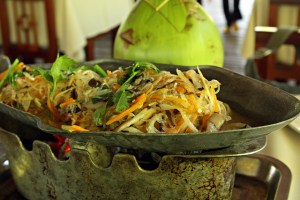
The photo below was our steamed snakehead fish dish when it was served on a fish-shaped metal dish. The fish was indeed very tasty; no wonder this was such a priced delicacy.

Steamed snakehead fish