One consideration you need to make when planning a visit to the Angkor Archaeological Park in Siem Reap, Cambodia, is how you will get around the area during your visit. With around 400 square kilometres with many points of interests to visit, you need to plan out your transportation option ahead of time to make the best use of your time there.
Since there is no lodging option available within the Park, most visitors stay in one of the lodging options in the city of Siem Reap (about six kilometres south of Angkor Wat). You can find transportation options quite easily in the city. Travelers typically visit the temples either by buses for large tour groups, or by vans, cars, tuk-tuks, motorcycles, or bicycles for independent travelers. What you need to consider is the distance of your travel/route, the cost, the time you have, and the weather conditions. If you’re going to one of the remote temples, you may want to make sure that you have a way to get back or go to your next destination (i.e., it may not be easy to get public transportation from there). Also, depending on the time of the day or the season of the year when you’re traveling, it might be very hot during the middle of the day or it might be raining. And negotiating transportation for the whole day may be cheaper than getting transportation from point to point.
For our visit to Siem Reap, we had a tour company arrange our transportation, so we had a driver with air-conditioned van and a tour guide ready for our day trips there. Even then, we had to make plan adjustment on the first day. Initially, we were thinking of ‘going healthy’ and spend our first afternoon touring the area in bicycles. Sounded like a good idea, until we found out the reality that afternoon that a) we were pretty tired after our trip from Phnom Penh to Siem Reap in the morning, and b) it was hot and humid outside. Our tour guide suggested that we went by air-conditioned van instead, though if we still insisted to go by bicycle, he was ready for that too. We followed his advice, and that turned out to be the right thing to do. We were able to spend more time at Angkor Wat and Phnom Bakheng that afternoon, and reserved our energy for a longer day trip the following day. Our driver also had a cooler full of cold bottled water, which was very nice to have especially as we walked around the temple area in the heat of the day.
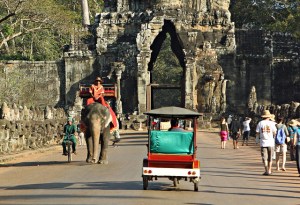
The photo below was taken from our van on our second day as we’re about to enter Angkor Thom. You can see some modes of transportation that others took: by tuk-tuk, on foot, by bicycle, and — in some areas — on an elephant.

 setiawanphoto