Khao San Road

Khao San Road is a road in the Banglamphu area of downtown Bangkok (northeast of the Grand Palace area) that is known among travelers as the place to go for budget hotels, restaurants, bars, clubs, stores, travel agents — anything that caters to travelers to Thailand and neighboring countries. It has been a popular place to stay for backpackers and budget travelers since the early 1980s. Now the area still has many low-priced guest houses that cater budget travelers, but it has also become a destination for foreigners and locals alike for night life with many restaurants, bars, and night clubs opening til late.

I learned about Khao San Road from the guidebooks that I read before going to Thailand (or really any travel guide to Bangkok these days would mention the place). Even though there are many cheap accommodations that could be found there, for us personally we would prefer staying away from this crowded place. We came to Bangkok to visit some landmarks and experience the traditional cultures, and we were not into the nightlife scene, so being close to the happening place was not really a priority. But for travelers on shoestring budget, or those who are more intrepid and like to ‘play it by ear’ and not doing advanced planning, coming to Khao San Road area might be a good idea as they would be guaranteed to find a place to stay that meets their budget, and there are many travel agencies that could help arrange travels in the region. You could also meet other travelers in similar situations there.

We visited the Khao San Road area after we finished with our culinary experience in the Sao Ching Cha area. The walk from the Sao Ching Cha area to Khao San Road was not too far. It was interesting to observe, however, that we hardly saw foreigners in the Sao Ching Cha area (which was mostly residential and local commercial), but once we crossed the last main road near Khao San Road area, we started seeing foreigners (westerners) everywhere. Once we got the actual road, walking along the road was like going to a tourist attraction for foreigners — there were more foreigners than locals around, and all the stores had signs in English (quite a contrast compared to our visit to the Sao Ching Cha area where we couldn’t even read signs and menus in restaurants because they were all written in Thai). There were also American fast food chain restaurants like McDonald’s, Subway, Burger King, and Kentucky Fried Chicken, and many restaurants would serve international fare (Italian, Japanese, etc.). I suppose this would be a good place for foreign travelers who are homesick and would like to take a break from the local cuisine and get the food that they’re used to from home.

The photo below was taken by my cousin Kristi as we walked along Khao San Road. You can see many foreigners around. The road was pretty much closed for motorized vehicle traffic (with so many pedestrians around), and street vendors lined up the side of the road selling souvenirs or snacks.

Khao San Road

Coconut Ice Cream

If you find a small local store that has been serving only one type of food for more than 60 years, it’s very likely a place that does that one thing very, very well, and you should definitely give it a try. Such place is the Nattaporn Ice Cream Shop in the Sao Ching Cha neighborhood. We found out about this place from an article on the website covering eateries in the Sao Ching Cha neighborhood. On the hot, sunny afternoon after eating a nice lunch at the meatball noodle soup store, we thought ice cream would be great to have before we continued on with our walk to the next destination during our full day visiting Bangkok, Thailand.

It took us quite a bit of time to find the ice cream shop, as it was tucked away on a quiet neighborhood street among residential areas. When we found the place, we had to wait for a few minutes since there were only three tables with 4 seats each, and those were all occupied. Once we got seated, we ordered the ice cream. I had the coconut ice cream that seemed to be the specialty of the place. You can get toppings on the ice cream. This is where this differs from the western counterpart; it has very different kinds of toppings to select from: red bean, taro, roasted mung beans, sticky rice, sweet corn — all natural toppings, none of the things you find in western ice cream shop (candies, chocolates, etc.). I had mung beans and sweet corn as my toppings. It was a unique combination of taste. I can’t say that the ice cream was that memorable, but the experience looking for the place, sitting outside the store, and enjoying the ice cream while watching neighborhood traffic passing by was definitely one to remember.

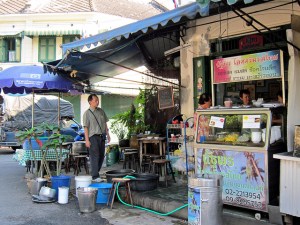
The photo below was taken from the street after we’re done eating our ice cream. You can see the little store with the tables and stools outside, and the blue basin and bucket outside where they would wash the bowls after you’re done with the ice cream. It may not be some people’s idea of great sanitary place, but the bowls seemed clean (you can watch them washing the dishes if you like) and 60 years of history means they’re doing something right.

Nattaporn Ice Cream

Meatball Noodle Soup

Sometimes unforgettable experiences start with the willingness to go outside your comfort zone. Such was our experience eating lunch at a noodle shop in the Sao Ching Cha area during our visit to Bangkok, Thailand.

When I did an Internet research to find lunch options after our visit to the Grand Palace, we found a website that seemed to be a great location to check out. It’s within walking distance from both the Grand Palace area where we were coming from and the Khao San Road area where we needed to go afterwards. There is also an easy to spot landmark, the Giant Swing, so we thought we would just find the Giant Swing, then follow the hand-drawn map from the website from there to locate the lunch options.

When we arrived in the area, I asked Kristi what she would like to eat for lunch. The guide from the website mentioned many places to check out, each specialized on a particular dish, and they all have the commonality of being local, street-level vendors that have been in the area for long time. Kristi said she wanted to have some noodle dish, so we picked several options from the list, and started following the map to find these stores. I had the description of the stores as well as map printed from the website to a PDF, and then sent to my Kindle. So conveniently we could look at my Kindle and looked around the neighborhood to find the streets and locate the stores.

Finding the streets on the hand-drawn map was not a problem, but once we reached the street, in some cases we saw several restaurants in a row that all seemed to sell the same thing. We couldn’t figure out from reading the description and looking at these stores which one is the one that’s actually featured on the website. To make it more discouraging, pretty much all of these stores didn’t have any writing in English, so not knowing how to read and speak Thai, we were not sure even how to approach ordering lunch there.

We continued our walk, and after finding a couple of the restaurants featured on the website, but refraining from entering/trying as we didn’t see anyone else around (it was around 2 pm, so it could be that lunch hour was already over), we finally found one small restaurant that was also on the review, and seemed to have good food. It smelled good from outside, and we saw many people (all locals) eating inside. We hesitated, but the lady who was cooking at the open kitchen at the front of the shop saw us, smiled, and motioned with her hands to invite us to come in. Still not sure, we decided to go ahead and try it out.

The lady didn’t speak English, but we could communicate with her with hand gestures. We pointed to the noodle soup dish that seemed to be their specialty, and she nodded and started preparing the food. We had no idea what we ordered, but we went along, waited for the soup bowls to be served. I still don’t know what the dish was called, but it was noodle soup with red, tomato-based soup and an assortment of meatballs, seafood, and pig’s blood pudding. Fortunately both Kristi and I had had these ingredients elsewhere before; it would’ve been a shock for some Americans who had never seen or tried these before.

I also ordered one item from their menu written on the wall in Thai. This particular one is recognizable from its logo.. Coca Cola. As we’re finishing our lunch, I looked at the page on my Kindle to read up about the place and compared the photos on the website with the surroundings to confirm that we’re indeed in the restaurant mentioned on the page. The shop lady noticed I was looking at my Kindle, and she pointed to it and smiled. I looked around, and then noticed an old lady coming from the back of the restaurant. It was the same old lady whose picture was on the website page. I showed the photo to the shop lady, and she called the old lady and showed the photo on the Kindle. Both of them smiled — very happy and proud to see their store on this electronic gadget brought by a couple of strangers who don’t speak their language. It was a memorable moment from this trip that I definitely treasure. And, in the hindsight, it would’ve not happened had we not gone outside our comfort zone and eating at this restaurant even though we didn’t know the language to communicate.

The photo below was taken from the outside of the noodle shop. I learned later on that the logo of the green bowl on the top left is ‘Shell Shuan Shim’ which is kind of like Michelin star or Zagat review that indicates recognition of the food quality at this place. The funny thing is that even the website simply called this shop as the ‘Shuan Shim noodle soup place’ — kind of like naming a restaurant as ‘the one with the Zagat logo’.

Noodle Shop

Sao Ching Cha

Sao Ching Cha is a landmark in downtown Bangkok, Thailand. It a giant red swing that is now located in front of a temple near a busy road. The giant swing was commissioned by King Rama I in 1784, and it was used for ceremonies up til the beginning of the 20th century. The game performed on this swing is no longer done because it is dangerous. The game involved having young men swinging to the height of 25m from the ground in an attempt to grab bags of coins placed on top of the posts with their teeth. In the euphoria of this event, dedicated to the God Shiva and the zealous excesses of trying to be the most skillful, some of the intrepid young men would fall to their death. As such, the tradition was discontinued and now the giant red swing remains only as a monument.

We found out about Sao Ching Cha actually when we were looking for an area within walking distance from the Grand Palace where we can find selections of local food vendors to try out for lunch. I found a website with reviews of places in a neighborhood close to Sao Ching Cha.

The photo below was taken from across the street of the giant red swing. You can see a couple of tourists standing near its base as size comparison.

Giant swing

Thai Buddhism

When visiting Thailand, a very visible aspect of the culture that you will encounter is its main religion, Buddhism. Nearly 95% of Thailand’s population is Buddhist of the Theravada school (the oldest surviving school of Buddhism — conservative and close to the early Buddhism). The religion has been part of the Thai people since the beginning of its history, and it very much influences the culture. Just like you find churches everywhere in Rome, you will find Buddhist temples everywhere in Bangkok. You’re likely to see monks with their orange or red robes everywhere; that’s because becoming monks is considered as a rite of passage for young Thai men. When you interact with the Thais, you will notice their mannerisms that reflect the teachings of Buddha — gentle, respectful, and full of smile.

Before our visit to Bangkok, I learned about this aspect of the Thai culture from reading guidebooks and talking to my cousin Kristi who had some Thai friends and had been in Thailand before. I wondered if this might be somewhat ‘in your face’ and might make a visitor feel uncomfortable or out of place. On the contrary, I thought we had a good experience immersing ourselves in the culture, and it brought out an interest in me to learn more about the culture and appreciate its rich history. What’s sad is that many foreigners (‘farangs’ as the Thai would call them) come to Thailand to look for white sandy beaches or the party scene (or even the darker side — sex tourism) and leave the country completely ignorant of this wonderful aspect of the culture that is rooted in their beliefs.

The photo below was taken in front of a store near the Sao Ching Cha neighborhood of Bangkok. We walked to this neighborhood after visiting the Grand Palace. On the way there we passed a street lined with stores selling statues of Buddha, ranging from the small ones to life-size. I suppose people will purchase these statues for their homes.

Buddha statues