Amok trei

After visiting Ta Prohm, it’s time for us to take a lunch break before continuing our visit in the Angkor Archaeological Park outside Siem Reap, Cambodia. Instead of taking longer time to drive to Siem Reap for lunch and back, our tour guide Vanna suggested that we should go to a restaurant located not far from Ta Prohm called the Khmer Village Restaurant. By the time we arrived at the restaurant, it was already 1:30 pm or so, so some of the lunch crowd had already left, but the restaurant was still quite full. Given its location pretty much inside the Angkor Archaeological Park, you could tell that it catered mostly to the visitors of the Park.

We wanted to try another traditional Khmer dish while we were there, and one dish I read that is a popular dish in Khmer cuisine is amok. Amok is a curry dish with coconut milk-based gravy that is cooked in banana leaves. It can be served with various kinds of meats, but the popular one in Cambodia is with fish, called amok trei. I wasn’t sure what kind of fish was used for ours, but I’m guessing it’s likely from fresh water fish like most things in Cambodia. When the dish was served and we tasted it, like some other dishes we had in Cambodia, we could taste something new and unique to Khmer cuisine, but at the same time it seemed familiar as parts of the dish were similar to dishes we have in Indonesian cuisine. I think it was somewhat like in between gulai (the gravy was not as thick and strong flavored) or opor (it wasn’t as soupy). It also resembled a Thai curry dish — not surprising given the regional influence of these cultures on each other.

The photo below was the amok trei dish that we had just before we tried it out. It wasn’t served in banana leaves container, but it had all the flavors that you would expect.

Amok trei

Ta Prohm

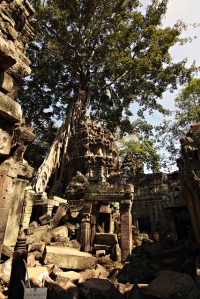
Ta Prohm is a temple in the Angkor Archaeological Park north of Siem Reap, Cambodia. The temple was built in 11th century by King Jayawarman VII, the same king who built the city of Angkor Thom nearby. This temple is famous among the temples in the Angkor Archaeological Park given that it had been consumed by the nature around it. Trees and vegetations grew on top of the ruins. The French organization that worked on preservation of the Angkor temples in the early 20th century decided to leave Ta Prohm alone as an example of how nature took over the land from man-made structure after centuries. In more recent years, this temple was also made famous by the movie Tomb Raider with actress Angelina Jolie, as scenes of the movie were filmed there.

We visited Ta Prohm in early afternoon before we went for lunch. The traffic near Ta Prohm was still pretty heavy, but it was better than the hours before or after that as many visitors were at lunch around that time. Along with Angkor Wat, this was one of the main sites we wanted to visit given its unique scenery. It was quite surreal to see large trees standing firm on and around the temple ruins, as if they were in the process of ‘eating’ the structure. We also found the spot where the famous scene of Angelina Jolie coming out of the temple ruins was filmed for Tomb Raider. It was quite easy to locate, as there were many visitors around there waiting to ‘reenact’ Angelina Jolie’s scene and got their photos taken. We didn’t do the same, but I did take a photo of other visitor doing the reenactment.

The photo below was taken inside the temple complex. You can see the big tree standing on top of the temple ruins, looking like they are well integrated with each other.

Ta Prohm

Education in Cambodia

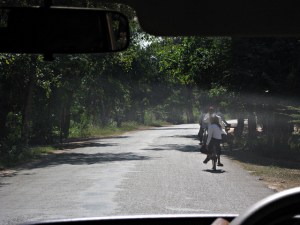
After visiting the Cambodia Landmine Museum, we continued our day trip heading back towards the Angkor Thom area. The drive back from Banteay Srei took about an hour. During the drive, I had good conversation with our tour guide Vanna. One of the topics was about education in Cambodia. The conversation started as I noticed we drove passing groups of students in uniforms either walking or riding bicycles on the side of the road.

Vanna said that the students could either be on their way to or from the school. I asked if there was a typical school hours there. Vanna said it’s not always the same. In some areas, since there were more students than teachers available, they would split the students into groups that come to school in the morning and those that come to school in the afternoon. I asked if public education was readily available. Vanna said that it would depend on the area or province in the country; some provinces like Siem Reap had better funding because the economy was doing better, so in those places you could find more schools reaching the villages in the area compared to other provinces. There are schools at the primary/elementary level and those at secondary level. There were more primary level schools than secondary level schools — in many cases when students moved up to the secondary level, they would have to go to schools that are located quite far from where they live. Vanna said when he went to high school, he would ride his bicycle every day for about 20 km to get to his school. He also was able to continue on to the university, studying in Phnom Penh.

But he said his experience was not as common as he would hope for. For a lot of people, there was economic barrier to get children educated. Many families couldn’t afford to buy uniforms and school supplies for their kids, or later on, they couldn’t afford to get bicycle for transportation to go to schools that are far away from their home. So as the result, the children ended up not going to school and working starting at early age. Another problem in some more rural areas is the danger of landmines in the fields around villages. I just couldn’t imagine having to fear about stepping on landmines on the way to school… This is where NGOs like the Cambodian Self Help Demining Team and the Ponheary Ly Foundation helped their own society by improving the safety and providing the opportunity for the children to get education.

I compared that story to my own experience growing up and going to school. I experienced going to school in two different countries, Indonesia and the United States. In Indonesia I went to a private school, but we had regulation that required all students whether at public or private schools to wear uniforms, similar to the students in Cambodia. I had to go to school on my own, but since I lived in downtown Jakarta, I took public transportation (buses) to go to or from school. Later on, I also had the opportunity to experience education in the United States as a high school exchange student. There I lived with my host family about 25 miles away from my school, but every day we had school bus coming to pick us up before school, and take us home after school. I felt very fortunate and thankful that I was able to get the education in much easier way than what the Cambodians had to go through.

The photo below was taken as we drove past several students in uniforms riding bicycles on the side of the road.

Cambodia students

Aki Ra

When we visited the Cambodia Landmine Museum in Banteay Srei, northeast of Siem Reap, Cambodia, we learned about the man who started the museum and an organization called the Cambodian Self Help Demining. He and other members of this organization go from place to place in rural Cambodia to clear up areas that are still littered with live landmines and unexploded ordnances from the Vietnam War and Khmer Rouge era years back. There are more than three million of these live landmines and unexploded ordnances estimated still out there, causing people to accidentally step on them and either causing lost of limbs or, worse, death. Aki Ra had training as a soldier to work with the explosives, so he used his knowledge to help address the problem of landmines. The museum was started as a way to educate people especially foreign visitors about the danger and problem that landmines cause, even years after the war was over. The proceeds from the museum went to an orphanage for children who had been impacted by landmines.

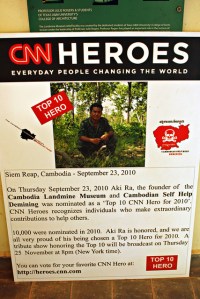
You can read Aki Ra’s own story on his organization’s website, but here is the text from the award given to him by CNN as one of 2010 Top 10 Heroes:

“On any given day, Aki Ra walks where others fear to tread in the remote villages of Cambodia. Dressed in protective gear, he takes careful steps, searching for one of the nearly six million land mines buried underneath the war-torn soil. For Aki Ra, this is his path to redemption. As a child, he was kidnapped to become a soldier with the Khmer Rouge and was taught to lay mines — planting as many as 5,000 every month. When peace finally came, he saw an opportunity to undo the damage he had done and he began to clear them. At first, he used his hands, knives, and other unconventional tools; now, he has formal training and leads the Cambodian Self Help Demining Team, which he created. Since 1993, Aki Ra has cleared more than 50,000 mines and unexploded weapons. He has also opened a museum so the world can see the damage that remains long after a war ends. He often meets children who are orphaned or have lost a limb to a mine and gives them a home at the orphanage he built next to that museum — there are 30 living there. Aki Ra teaches them that to move forward in this world they must “do good acts and love each other.”

His mission:
Aki Ra wants to make every village in Cambodia land mine-free. While the Khmer Rouge stole his childhood, he works to make Cambodia safe, secure, and strong so that every child has the chance to prosper. Aki Ra doesn’t believe the Khmer people should wait for others to clear the mines from their villages; he believes they should “do it for themselves.”

You can also check out CNN’s story on Aki Ra.

A couple of thoughts after visiting the museum and learning about Aki Ra: 1) Sometimes we take it for granted the ability to walk outdoors. In Cambodia, some of these ‘normal activities’ end up with people losing their limbs or even their lives because of things that were left from the war years ago. 2) It’s very inspiring to hear the story of a man who used his knowledge that was initially taught to him to harm others, but now he uses it to save lives. I wonder if sometimes he might get discouraged by the thinking that there are still so many of these landmines out there to clear, but I hope he’s also encouraged by seeing the lives that he’s impacted, the children who now can play freely out on the field after the landmines have been cleared, and the awareness he had spread to people like me who had never thought about this aspect of war.

The photo below was taken at the museum. It was the poster about Aki Ra’s nomination as CNN Top Hero in 2010.
Aki Ra

Cambodia Landmine Museum

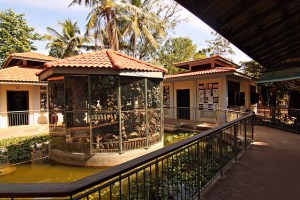
The Cambodia Landmine Museum is a unique museum located near Banteay Srei, northeast of Siem Reap, Cambodia. The museum was founded by Aki Ra, a former child soldier during the Khmer Rouge era who leads a group called Cambodian Self Help Demining, which has a mission of raising awareness of problem of landmines and go from place to place in rural Cambodia to clear the landmines that are still on the ground and can cause risk of injuring or killing someone when accidentally stepped on. These are landmines and unexploded ordnances left from the Vietnam War and Khmer Rouge years — there is still estimated around three million of these still to be cleared in Cambodia. The museum has exhibit that tells the life story of Aki Ra (who received CNN Top 10 Hero for 2010 award for his work), and educates the public about the problem that Cambodia is still facing as the result of the landmines that need to be cleared. The proceeds from the museum admission ticket goes towards funding the demining work and an orphanage set up to care for children who were victims of landmines.

We stopped at the Cambodia Landmine Museum after our visit to Banteay Srei. Our tour guide Vanna told us we had about an hour or so to visit the museum and look around. I wasn’t really sure what to expect. We started the visit with watching a short video explaining the problem of landmines in Cambodia. Since we started very early that day, by then (close to noon time) I was a bit tired, and I dozed off a little bit during the video presentation. But I did get the gist of the presentation. Then we spent the rest of our visit looking at the displays, which include artwork/sculpture done using the shells of disarmed mines. When we saw the display, these shells looked like little toys. No wonder that they looked interesting to little children in Cambodian villages who found them in the field while playing, and ended up causing death or kids losing their limbs to explosion. Definitely give a new perspective on the impact of war to a society, even years after the war was over.

The photo below was taken at the museum while we’re visiting. The middle display had shells of disarmed mines inside.

Cambodia Landmine Museum