
Chong Kneas is a floating village on the Tonle Sap Lake that has become a popular tourist destination for those who want to observe life on a floating village that is dependent on the most important lake in Cambodia. To visit the village, one must drive or take public transit to get to the port from Siem Reap (about an hour drive), then take a small boat from there to visit the village.
When we arrived at the port, one thing that was quite noticeable was how new the port building was, and it looked a bit out of place in comparison to the surroundings. Our tour guide Vanna explained that the port was pretty new — it was built a few years ago by a South Korean investment company that saw tourism there as a business opportunity. It used to be that one would get to the river bank and would have to find and haggle the price of a ride to visit the floating village with the boat driver. Now it all seemed to be organized at the port where there is a ticket booth where passengers would purchase tickets and then getting assigned to a particular boat.
While the new development sounded good on the surface to the visitors who want to avoid the hassle and the risk of getting ripped off, there was a controversy as some saw the coming of the foreign management company as bringing in the regulated system without consulting the people who rely on the boat tourism for their livelihood. Where it used to be competition among the boaters, now it’s regulated by the management company, and the boats are rotated. The equality means it’s good for some, but not for others. Tour operators also had mixed reactions to the development. Some welcomed the change that would help protect the visitors from getting ripped off, but others had already had business arrangements with local boaters to obtain fair pricing for their tour guests that now would have to renegotiated with the management company in the middle as part of the equation.
For us, since our visit was part of a tour package, we didn’t have to worry about getting the tickets. When we arrived at the port, Vanna asked us to wait at the entrance of the port while he went to the ticket booth and got the tickets for us. We didn’t ask how much we were charged for it; all we knew was that we had a chartered boat just for us: Kristi, myself, Vanna, and the accompanying boater. It might be interesting to find out out how much it ended up costing us per head, and out of that price, how much actually end up at the hands of the boater himself.
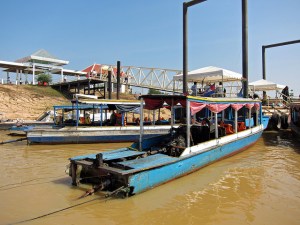
The photo below was taken from the boat overlooking the port, as we waited for our boat to leave the dock. You could see the port looked like being added on to the landscape, and you can probably imagine what it was like before the port was there with just the dirt river bank and the boats docked there.

 setiawanphoto