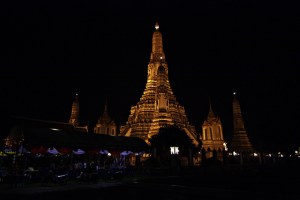
Wat Arun

Wat Arun is a temple located in Thonburi area on the west bank of the Chao Phraya River. The temple was named after Aruna, the Indian God of Dawn, because the first light of morning reflects off the surface of the temple and making it glow. The temple has been there since more than 300 years ago. During the time when Thonburi was the capital of the Thonburi Kingdom, the palace was located on the grounds of Wat Arun. It was the home for the Emerald Buddha statue until the capital was moved across the river to present day Bangkok and the Grand Palace in Bangkok was built. Today Wat Arun is one of the most recognizable landmarks in Bangkok as it can be seen prominently from the river.

During the night bike tour with the Grasshopper Adventures, we stopped at Wat Arun while riding in Thonburi area. The temple was closed at night, so we could only observe the architecture from outside. At night the temple was illuminated, so it still looked quite impressive. I thought it was interesting however, that the temple was located in a residential neighborhood, and there were many local residents hanging out around the temple. While we stopped and listened to our tour guide Tami telling us about the history of the temple, there were many local kids (5-10 year olds) playing around near us — some with their little bicycles even rode around with our group for a little bit. Many people were at the temple preparing floats and flower arrangements; apparently the following day was King Taksin’s birthday, so they were preparing for a ceremony to commemorate that. King Taksin was the Thai King when the capital was in Thonburi, and he was one who set up the royal palace near Wat Arun.

The photo below was taken from outside the temple. You can see the recognizable spires of the temple, and the area on the left was where the preparation for King Taksin’s birthday ceremony was taken place.
Wat Arun

Thonburi

Thonburi is an area in Bangkok, Thailand. Located on the west bank of the Chao Phraya River, it is an area that has its place in the Thai history. From 1767 to 1782, it was the capital of the Thailand under King Taksin, after the previous capital Ayutthaya was destroyed by the Burmese. In 1782, King Rama I took over power and moved the capital across the river to the present day Bangkok. Thonburi remained as an independent town and province until 1972, when it was merged into Bangkok metropolitan area.

During the night bike tour when we’re visiting Bangkok, we rode through Thonburi after crossing the river in a ferry. It was quite a contrast comparing the section of Thonburi that we visited to the Banglamphu area across the river. The Thonburi area was a quiet residential neighborhood that’s nothing close to the busy Khao San Road. The area that we passed reminded me to some residential area in Jakarta, Indonesia — small homes lining up on the sides of very narrow streets and alleys, some were not even wide enough to be accessible by cars. It was mostly quiet, in some homes we could see and hear residents watching TV, cooking dinners, or simply just enjoying the company of others — just a quiet night in a residential neighborhood.

I thought it was interesting to think about this place as the center of power at one point in Thailand history. I wonder if the present residents knew about that fact, and even if they did, if that really mattered much to them. Most of the neighborhoods we rode through seemed to be of a lower class economically, so I’m guessing thinking about the history was the last thing in their minds.

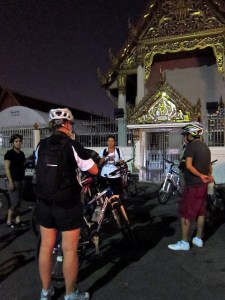
The photo below was taken when we stopped outside a temple in Thonburi. It was very quiet and somewhat dark in the area. Our guide Tami gave us a little history and culture lesson there.

Temple in Thonburi

Bangkok

The first city that my cousin Kristi and I visited during our Southeast Asia trip last year was Bangkok, Thailand. We decided to go to Bangkok as our first stop of the trip as it is a hub in Southeast Asia that provided us with more flight options for traveling to the next country in our trip, Cambodia.

In the last twenty years or so, Thailand has become a major tourist destination in Southeast Asia. The city of Bangkok itself has its charm with its palaces and temples, as well as the river and canals (that gave it a nickname ‘Venice of the East’). Many westerners (from Europe and America) come to Thailand also to visit its pristine beaches (Phuket, Ko Samui, Pattaya) and mountainous region (Chiang Mai). It is also rich culturally and historically, being the only country in Southeast Asia that was never colonized.

When we were planning our trip, we knew Bangkok was the most convenient gateway city to come into Thailand from Indonesia. We did consider visiting other parts of Thailand (particularly Chiang Mai in the north), but after considering the time that we had available, we decided to visit only Bangkok for this trip and leave the other places in Thailand for future trip when we can spend more time in this country.

Kristi had been to Bangkok before with her friends, but her experience before was limited mostly to accompany her friends shopping. For some, Bangkok is a choice destination for shopping as you can get some goods (garments, electronics) for lower price than elsewhere. In this trip, we decided to focus our time exploring the cultural aspect of the city, so it’s also a new experience for Kristi.

The photo below was taken at the Grand Palace in Bangkok. The stupas, spires, and statues are very distinct and recognizable landmarks in the city.

Grand Palace

Philadelphia

In the next few days, I will post entries about places in Philadelphia. Philadelphia is one of the major cities in the northeast region of the United States. It’s located along one of the busiest interstate highways in the country, Interstate 95, in between two other big cities, Washington, DC, and New York City. The city was founded in 1682 by William Penn (who also founded the Commonwealth of Pennsylvania). It was an important city during the American Revolution, as it was the meeting place for the Founding Fathers of the United States who wrote and signed the Declaration of Independence in Philadelphia on July 4th, 1776 and the US Constitution on September 17, 1787. The city also served as the temporary nation’s capital between 1790 and 1800 while the federal city of Washington, DC was under construction. Today, Philadelphia plays an important role as one of the major financial centers in the United States, and it’s also one of the largest health education and research centers in the country.

I first visited Philadelphia only to stop for lunch during a road trip between Washington, DC, and New York City. A few years ago, I spent almost a year traveling between Washington, DC and northern suburb of Philadelphia as I worked on a couple of projects for large healthcare companies in the area. I spent most of the time at work, however, so I didn’t get a chance to do touristy things until later after the projects were done. Since the location is not too far away from Washington, DC, area where I live (about 3.5 hour drive), it’s possible to do day trip to visit the city.

The photo below was taken when I visited the Independence National Historical Park in downtown Philadelphia a couple of years ago. It’s a statue of Philadelphia’s most famous resident, Benjamin Franklin, outside the American Philosophical Society building. Ben Franklin’s name is commemorated in many places in Philadelphia area — Ben Franklin Parkway, Franklin Institute — and rightly so, as he played an important role in the city and nation’s history. Franklin was instrumental in establishing some of the cities important services (e.g., its first fire department, library, and hospital). He also played important role in advancing science (he invented the lightning rod, bifocals, among others), and he also served as the Governor of Pennsylvania and as US Ambassador to France. Today you can also find his portrait on the US $100 bill.

Ben Franklin Statue

Trinity Church

Only one block away from the NYSE Building on Wall Street, there is another historical building that seems to be out of place with the tall buildings around. The Trinity Church, located at the corner of Wall Street and Broadway, was founded in 1697. The current building is the third building built on the same place in 1846. The architect of the building was Richard Upjohn, who was one of the co-founders of the American Institute of Architects.

The Trinity Church is one of the Episcopal churches in New York City. The church also has a chapel few blocks away from the main church building called the St. Paul’s Chapel. Opened in 1766, the St. Paul’s Chapel is the oldest surviving church building in Manhattan. George Washington worshipped at this chapel after his inauguration as the first President of the United States. In 2001, it became known as ‘The Little Chapel That Stood’ as it remained standing after the nearby World Trade Center twin towers collapsed during the September 11, 2001 terrorist attacks.

I’ve passed both the Trinity Church and the St. Paul’s Chapel when I did a walking tour around the Financial District. On one visit to the Trinity Church, I ended up not going in to see the church interior because there was a service going on. I did visit the churchyard next to the church. It was a nice oasis in the middle of the Financial District to retreat for a moment from the hustle and bustle of the city. One of the people buried there was Alexander Hamilton, the first United States Secretary of Treasury (his portrait appears on the US $10 bill).

The photo below was taken during my visit to the Trinity Churchyard. I noticed this cool reflection of the churchyard on the church’s door glass pane — an interesting perspective to see churchyard with the big office building next to it.

Trinity Church