Culture Almost Lost

Sometimes you take for granted the value of something until you realize that it was once almost lost, and that you’re fortunate to still be able to experience/see it. Such was my feeling after visiting the National Museum of Cambodia in Phnom Penh. The museum houses collection of artifacts from the rich Khmer history. Many of these were almost lost during the Khmer Rouge reign, as the regime attempted to erase the culture and history and ‘start over’ in the agrarian society that they envisioned.

I made some observations as I walked around viewing the exhibits. There were some groups of school students in uniform listening to young tour guides explaining the exhibit to them in Khmer. I think that was nice to see the young generation of the locals also coming to the museum to learn about their own culture and history, considering that most of them were not even born at time of the Khmer Rouge reign (more than 80% of Cambodian population was under the age of 30 in 2010).

There was also an exhibit explaining about an archaeological site in rural Cambodia where they found many artifacts from the golden age of the Khmer Empire. It’s interesting to read the story how the site was initially discovered. A farmer found some of the metal artifacts, and initially collected and sold them in the market as scrap metal. It turned out that the site was one of the richest archaeological sites ever excavated in Southeast Asia. One of the purposes of this exhibit was to educate people about the importance of these archaeological finds in learning about the history, and how it’s a loss for the society when the treasures fell into the hands of looters and art dealers. I think that would be a difficult concept to get people to adopt, especially when many people lived in poor condition and the short-term gain from selling those artifacts was more appealing than the long-term gain for the society from turning over the findings to the archaeological research groups.

As I walked through another section of the museum, I overheard a tour guide explaining some artifacts to a couple of foreign visitors in French. What’s interesting to observe was that the lady who guided the tour seemed to be a Cambodian in her 50s. That means she’s old enough to have gone through the Khmer Rouge era. Given her knowledge about the art history, I wonder if she was an educated person who fled the country before the Khmer Rouge era or if she was a survivor who lived through the Khmer Rouge time and managed to avoid being identified as educated and killed by the regime. Either way, I thought that was great to have someone from the previous generation who can help link the culture to where it was before the dark times.

So there it was, a brief visit to a museum that holds a nation’s treasure. It may not be as well known as what you find in other history museums in the world, but when you consider what this nation had gone through, this is definitely a collection that should be appreciated. I hope as the country becomes more developed and more of the Cambodian people become more educated and come out of poverty, these national treasures become more known and they can appreciate the richness of their own culture and history.

The photo below was taken at the front of the museum, as we wrapped up our visit to this museum. Notice the group of young people walking out in white shirts. Those were the students that I mentioned above.
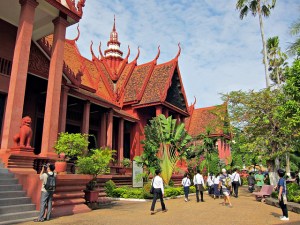
Students at the National Museum

National Museum of Cambodia

The National Museum of Cambodia in Phnom Penh housed a large collection of art work from the Khmer culture, dated back to the periods even before the Khmer Empire. This museum was opened in 1917, but during the Khmer Rouge era (1975-1979) it was abandoned. The museum building was left in disrepair, the roof rotten, and it became home to a vast colony of bats. In 1979, it was repaired and reopened to the public. As we visited the museum more than 30 years later, the museum was already back as an important place to learn about the Khmer art history.

As we entered the museum, the ambience inside the museum reminded me to the National Museum of Indonesia in Jakarta that I visited years ago. The museum building itself was an old building (93 years old, as compared to the Indonesian one that’s almost 150 years old), and it was also started by the colonial government that occupied the land when the museum was founded (the National Museum in Cambodia was founded by the French, while the National Museum in Indonesia was founded by the Dutch). The collections of art work were also similar that they represent the history going back to hundreds of years ago.

I think to really get an appreciation of the importance of the artifacts we’re seeing at this museum, we would need a guide and / or good understanding of the historical context of the culture and time where the artifacts came from. We were on our own and we only had short time to visit this museum, so unfortunately our tour at the museum was very cursory.

The photo below was taken at the courtyard inside the Museum. It’s nicely set up and felt very nice and peaceful to be there.

National Museum of Cambodia

Encounter with Poverty

When you’re visiting a developing country, especially one that had just emerged from years of civil war like Cambodia, you’re likely have to deal with the reality that many local people are struggling economically. I had read in the guidebooks and on people’s travel journals about encountering poverty in Cambodia, with many children begging for change from tourists. But I wasn’t really prepared to experience this personally.

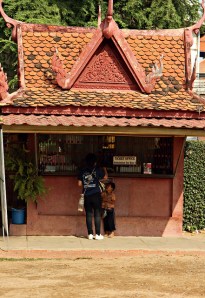
After finishing our tour of the Royal Palace in Phnom Penh, we continued the day with a visit to the National Museum of Cambodia that is located pretty close from the Royal Palace. When we arrived there, I went to the ticket office to purchase tickets. As I stood in front of the ticket counter to wait for our tickets, I felt a gentle tug on my shirt. I looked down, and under the ticket counter there was a little boy, looking at me with a sad face, asking for some change. This caught me off guard. I ended up looking back at the little boy, shook my head to say no, and walked away. He stayed there and waited for the next visitor to come.

Many guidebooks suggested to tourists not to give money to the child beggars, as in most cases, the children actually wouldn’t benefit from the money as they were taken advantage of either by their own parents or by other adults. They suggested donating through other means, like by supporting Non-Governmental Organizations (NGOs) that work with the street children to help them out of poverty. Logically that made sense, but emotionally it’s still hard to just walk away and not do anything for the little boy.

I took the photo below few minutes later from a little distance. The little boy stayed there at the ticket counter, and asked for money from the next visitor coming to purchase ticket. The person at the ticket counter didn’t do anything and let the little boy stay there.

Child beggar