Leaving Phnom Penh

After a good night rest following an emotionally exhausting day in Phnom Penh, we got up early to pack up and get ready for our trip from Phnom Penh to Siem Reap. This part of the trip was one that I was a bit worried about. According to the tour company that arranged our trip, we were supposed to be picked up by a tuk-tuk that will take us to the van terminal, where we would switch to the van that would take us to Siem Reap. After the false start that happened the day before, I was even more worried that if there is any miscommunication in terms of the pick-up, we might miss our scheduled van and end up having to wait for the next available departure to Siem Reap.

Our passenger van was scheduled to leave its terminal in Phnom Penh at 7:30 am, so our tour company scheduled to have someone picking us up at our hotel at 7 am. We were ready to go few minutes before that. The night before, I had already taken care of the checkout so all we had to do was to leave our room key at the front desk before we left. We also asked for take-out breakfast so we had something to eat in the morning even before the hotel restaurant opened.

Unlike the day before, to my relief this morning everything seemed to work like clockwork. We had our breakfast take out boxes ready to pick up at the hotel restaurant, and before we even finished eating our breakfast, a passenger van showed up and a gentleman asked if we were waiting to go to Siem Reap. I confirmed the name of the van operator, and off we went.

There were already three other passengers on the van when we were picked up. It looked like they went around to various hotels or guest houses to pick up some passengers before we depart for Siem Reap. I overheard the conversation among the passengers on the van. They all spoke English; from the accents I could tell that one person was American, one person was Australian, and the other person was European (not sure what country). This was the first trip to Siem Reap for all of them, and they were all quite excited to go (so did we) given that it’s close to New Year’s Eve. As I listened to their conversation, I figured out that the American girl was teaching English at a school in Phnom Penh. The other two passengers were backpackers. We stopped at another hotel not far from ours to pick up another passenger, a Japanese man who traveled alone. He had his backpack and a camera bag with him — looked like a serious photographer.

We stopped at the van company’s office near Psar Kandal. We got out of the van briefly to sort out which van each passenger would go into; there were apparently two vans that would be going to Siem Reap approximately at the same time. Kristi and I went into one van with the American girl and the Japanese man; the other two passengers went to a separate van. The passenger van had four rows of seats, and ours was almost full to the capacity with eleven people including the driver. Kristi and I sat on the second row with the Japanese man. Once we were seated, a lady came out from the van operator’s office with plastic bags full of snack boxes and bottled water. Each of us got one – that was our ‘in-flight snacks’ for the trip. Nothing fancy, but it’s actually better than what you get in American domestic flights these days.

We left pretty much on time. On the way out of Phnom Penh, we made one more stop at a guest house to pick up the last passenger, a British man, who took the last seat available on the front row next to the driver. After that, off we went on our trip to Siem Reap. So long Phnom Penh…

The photo below was taken from my seat on the second row, as our van was slowly navigating its way through downtown Phnom Penh on the way northeast towards Siem Reap.

Leaving Phnom Penh

Transportation to Siem Reap

After visiting Phnom Penh, the next destination in our Southeast Asia trip was Siem Reap, another area in Cambodia where Angkor Wat and other temples are located. To travel from Phnom Penh to Siem Reap, we considered several transportation options. The first option was to fly. This would be the fastest way to get there, but it’s also the most expensive, and there wasn’t much to experience on the way there. The second option was to take a boat. This was an intriguing option to consider, as it would definitely be a new experience for us. You could also see some village life on the river banks along the way. The cost was much cheaper than the airfare. However, some people who had traveled this route said being on the boat for four hours could get boring after a while, and the boats were not necessarily the most comfortable environment to be for that long of period. That brought us to consider the third option, traveling by land. This was the typical option taken by locals as it’s the cheapest and there were many options of operators to consider. Some travelers recommended this option because it also allows the travelers to mingle with locals, and you get to see countryside scenery along the way. There was also a stop in the middle so you could stretch and rest for a little bit before continuing the journey. It took around four hours to drive to Siem Reap, so time-wise it’s roughly the same as taking a boat.

Once we decided to travel overland to Siem Reap, then we had to decide which travel operator to use. We could either hire a private car, ride a passenger van, or ride a bus. The private car option was obviously the most expensive, and you get the whole car for yourself. It’s nice, but we wouldn’t get to mingle with locals as much. So we initially thought we would go by bus, as some of them had pretty extensive schedule, and supposedly they had restrooms on board, and even attendants. In the end, we ended up going with a passenger van as recommended by our tour company. They said the cost of going by bus was roughly the same as going by passenger van. The difference was that passenger vans typically end up traveling faster because they are smaller and nimbler than the buses.

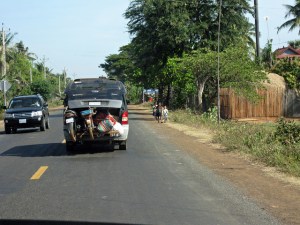
The photo below was taken during our van ride to Siem Reap. You can see in front of us another van / minibus going the same direction — that particular one had full cargo that included two motorbikes.

Travel to Siem Reap

Hope for Cambodia

As I mentioned in my post yesterday on Writing About Phnom Penh, it was quite challenging to write about my experience and thoughts after visiting the sites in Phnom Penh. It’s very easy to end the story at the negative side. However, during the process of learning more about what the Cambodians had gone through, I also found out about some Cambodians whose life stories provide inspiration and hope in creating a better future for Cambodia. I thought it would be good to finish the series of posts on Phnom Penh on a high note by providing pointers to their stories. Check them out; I think you would be inspired by them.

Sophal Ear
Sophal Ear is a professor at the US Naval Postgraduate School who works on economic development in post-war countries like Cambodia. He was born in Cambodia, and when he was young, his mother took him and his siblings out of Cambodia to escape the Khmer Rouge. I found out about him and his story when I was looking to learn about how the genocide victims deal with the topic of justice and forgiveness.

Check out his TED 2009 presentation about his family’s escape from the Khmer Rouge, his Oslo Freedom Forum 2010 presentation about the genocide in Cambodia, and his New York Times Opinion article about the Khmer Rouge Tribunal.

Kounila Keo
Kounila Keo is a young Phnom Penh-based journalist who uses her blog (the blue lady blog) as a means to speak up her mind about some contemporary topics in Cambodia. I came across her blog as I was reading articles about Sophal Ear. I think she has some interesting postings in her blog that gives us a look at Cambodia from the perspective of one of its young, educated people.

Check out her blog postings with her thoughts about what young Cambodians can do for their country, her thoughts after visiting Germany about what the Cambodians can learn from the Germans about reconciliation after genocide, and her impressions after her first visit to the United States.

Ponheary Ly
Ponheary Ly is a teacher and tour guide in Cambodia who used her earnings to educate poor children in the rural area. I first learned about her and her work when reading a travel blog of an American lady who met Ponheary during her first visit to Cambodia and had come back a couple of times to volunteer.

Check out a CNN Hero of the Week profile honoring her work on improving the welfare in Cambodia through education.

The photo below was taken at Choeung Ek as I rested after an emotionally exhausting visit. We were sitting under the shade of a couple of trees, with nice breeze gently blowing. In front of us we saw the memorial stupa in the background, and a Cambodia flag flying in front. I thought that was a wonderful symbolism of the hope for a peaceful future for the people of Cambodia.

Hope for a peaceful future

Writing about Phnom Penh

If you’ve been reading the posts on this blog from the few weeks, you might have noticed that the majority of the posts were about the places I visited during the one full-day we had to do a day trip in Phnom Penh, Cambodia during my trip to several Southeast Asian countries with my cousin about a year ago. The reason why we included Phnom Penh in our itinerary in Cambodia was to learn about the country’s history. We did accomplish that, but what I personally didn’t expect was the impact it had on me after the trip was long over. So, before continuing on with more blog posts from other places we visited during this Southeast Asian trip, I thought I’d write a little bit about my experience remembering, processing, and reflecting about this one day visit to Phnom Penh.

A travel writer named Dave Fox wrote in a book called Globejotting about the meaning of the word souvenir as a remembrance (or something to remember an experience with). Coming into this trip, I had an objective of creating a photojournal about the trip that I could use to tell the story about my experience as I visited places and experienced the culture. So, during this trip, in addition to taking photos, I also took short notes using my Blackberry so I would remember the interesting details I learned from the visit or those that are important to remember (like the names of the people we met).

When I got back home in the United States and worked on the photojournal, the short notes were very helpful in remembering the details of the trip, as without it, I would’ve mixed up many details that were somewhat similar between places we visited (e.g., there is a wall with ramakien frescoes at the Grand Palace in Bangkok, and there is a similar looking wall with ramaketi frescoes at the Royal Palace in Phnom Penh). The one photojournal I wanted to create ended up to be too big to have as one album, so it ended up getting split up by cities that we visited. I was quite happy with this souvenir once it was done (around 600 photos divided into eight albums), but as I went through the process of putting together the captions to go with the photos, I realized that while a photograph may ‘speak a thousand words’ there are some things that it cannot convey (e.g., feelings, thoughts). So then I thought may be it would be an interesting exercise to take the short notes and the photos (including the thousands that didn’t quite make the cut for the photojournals) and retrace my steps during the trip and recount the experience in writing.

There is a site called TravelBlog that is similar to WordPress as a blogging site, but it’s specifically oriented towards travels (e.g., it’s indexed by travel locations). A lot of people use it to blog as they travel to provide a nice update to people they know who want to follow their journey as it happens (very nice especially for folks who are doing epic journeys like the Round the World travels). In my case, I didn’t use it during my actual travel, but I thought it would still be nice to write entries about my daily experiences during the trip after the fact.

I started writing the entries, and it went fine until I reached the day in Phnom Penh. The challenge with this one day is because of the emotional nature of the experience, and recounting the horror seen at Tuol Sleng and Choeung Ek was very difficult. If you go to TravelBlog and read entries from people who visited these places in Phnom Penh, the majority of them would either simply post photos they took there, or only summarize their experiences with words like ‘sad’, ‘angry’, ‘depressing’, or ‘appalling’. If you know even only a little bit about these places and their role in the Khmer Rouge genocide, those are the right words to describe these, but someone reading the story wouldn’t necessarily know much or learn about it beyond that. So rather than simply doing the same thing, I tried to write down more descriptively what I saw and experienced there, and added relevant facts around it so even those who had not heard of the Khmer Rouge atrocities (like I was prior to the trip) would at least take away something after reading it.

The process of writing the ‘one day travel entry’ for Phnom Penh ended up taking me almost three months to do. I could picture the experience very clearly in my head, but it was very difficult at times to find motivation to sit down and put those in writing, especially when it’s difficult to find words to express what I felt about it. In some cases, I ended up browsing through sites on the Internet to learn more about the historical aspects of this and the impacts it had on people, rather than writing the entry itself. It also caused me to reflect on what I think and believe about some very difficult topics that the Cambodian people had to struggle through, such as the idea of forgiveness and retribution, and how to deal with hardships.

In the end, I did manage to finish writing about that one day in Phnom Penh, and in the last few weeks, the posts in this blog, especially those that are related to Tuol Sleng and Choeung Ek, were largely based on what I wrote last year.

The photo below was one that I ended up selecting as the cover photo for my photojournal on Phnom Penh in flickr. It’s the memorial stupa at Choeung Ek that from far away it looked quite majestic, and served as a wonderful way to honor the victims at this site (it housed the remains of the victims found in the nearby mass graves).

Memorial Stupa

Romdeng

We got back to our hotel around 4 pm after our day trip in Phnom Penh, Cambodia. It’s still too early to go for dinner, and we were exhausted mentally and emotionally after the day’s experience. So we decided to spend a couple of hours to rest and take it easy for the rest of the day.

For dinner, we decided to go to a restaurant called Romdeng. The restaurant was highly-rated for its authentic Khmer food. It was also unique as it served as a training restaurant run by an NGO to help street kids learning skills to work in hospitality / restaurant business.

Just like the previous night, we went outside our hotel to get a tuk-tuk to take us to the restaurant. The tuk-tuk driver from the previous night was not there, but there was another driver waiting for passengers out there. This time I discussed the price for the ride with the driver ahead of time.

The restaurant was only about 15-minute tuk-tuk ride from our hotel. On the way we got to see more of the night life in Phnom Penh. There were local street-side restaurants everywhere, similar to Bangkok and Jakarta. Romdeng itself was situated on a side street. The restaurant was housed in a big, old house. There were some tables outdoors under the trees, and there were some indoors in air-conditioned rooms. We were seated inside, and the ambience was pretty nice. The walls were decorated with artwork made by some of the students that the same NGO supported.

Since Romdeng was a training restaurant, the service was quite interesting. We had several people taking turns serving our table; the servers were mostly students who came with their teachers to our table. The students would do most of the work while their teachers observing their work. At times the students were not sure on how to respond to the customer’s request, so they would ask their teachers to help. At our table, the students did very good job in serving us. I could tell that some were being extra careful in doing their job as they knew their teachers were watching.

The food at Romdeng was very good. One particular dish that was popular among the foreigners who dined at Romdeng was a local delicacy that might be too extreme to try for many: the deep-fried tarantula appetizer. Cambodians started eating this out of necessity during the hard times, but over time it became a delicacy. We decided to give it a try. It turned out that it tasted not as bad as it looked. It tasted like eating chicken liver. It was cooked similar to Indonesian way of deep frying chicken liver and gizzard, with turmeric, coriander, and soy sauce to spice it up. So after the first bite, it wasn’t really that bad or scary for us.

We also had a refreshing salad dish and a fresh water fish dish. Both dishes were good. To close, we ordered a couple of desserts, a rice flour and turmeric crepe with caramelized banana filling and coconut gelato topping, and banana-filled rice dumplings with palm sugar syrup. The crepe was a great ‘east meet west’ dish. The rice balls were good as well, but they were too filling to have after the meal.

As we paid for our bill, we were asked to fill a survey to rate our dining experience. I thought that was a good way to provide feedback to the program. Judging from our own experience and the other patrons at nearby tables, I think everyone was satisfied with their dining experience. I know personally I would definitely come back to Romdeng the next time I’m in Phnom Penh again.

The photo below was taken as we’re about to try the first dish delivered to our table… the aforementioned deep-fried tarantula appetizer. As you can see, it’s presented quite nicely, though you can still tell those are tarantulas that we’re about to eat.

Deep-fried tarantula