History Triangle

The area around Williamsburg is also known as the History Triangle as there are three places where important events in the American history happened. Jamestown is the site of the first British settlement in the new world. It was the first capital of the colony of Virginia until it was moved to Williamsburg. Williamsburg then served as the capital of the colony for several years. Yorktown entered the history due it’s strategic location from maritime perspective, and it was the place where the British troops surrendered that led to the end of the American Revolutionary War and the United Stated became gaining recognition as an independent nation.

Today history buffs can come to the area and spend some time to learn and relive history by visiting these three places. They are connected through a route called the Colonial Parkway, so you can easily drive between the places. Alternatively, you can also park your car at the Colonial Williamsburg Visitor Center, and take shuttle bus to visit the three places.

During my day trip to the area, I arrived at the Colonial Williamsburg Visitor Center right before it opened around 9 am in the morning. I considered trying to visit the other sites on the same day, but later I decided to just spend the day in Williamsburg and attend the special events that went on throughout the day as part of commemorating the siege of Yorktown.

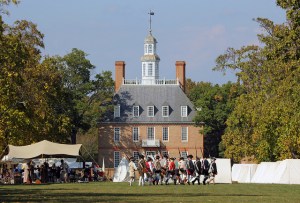
The photo below was taken right at the heart of Colonial Williamsburg. You can see the governor’s palace at the end of the grassy area, and a reenacted encampment of the Continental Army to commemorate their stay in Williamsburg prior to going to Yorktown.
Governor's Palace

Day Trip to Colonial Williamsburg

Williamsburg, Virginia, is a city located about 3.5 hour-drive away from Washington, DC. The city was the capital of the Colony of Virginia before it was moved to Richmond. It is the home of the second oldest college in the United States, the College of William and Mary. Part of the city is known as Colonial Williamsburg, where an area consisting around 50 buildings has been preserved from the Colonial era. It serves as a living interactive museum as life from that era is reenacted by actors daily.

I had heard of the Colonial Williamsburg since a long time ago, having lived in Virginia for several years. However, I had never visited the place until earlier this fall when I made a last minute trip on Saturday. I found out that during that particular weekend, they were going to commemorate the preparation before the American troops went on to nearby Yorktown to attack the British under General Cornwallis. The siege that happened in Yorktown was an important event during the American’s fight for its independence as it marked the surrender of the British troops during that war.

I did not grow up and go to primary or secondary school in the US, so I never really learned about the US history. During this visit to Colonial Williamsburg, I learned some interesting historical facts and about some important figures from that era. So in the next few posts I will write about that day trip to Williamsburg.

The photo below was taken in the Colonial Williamsburg area. You can see here the actors and volunteers reenacted the American troops marching into Williamsburg following General George Washington, on their way to Yorktown. For a moment, you can be transported to that era and feel that you are reliving the history.

Colonial Williamsburg

Shenandoah

Shenandoah National Park is the nearest of the 58 US national parks from my home, around 60 miles away. As such, it’s a great place to go for weekend outdoor activities when the weather is nice. The main route through the park is the Skyline Drive, which stretches around 100 miles from the north entrance to the south entrance of the park. There are a couple of highways that cut across the park, so you can also enter or exit the park at those points instead of coming or going all the way to the end.

Most people visiting the park stay only on the Skyline Drive. It has many nice lookouts where you can stop and enjoy the scenery. But if you’re physically able and have the time, I think you can enjoy the park even more by hiking through some of the 500 miles of trails within the park. Some of these trails take you to places with scenic views of the Shenandoah Valley, while others take you to waterfalls and streams. About 100 miles of the legendary Appalachian Trail goes through Shenandoah, so you might meet hikers in the middle of doing that epic journey. During the hike, you might also encounter the wildlife, from deer to wild turkey, rabbit, or even black bear. So for nature photographers who live in DC area, this is one of the popular photography destinations nearby.

The photo below was taken from a lookout on Skyline Drive in the morning, not long after the sunrise. You could see some of the clouds and fogs still covering the lower altitude area in the valley.

Morning at Shenandoah

South River Falls Trail

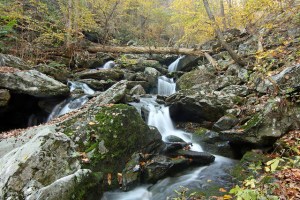
Today I went hiking at the Shenandoah National Park with some friends. We went on the South River Falls Trail, a trail close to the southern end of the Central District of the park. The trail went downhill for about 2.3 mi towards the South River Falls, the third tallest waterfall in the park at 83 feet. The fall foliage was still pretty nice on the trail, though on higher grounds, the leaves had almost completely fallen. Coming back we decided to follow the fire road all the way to the Skyline Drive. It’s roughly similar distance compared to going back on the original trail, but it was a little easier uphill hike. The photo below was taken at the stream close to the base of the waterfall.

South River Falls Trail

Rose River Trail

Another nice hike to do during the fall time at the Shenandoah National Park is the Rose River Trail. I went there last year also in October, a week after my hike to the Hawksbill Summit. Since the elevation for this trail is lower than Hawksbill Summit, the fall foliage was still closer to the peak along this trail. The beginning part of the trail was a walk through the woods, then followed with a walk along a river for quite some time, There were many small waterfalls to see along the way. The photo below was taken around the beginning of the hike. This was my first attempt at HDR photography — couldn’t resist given the wonderful colors of the foliage and the nice morning lighting.

Rose River Trail