Acadia National Park

Acadia National Park is a wonderful place to visit in Maine to experience the beauty of nature. The park is located on Mount Desert Island, which is reachable from the mainland through a bridge. Most visitors stay at the town of Bar Harbor, which is located just at the edge of the park. The park is a popular getaway destination in the Northeast United States especially during the summer months and early fall when the fall foliage is at its peak. The park is the oldest national park east of the Mississippi. It has a wonderful one-way road called Park Loop Road that goes around the park on the coastline — the landscape was beautifully designed by Frederick Law Olmsted Jr, who was also the landscape designer of the National Mall, the White House grounds, the Jefferson Memorial, and Rock Creek Park in Washington, DC. There is also a network of old carriage roads that was financed by John D. Rockefeller, Jr., and now provides a nice network of trails to explore the park.

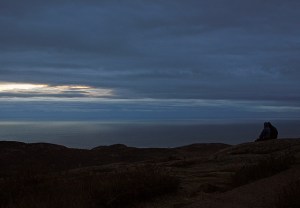
There is one cool place to check out and experience if you go to Acadia — going to the Cadillac Summit, the highest point along the eastern seaboard of the United States, in the morning to see the sun rising over the horizon. During the months of October through March, this place has the distinction as the first place to see the sunrise in the United States. The photo below was taken when I went up there to experience the sunrise on my first morning at Acadia. It’s a neat picture of the sun rising over the horizon on the left, and on the right there was a couple sitting bundled up and enjoying the view.
Sunrise at Cadillac Summit

Bass Harbor Light House

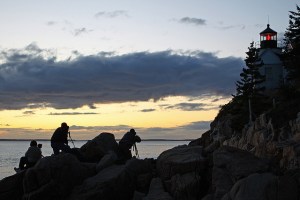
One of the famous landmarks in Maine is the Bass Harbor Head Light House near Acadia National Park. It’s one of the most photographed lighthouses in New England, which means that if you go there to take the iconic photos at sunset, it’s very likely that you will not be the only one with that great idea. I arrived at the location about a couple of hours before the estimated sunset time, enough time to look for the spot to take the iconic shot of the lighthouse. There were already a couple of other photographers getting set up, so I found a spot on the rocks to get my tripod and camera ready for taking the shots. I thought all was great, until more and more people arrived as we got closer to the sunset time. Some were respectful of the photographers who were already there, and picked spots on the side that would not interfere with the view of the other photographers. But there were only limited room to ‘spread out’ so before long people started jockeying for positions to take photos, even if that meant obstructing others’ view. Somewhat annoying, especially for those who had come earlier to find good spots to set up. After some positional adjustments and using a zoom lens to limit the view to only the lighthouse, I was able to get some shots of the lighthouse. But then I thought of an interesting point of view — rather than ‘fighting’ the other photographers, why not capturing that very experience of having photographers taking photos of the landmark. So I took few steps back, changed my zoom level, and shot the photo below.

Bass Harbor Head Light House

New England

After finishing the coast-to-coast road trip from Santa Monica, CA, to Brooklyn, NY, I continued on up north to the New England area. Our coast-to-coast road trip took place in early October, and since I already took several days off from work, and I was already in New York City, I thought why not continuing the trip to visit New England during its peak fall foliage time. Prior to this trip, I had only visited Boston, MA, for business trip. I had never been to the other New England states. So this was a good opportunity to do it, and I decided to ‘sample’ all of the New England states in one extended weekend.

The route for the trip was quite an ambitious one, covering Vermont, New Hampshire, Maine, Massachusetts, Rhode Island, and Connecticut in only four days. But since I was traveling alone (initially I invited my brother to come along, but he had some events to prepare for immediately after getting back to New York), my schedule was somewhat flexible and I could push it as far as I could personally take. The trip ended up to be a wonderful one as I got to experience many things unique to the region — fall foliage, maple syrup, lobster, history — capping the longest road trip I had ever undertaken, around 5,300 miles covering 22 states from California to Maine in 10 days.

The photo below was taken on the Park Loop Road in the Acadia National Park, ME. I had purchased the car about one month before the trip, and this trip was its first road trip outside the DC metro area. On a morning drive through the gorgeous drive, I noticed this stretch of the road that was lined with colorful trees, and the road had a nice S curve. It was early enough that there was no traffic for few minutes, so I ‘staged’ my car and took the photo.

Fall drive in Acadia

Route 66

Two years ago, I had an opportunity to do one of those ‘once in a lifetime’ trips. My brother was moving from Santa Monica, CA, to Brooklyn, NY. He had some belongings that couldn’t easily be carried in a flight or shipped, so he thought of renting a car for one-way drive from West Coast to East Coast and asked if I would like to join him in this road trip. While I had been to many places between the two coasts of the United States, this trip sounded interesting simply because it’s going from one end to another in one trip. There were many routes that we considered, until finally we decided to take one that partly going through a legendary route, Route 66.

Route 66 was an old route connecting Chicago, IL, in the Midwest to Los Angeles, CA, in the West, back in the early days of automobiles before the Interstate Highway system was built. There were many little towns within the route that made their living from providing services to travelers. For many of the travelers, the journey in itself was the attraction as back then not many people traveled extensively from their homes. Today with the emphasis on efficiency and going to the destinations, most people would focus on getting to their destination in the shortest amount of time possible (thus, the invention of the Interstate Highway system which is intended to provide a high-speed route that connects major cities in the United States). This contrast between then and now was portrayed well in the Pixar animated movie Cars. The movie’s story, its characters, and even some of the places and landmarks were based on real-life places and characters that the Pixar crew met along the Route 66 when they did research prior to making the movie. Prior to our trip, I did some research on these locations, and made them part of our road trip’s route.

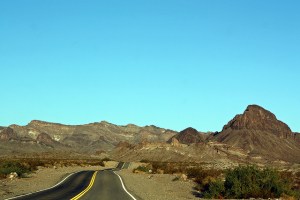
The result was a memorable experience of seeing places that otherwise we would’ve ignored or skipped. The photo below was taken in Arizona on the old road that was part of the original Route 66. Today the Interstate Highway cut through the area and made the distance shorter for those traveling east-west. At the same time, it pretty much ‘killed’ the original route that went through the mountains. Now you only find ghost towns and places selling memorabilias from the old days on this route. If you’re reading this post and are interested in doing the trip of your own, you can take a look at my photo album on flickr to give you some ideas on places to visit along the way. There is also a list of resources to plan for the trip at the end of the photo album.

Old Route 66 in Arizona

South River Falls Trail

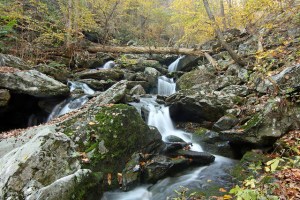
Today I went hiking at the Shenandoah National Park with some friends. We went on the South River Falls Trail, a trail close to the southern end of the Central District of the park. The trail went downhill for about 2.3 mi towards the South River Falls, the third tallest waterfall in the park at 83 feet. The fall foliage was still pretty nice on the trail, though on higher grounds, the leaves had almost completely fallen. Coming back we decided to follow the fire road all the way to the Skyline Drive. It’s roughly similar distance compared to going back on the original trail, but it was a little easier uphill hike. The photo below was taken at the stream close to the base of the waterfall.

South River Falls Trail