Victory Gate

The Victory Gate is one of the five entrance gates into the ancient fortified city of Angkor Thom in the Angkor Archaeological Park north of Siem Reap, Cambodia. Four gates, one for each cardinal point, lead to the temple of Bayon at the center of Angkor Thom. There is another gate on the east side that leads toward the royal palace. The East Gate from Bayon is also known as the Gate of the Dead, as it was used as the gate where the body of the dead kings were taken out from the city for the last time. The East Gate towards the palace is also known as the Victory Gate, as it was the gate used by the Khmer army to enter the city after a victorious battle campaign.

Each gate has similar architecture design. There is a causeway across the moat that surrounds the wall of the city. On the sides of the causeway you can see a row of devas (demi-gods) on one side and asuras (demon / giants) on the other side, each holding the body of a naga (serpent). This represents the scene from the Hindu myth the Churning of the Sea of Milk. Above the entrance gate, there is a 23 m high tower with faces similar to those seen at Bayon.

We stopped at the Victory Gate before entering and exploring Angkor Thom. Our guide Vanna pointed out the devas and the asuras from the myth. The day before he actually told us the story of that myth when we saw the bas reliefs at Angkor Wat. Honestly I couldn’t follow the story as there were many turns in it, and there were so many names mentioned that I couldn’t keep up on who’s who. Later on I found an online text retelling the story (as well as the explanation on the symbolism behind it), and after reading it slowly, now I think I kind of get it. The main scene of the story was the tug of war between the devas on one side and the asuras on the other, both holding the long serpent, and in the middle there is a mountain that serves as the churning rod to churn the ocean. At the Angkor Thom gate, it’s like this scene was depicted in quite large scale; you have the large devas and asuras on both sides of the causeway, and the gate’s tower in the middle in a way is like the mountain at the center of the churning scene. Another interesting observation was that there were many names in the story that sounded familiar to me: Indra, Candra, Vasuki, Vishnu, etc. These are names of Hindu gods that were adapted into common people’s names in Indonesia back when the Hindu influence was strong there.

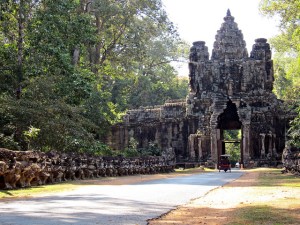
The photo below was taken from the causeway leading into the Victory Gate. You can see the row of devas on the left side of the road, and the tall tower / gate in the middle. As size comparison, you can compare them with the tuk-tuk that was about to go through the gate.
Victory Gate

Angkor Thom

Angkor Thom is a walled city complex in the Angkor Archaeological Park north of Siem Reap, Cambodia. The city was built by King Jayawarman VII in the 12th century, and the city was the capital of the Khmer Empire for several hundred years until it was abandoned sometime before year 1609. It is believed to have sustained a population of 80,000 – 150,000 people. The complex is about 9 km2, shaped in a square (3 km x 3 km), with five gates (one in the north, west, and south sides, and two in the east side). The surrounding wall is about 8 m high and flanked by a moat. Inside the complex, today visitors can find ruins of several temples and the royal palace and terrace. At the center of the city is the temple of Bayon, famous for its towers with their stone faces.

Our first encounter with Angkor Thom was during the drive from Angkor Wat to Banteay Srei. The modern highway actually goes through Angkor Thom. We entered through the South Gate, drove to the center past Bayon, and continued through one of the East Gates knows as the Victory Gate. We came back again and stopped at several parts of Angkor Thom on the way back after we visited Banteay Srei and Ta Prohm earlier in the day.

The photo below was taken as we drove throught the East Gate known as the Victory Lane. It was the entrance where the victorious Khmer army would march into the city after winning battles against their neighboring enemies (like the Chams). As we drove through the Victory Lane, I couldn’t help trying to imagine what it would like with thousands of people lining the entrance welcoming their victorious troops.

Victory Lane

Amok trei

After visiting Ta Prohm, it’s time for us to take a lunch break before continuing our visit in the Angkor Archaeological Park outside Siem Reap, Cambodia. Instead of taking longer time to drive to Siem Reap for lunch and back, our tour guide Vanna suggested that we should go to a restaurant located not far from Ta Prohm called the Khmer Village Restaurant. By the time we arrived at the restaurant, it was already 1:30 pm or so, so some of the lunch crowd had already left, but the restaurant was still quite full. Given its location pretty much inside the Angkor Archaeological Park, you could tell that it catered mostly to the visitors of the Park.

We wanted to try another traditional Khmer dish while we were there, and one dish I read that is a popular dish in Khmer cuisine is amok. Amok is a curry dish with coconut milk-based gravy that is cooked in banana leaves. It can be served with various kinds of meats, but the popular one in Cambodia is with fish, called amok trei. I wasn’t sure what kind of fish was used for ours, but I’m guessing it’s likely from fresh water fish like most things in Cambodia. When the dish was served and we tasted it, like some other dishes we had in Cambodia, we could taste something new and unique to Khmer cuisine, but at the same time it seemed familiar as parts of the dish were similar to dishes we have in Indonesian cuisine. I think it was somewhat like in between gulai (the gravy was not as thick and strong flavored) or opor (it wasn’t as soupy). It also resembled a Thai curry dish — not surprising given the regional influence of these cultures on each other.

The photo below was the amok trei dish that we had just before we tried it out. It wasn’t served in banana leaves container, but it had all the flavors that you would expect.

Amok trei

Ta Prohm

Ta Prohm is a temple in the Angkor Archaeological Park north of Siem Reap, Cambodia. The temple was built in 11th century by King Jayawarman VII, the same king who built the city of Angkor Thom nearby. This temple is famous among the temples in the Angkor Archaeological Park given that it had been consumed by the nature around it. Trees and vegetations grew on top of the ruins. The French organization that worked on preservation of the Angkor temples in the early 20th century decided to leave Ta Prohm alone as an example of how nature took over the land from man-made structure after centuries. In more recent years, this temple was also made famous by the movie Tomb Raider with actress Angelina Jolie, as scenes of the movie were filmed there.

We visited Ta Prohm in early afternoon before we went for lunch. The traffic near Ta Prohm was still pretty heavy, but it was better than the hours before or after that as many visitors were at lunch around that time. Along with Angkor Wat, this was one of the main sites we wanted to visit given its unique scenery. It was quite surreal to see large trees standing firm on and around the temple ruins, as if they were in the process of ‘eating’ the structure. We also found the spot where the famous scene of Angelina Jolie coming out of the temple ruins was filmed for Tomb Raider. It was quite easy to locate, as there were many visitors around there waiting to ‘reenact’ Angelina Jolie’s scene and got their photos taken. We didn’t do the same, but I did take a photo of other visitor doing the reenactment.

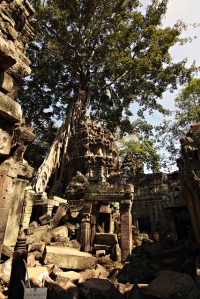
The photo below was taken inside the temple complex. You can see the big tree standing on top of the temple ruins, looking like they are well integrated with each other.

Ta Prohm

Education in Cambodia

After visiting the Cambodia Landmine Museum, we continued our day trip heading back towards the Angkor Thom area. The drive back from Banteay Srei took about an hour. During the drive, I had good conversation with our tour guide Vanna. One of the topics was about education in Cambodia. The conversation started as I noticed we drove passing groups of students in uniforms either walking or riding bicycles on the side of the road.

Vanna said that the students could either be on their way to or from the school. I asked if there was a typical school hours there. Vanna said it’s not always the same. In some areas, since there were more students than teachers available, they would split the students into groups that come to school in the morning and those that come to school in the afternoon. I asked if public education was readily available. Vanna said that it would depend on the area or province in the country; some provinces like Siem Reap had better funding because the economy was doing better, so in those places you could find more schools reaching the villages in the area compared to other provinces. There are schools at the primary/elementary level and those at secondary level. There were more primary level schools than secondary level schools — in many cases when students moved up to the secondary level, they would have to go to schools that are located quite far from where they live. Vanna said when he went to high school, he would ride his bicycle every day for about 20 km to get to his school. He also was able to continue on to the university, studying in Phnom Penh.

But he said his experience was not as common as he would hope for. For a lot of people, there was economic barrier to get children educated. Many families couldn’t afford to buy uniforms and school supplies for their kids, or later on, they couldn’t afford to get bicycle for transportation to go to schools that are far away from their home. So as the result, the children ended up not going to school and working starting at early age. Another problem in some more rural areas is the danger of landmines in the fields around villages. I just couldn’t imagine having to fear about stepping on landmines on the way to school… This is where NGOs like the Cambodian Self Help Demining Team and the Ponheary Ly Foundation helped their own society by improving the safety and providing the opportunity for the children to get education.

I compared that story to my own experience growing up and going to school. I experienced going to school in two different countries, Indonesia and the United States. In Indonesia I went to a private school, but we had regulation that required all students whether at public or private schools to wear uniforms, similar to the students in Cambodia. I had to go to school on my own, but since I lived in downtown Jakarta, I took public transportation (buses) to go to or from school. Later on, I also had the opportunity to experience education in the United States as a high school exchange student. There I lived with my host family about 25 miles away from my school, but every day we had school bus coming to pick us up before school, and take us home after school. I felt very fortunate and thankful that I was able to get the education in much easier way than what the Cambodians had to go through.

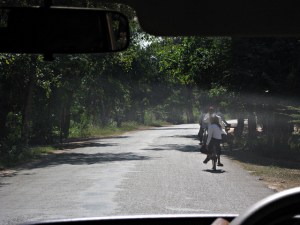
The photo below was taken as we drove past several students in uniforms riding bicycles on the side of the road.

Cambodia students