Sunrise at Angkor Wat

After a good night rest following a long day that started with a trip from Phnom Penh to Siem Reap, followed by a visit to Angkor Wat and Phnom Bakheng, and completed with attending an apsara dance performance over dinner, we’re ready for another day full of activity in Siem Reap area. We started very early in the morning, leaving our hotel around 6 am when it’s still dark. The first activity of the day, back to Angkor Wat to watch the last sunrise of year 2010.

This activity was as popular among tourists as going to Phnom Bakheng to watch the sunset. It was still dark when we arrived at the entrance gate to the Angkor Archaeological Park, but we could tell that it would be quite a crowd judging from the line of cars waiting to get the entrance passes checked by the officials.

When we arrived inside the Angkor Wat complex, there were already many people in there, mostly waiting near the pond in between the library and the main temple building. That seemed to be a popular spot to wait for the sunrise as from there you could see the silhouette of the temple with the sun rising behind it, and the temple reflected on the pond.

The area near the pond was already full of people, so I decided to set up my camera and tripod a little bit further to the side so I had room to capture the image with long exposure at low light with the tripod support. It worked pretty well, though there were several takes that had to be redone because I had people walking in front of my camera setup as they didn’t realize I was taking photos there.

After a little while, the sun had been rising for a few minutes and it’s getting brighter. Many people had left the pond area, so Kristi and I decided to get closer there to take photos of the temple reflected on the pond. I was able to still get the effect of sun rising by changing my shutter speed to be very high. That allowed me to take some photos like one below without the aid of tripod — very helpful as there were people around me that made it difficult to do any set up at all that require space. It was a great experience, and I was glad that it was a nice, clear sky and we could see the sunrise nicely as we hoped for.

Sunrise at Angkor Wat

Apsara Dance

The apsara dance or the royal ballet of Cambodia is a form of performing arts established in the royal courts of Cambodia. Traditionally it was performed only on special occassions and ceremonies. Like many other forms of art in Cambodia, this traditional dance was almost lost during the repression of the Khmer Rouge. Fortunately it became popular again in 1980s and 1990s. Today when you’re visiting Cambodia you can find dance performances at places in Siem Reap and Phnom Penh.

After visiting Angkor Wat and Phnom Bakheng, we closed our day with a dinner show arranged by our tour company. We went to a restaurant with a large dining hall with a stage at one end, serving international-style buffet dinner. After most people got their dinners, a dance troupe performed several dance routines on the stage, a combination of classical and folk dances. Kristi and I were seated at a table not far from the stage, so we were able to enjoy the dance performances from a pretty good distance.

The dance performance was quite good, and at the beginning of each routine, a narrator provided us with a little description of the dance routine we’re about to see. Thought personally I’m usually not that interested in watching dance performances, I thought this was a good experience nevertheless since I had never seen it before, and they did very good job performing it. Later on Vanna said that these dancers went through quite rigorous training and selection process, so those who actually made it to the troupe are usually very good.

The photo below was taken during one of the dance routines. I used my 24-70 mm f/2.8 lens, taking the photo from my seat without the flash firing with the camera set with shutter priority at 1/125. It turned out pretty well and I was quite happy with the result.

Apsara dance

Sunset at Phnom Bakheng

Phnom Bakheng is a temple in the Angkor Archaeological Park near Siem Reap, Cambodia. The temple is located on top of a hill, thus from the temple one can get a nice panoramic view of the surroundings, including Angkor Wat not far away from there. This temple is one of the oldest in the area, being built in late 9th to early 10th century. Today it is becoming a popular place to go especially around sunset time. Given its age and the high volume of visitors, it is among the most threatened monuments in Angkor.

We went to visit Phnom Bakheng right after finishing our tour in Angkor Wat. It was a pretty short distance to go from Angkor Wat to the base of the hill where Phnom Bakheng was located. From there, we joined hundreds of other visitors hiking up the hill (about a mile or so) towards the temple. When we get to the base of the temple, our tour guide Vanna told us that he would wait there while Kristi and I climb up to the temple. He’s been there many times, and there were so many people going up there that he said it’s better for him to just wait there while we go up and enjoy the panoramic view.

The steps to climb up to the temple were quite steep; we had to go up very very carefully. Once we got up there, we saw so many people already waiting for the sun to go down. We followed suit and just waited, and took photos around the sunset time just like everyone else. I lost my directional bearing while up there and couldn’t really locate where Angkor Wat was, as I was hoping to be able to see Angkor Wat complex from higher elevation. Only later on after I got back to my hotel and looked at the area map that I realized most people were so focusing on the sunset in the west, that not many people were really looking at Angkor Wat that was located southeast of Phnom Bakheng.

After the sunset was done, we continued with a careful stepping down to the base of the temple. Again, it was quite steep, and with many people trying to go down around the same time (before it gets too dark), it was quite an interesting experience. I understood then why Vanna didn’t want to go up there…

The photo below was taken around sunset time when everyone was enjoying the view of a beautiful sky and the sun setting in the distance. I decided to take the photo to include the people around me taking photos. It was impossible to get just the photo of the temple and the sunset without the crowd; having them as part of the photo actually gave it a ‘sense of place’ that helps tell the story about the experience up there with other folks at sunset time.

Sunset at Phnom Bakheng

Worship at Angkor Wat

When visiting Angkor Wat, most foreign visitors come to see a magnificent monument / structure and the intricate details of the bas reliefs in the galleries of the main temple structure. One thing to note, however, is that Angkor Wat is still actively being used as a place of worship by the Cambodians. As such, I think it is important to have the proper respect and reference when coming to visit the place.

As we walked around the main temple building, we saw tourist groups accompanied by their guides visiting the galleries and looking at the details. When we reach certain parts inside the temple, however, we noticed that there were not as many foreign tourists there, but instead you see local Cambodians coming and setting up mats in front of statues of Buddha, and brought with them offerings to use for worship. In one of the guidebooks I read, it mentioned that during the Lunar New Year time, this was even more pronounced as the locals would come in numbers to worship, and this might be the time for tourists to yield to the locals and instead observe the use of the temple as it is intended to be rather than simply as a historic monument.

I think it’s also important that before coming to visit places like Angkor Wat that has special meanings to the locals to be reverent and pay the due respect to the traditions and culture. Often times you see visitors who come and think that because they’re the guests who paid their way to come and visit, they should be treated like royalty and they can do whatever they want. That’s very insensitive, and it’s what often times give certain group of people bad stereotypes from the locals.

The following photo was taken from a little distance when I saw the locals in the process of doing their worship ceremony. We watched silently from a bit of distance to ensure that our presence did not cause any distraction or interruption to the worship ceremony that was in progress.

Worship

Tourism at Angkor Wat

When visiting Angkor Wat, one thing you’re sure to notice is that you’re not alone; there are thousands of other tourists from all over the world coming to see the same sights in the area. So if you’re imagining having the place for yourself and take photos like what you might have seen in guidebooks, well, good luck…

The increase in tourism in the area in the recent years is definitely welcomed economically for a country like Cambodia that is in the process of recovering from years of civil war. But I thought it’s interesting to observe this first hand, and to hear the thoughts from a local Cambodian like our guide Vanna.

It’s pretty easy to notice the official tour guides in Cambodia as they are required to wear a uniform (tan-colored, long-sleeve shirt). What’s interesting is when you listen closely to the tour guides talking to to their guests, you might actually hear these Cambodian tour guides speaking fluently in many foreign languages. Vanna was very fluent in English; he even volunteered as an English teacher during his time off from guiding. During our tour around Angkor Wat, we also overheard other Cambodian tour guides talking in German, French, Japanese, and Chinese to their respective guests. Vanna said each tour guide pretty much decides what language he/she wants to master, and then they would look to guide tour groups that speak that language. English, French, and German were pretty popular languages for most visitors from Western countries, but apparently in the recent years there were quite an increase of tourists coming from other Asian countries like Japan, China, and Korea.

I asked Vanna if he had any particular group of people that he preferred or liked guiding. He said generally the Europeans and Americans were pretty nice. The Japanese were generally quite generous. He didn’t like the Koreans because typically they came in big groups with their own Korean tour guide, and his words were translated into Korean by the guide and most of them wouldn’t listen anyway.

Another thing I noticed was there were many little kids and locals trying to sell snacks, drinks, and bootlegged guidebooks to the tourists. During a hot day, sometimes those bottled waters might be nice even though they might be overpriced. And I’ve read that the bootlegged guidebooks, though might be a bit poor in print quality, might be a good, informative reference to have especially if you’re exploring on your own. What’s impressive though was to hear even some of the kids that must have been the age of 5 to 10 years old being able to promote their goods in fluent foreign language like English, and they could have conversation with the tourists when asked about what they have to sell.

One thing I also thought was the interesting contrast between the tourists who have come from far away to see such a magnificent sight, perhaps for that one time in their lifetime, and the locals who live nearby and have seen Angkor Wat on daily basis. It’s no longer a special place, and I suppose when you’re trying to make ends meet, the last thing you think about is learning about the history of the temple…

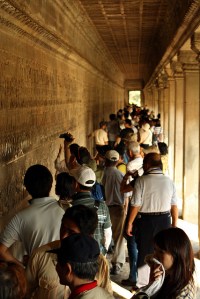
The photo below was taken as we walked through one of the galleries at the temple. You could see the tourist groups, each listening to a tour guide wearing tan long-sleeve shirt.

Tourists at Angkor Wat