Unknown's avatar

About setiawanphoto

Photographer. Traveler. Foodie.

Zion

Zion National Park is located in Southwestern Utah, close to the Nevada and Arizona borders. The main feature of this park is the Zion Canyon, a canyon 15 miles long and up to half mile deep, surrounding by large sandstone mountains. At the end of the Zion Canyon, there is the Zion Narrows, a gorge that at one point is as narrow as 20 feet wide but 2,000 feet tall. The east entrance to the park goes through the Zion-Mount Carmel Highway, which is a winding road that cuts through rocky surroundings and then descends into the canyon.

The first time I visited Zion was during a weekend road trip with my brother when we went from Phoenix to the Grand Canyon National Park, and continued north to southern Utah to visit Bryce Canyon National Park and Zion National Parks. The drive through the Zion – Mount Carmel Highway was interesting enough, not knowing what to expect to see when started descending into the Zion Canyon. That’s when we were awestruck seeing the tall mountains around us (and realizing how small we were in comparison). We parked our car at the Visitor Center and took the shuttle bus to the Zion Canyon (that’s the only motorized vehicle allowed into the canyon). At one point of the ride, our driver slowed down and pointed us to a vertical cliff of one of the mountains. There were two specs in the middle — a couple of mountain climbers on their way up. They had been climbing since the day before, and it would take them at least another day to reach the top.

The photo below was taken during my second visit to Zion on another road trip with two of my cousins. We stopped after driving down the canyon on the Zion – Mount Carmel Highway to pause and enjoy the scenery around us. On this photo you could see my cousin in the bottom middle part of the photo looking at the mountains around him. He’s about 5’6″ in height, but in this photo he looked quite small in comparison to the surrounding mountains.

Zion National Park

Grand Canyon

One national park in the United States that is among the most well-known is the Grand Canyon National Park. Located in Northern Arizona, it is a canyon carved by the Colorado River since over 17 million years ago, exposing layers of rock that tell the earth’s geological history from over two billion years ago. The Grand Canyon is 227 miles long, up to 18 miles wide, and over one mile deep. It is considered as one of the world’s natural wonders.

The first time I visited the Grand Canyon was during the time I was working on a project for a regional hospital in the Navajo Indian Reservation about one hour north east of the Grand Canyon. One day I decided to leave work early and on my way back to Phoenix, I took a detour into the park. I remembered the first time I saw the canyon after driving on flat lands for a while. I’ve seen photos and TV programs on Grand Canyon before, but nothing compared to seeing it with my own eyes. It’s one of those sights that just took my breath away and all I could say was ‘wow.’ Since then, I’ve been back to the Grand Canyon National Park several times, and it’s still awesome to see the sights and observer other visitors’ reaction in seeing the canyon for the first time. But that first visit was one that I always remember.

The photo below was taken during one of my return visits to the Grand Canyon. It’s a photo of the canyon from the South Rim during the sunset. One of the lessons I learned from visiting the Grand Canyon is that the best time to take photographs of the canyon is either at sunrise or at sunset, when the sun light is soft and not as harsh as in the middle of the day. During the day in the bright day light, your photos of the rocks would look washed out.

Sunset at Grand Canyon

Saguaro

Saguaro National Park is located in Tucson, Arizona. It comprises two areas (called districts), the West District at the west suburb of the city of Tucson, and the East District at the east suburb of the city. The park gets its name from the saguaro cactus that grow abundantly in the park area. The saguaro cactus is native to the Sonoran desert, and it’s known for its large size (it can grow anywhere from 15 to 50 feet) and long life (some can live for more than 150 years). Whenever you think of the ‘wild west’ the picture wouldn’t be complete without saguaro cacti as part of the scenery.

I visited Saguaro for the first time when I was working on a project in Scottsdale, Arizona. While I was there, I did a road trip to visit the park in Tucson. You can drive your car on both the paved and gravel roads inside the park. There are also walking paths where you can walk among the tall saguaro cacti. And a trip to the Saguaro National Park wouldn’t be complete without a visit to the nearby Arizona-Sonora Desert Museum, a living museum that showcases the native vegetations and animals.

The photo below was taken at the West District of the Saguaro National Park on my second visit to the park, during a road trip I took with my cousins on the way to Phoenix, Arizona. We arrived in Tucson close to the sunset time, in time to catch one of those amazing moments of the day in the Southwest United States when the sky lights up as the sun sets in the west. The silhouette of the saguaro cacti added interesting details to the scenery; the cacti with their arms looked like human beings standing around.

Sunset at Saguaro National Park

Kings Canyon

Kings Canyon National Park is another national park in the Sierra Nevada that is north of the Sequoia National Park. The two parks are contiguous and are connected by a highway. Kings Canyon National Park consists of two parts. One part is the General Grant Grove, which has a smaller concentration of giant sequoia trees compared to the area in the Sequoia National Park. The General Grant Grove includes the General Grant Tree, the largest in the the park and the second largest by volume after the General Sherman Tree in Sequoia National Park. Another part of the Kings Canyon National Park is the backcountry area east of the General Grant Grove, which comprises 90% of the total area of the park. This includes the namesake of the park, the Kings Canyon, which at the maximum depth of 8,200 feet is one of the deepest canyons in the United States.

I visited the Kings Canyon National Park right after visiting the Sequoia National Park. We drove through the General Grant Grove area and continued eastward until we reached the end of the paved highway. It was towards the end of the day, and there were hardly any other visitor in the area, so it really felt like we’re alone in the middle of the nature. It was very quiet and peaceful out there.

The photo below was taken when we stopped at the east end of the paved highway through Kings Canyon. In the distance is the Kings Canyon and the mountain range around it. We didn’t go on any hike down the canyon, but even just from this overlook we could imagine it would be quite an experience going through the backcountry and experiencing the nature there.

Kings Canyon

Sequoia

Sequoia National Park is located in the southern part of the Sierra Nevada mountain range in California. The national park includes Mount Whitney, which at 14,505 ft is the highest point in the contiguous United States. But it’s most famous for its giant sequoia trees, including the General Sherman Tree, the largest tree by volume on earth.

I went to Sequoia National Park on a road trip with my mom and uncle. We drove from LA area where my brother lived at that time. It took about four hours to drive to the national park. We spent an afternoon driving inside the park, starting with a winding road with great view of the Sierra Nevada mountains around, and ended with a drive through the giant sequoia forest among the very large trees. It was quite surreal driving with these giant trees around us; I felt like the scale proportion (between us/our car and the trees) was off. We stopped at a couple of places to observe the trees from up close, and we did the short hike to get to the General Sherman Tree.

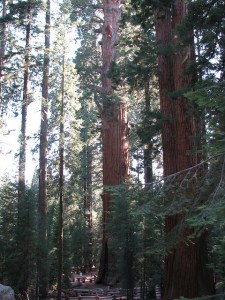
The photo below was taken during our hike to see the General Sherman Tree. The tree in the middle is the famous tree from some distance. At a glance, it looked like a normal tree, until you see the little specs at the foot of the tree — those are adult-sized humans around 5′ 5″ – 6′ tall! Here are some statistics that would put this tree in perspective: It is not the oldest, highest, or widest tree in the world, but with a height of 83.8 metres (275 ft), a diameter of 7.7 metres (25 ft), an estimated bole volume of 1,487 cubic metres (52,513 cu ft), and an estimated age of 2,300 – 2,700 years, it is among the tallest, widest and longest-lived of all trees on the planet.

General Sherman Tree