Free Range Chicken

We finally reached the village of Lao Chai as we hiked down to the valley near Sapa, Vietnam. We walked on the dirt road that cut through the village. On the side of the road, we saw more terraced rice fields and some homes. We also saw something that’s probably common to see in the villages in Southeast Asian countries, but not in the United States or other western countries, animals roaming around near the homes: dogs, chickens, and pigs. Seeing dogs roaming around as pets are not unusual. But seeing chickens and pigs, those are a little different. They pretty much roamed around freely, not just in an enclosed, grassy areas, but really just anywhere around the homes, and some even roamed outside to the dirt road.

The first thought that came to my mind was that this gave a new meaning to ‘free range.’ In the United States, there were concerns about how farm animals are treated. Many farms were focusing on increasing the production of meats and poultry that the way the animals were grown some considered as ‘inhumane’ or cruel. The animals were caged and lived unnaturally. So the industry then tried to improve this by introducing the idea of having ‘organic’ and ‘free range’ animals. The animals were fed more natural foods (without chemicals or growth hormones) and instead of caged, they were free to roam on the field. The result was supposedly not only more humane treatment for the animals, but also healthier and better tasting meats.

I thought of that concept in comparison to how locals grow animals in Vietnam. The locals in the villages have some pig and chicken, but they’re not necessarily farmed for high volume production. According our guide May, the locals eat meat, but that’s considered as luxury and they only have those for special occasions. So no one cares really about the idea of ‘organic’ or ‘free range.’ They would probably look at you funny if you talked about treating the animals in ‘humane’ way. Animals don’t get treated in any special way, but they are also valued so it’s likely they don’t get treated in any bad way either. I remembered a story from my father who lived in a poor village in Indonesia when he was young — having eggs as special meal for a birthday as those were too expensive to get for day-to-day consumption. That makes me feel grateful of the blessings we have today — in many cases it seems that if anything we need to reduce the consumption as the excess can be detremental to our health.

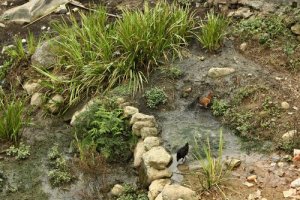
The photo below was taken from the dirt road as we walked into the village. You can see the chickens just roamed around on what looked like a pretty dirty grounds.
Terraced rice fields

Terraced Rice Fields

As we continued our descent to the valley near Sapa, Vietnam, we saw that we closely approached where the some of the terraced rice fields were located. So far we had been following a muddy path down. Then as I looked at where that path led to at the bottom of the descent, it looked like it ended at a small stream that we would have to cross. On the other side of the stream, I couldn’t see any continuing path. Instead there were the terraced rice fields.

We watched the group in front of us going through there, and it became clear that once you cross the stream, you would then walk on the narrow pathway in between the rice fields (what looked like the boundary or outline of the terraced rice fields when you see them from far away). It didn’t look too bad from far away, but when you get closer, it looked like an interesting exercise walking through that stretch while staying in line within your group. The challenge was that you need to maintain your balance on the narrow path, and on one side it plunged down to the stream below, and on the other side you have the muddy rice fields.

When it came to our turn going down there, I walked carefully crossing the stream to make sure I hopped from rock to rock and not getting wet from plunging to the stream. That was not too bad. But then as we walked on the narrow pathway next to the rice fields, at one point I lost my balance a little bit, and ended up with one foot in the muddy rice field — my whole hiking boot turned brown covered with mud. So much for trying to keep my boots clean… At least it wasn’t as bad as going to the other side and falling into the stream. We continued on our trek as if nothing happened. Fortunately it wasn’t too far until we reached an actual road / path again.

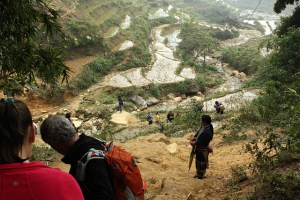
The photo below was taken before we descent through the last segment before we reached the bottom of the valley. You can see here May was already a bit in front of us and waited for Dave and Anna in front of me to start descending. At the bottom of the descending path, you can see the little stream and the terraced rice fields on the other side.

Terraced rice fields

Local Kids

As we continued our descend to the valley on the way to the villages near Sapa, Vietnam, we reached an area where there was a logjam of many hikers with their guide and local women entourage trying to go through a narrow and steep descending path. It was getting uncomfortable stopping and waiting on the incline, though finally there was a flat area with a couple of houses where we could take a break before continuing the descent.

At this area, there was a local lady opening up a little shop selling souvenirs and handicrafts. She also had some bottled and canned drinks — a welcome sight for many of the hikers who by then had gone through at least about an hour or two into their trek. No one from my group went for those, however. We just stayed there for few minutes waiting for the group in front of us to walk through the path. While waiting, I noticed a group of several local kids, mostly under five years old, hanging out and sitting near the souvenir stand. I guess the kids came there with their mothers who were selling souvenirs, or they probably live nearby? In any case, it was interesting to see these little kids at a spot in the middle of a steep trail between the main road to Sapa and the village in the valley. I wondered how they got there… either they came with their parents, or somehow they made it there on their own through the rough terrain that made us the visitors who came with our fancy hiking gears looked like rookies when it comes to navigating through there. I also wondered what these kids think of the strange-looking people going through their ‘neighborhood’ every day; I suppose they’re used to seeing foreign tourists after a while.

The photo below was taken while we’re waiting in that area and when I observed these local kids hanging around there watching the tourist traffic passing by.

Local kids

Trekking Path

Sometimes when you go on a trip what you had in mind when planning for it and what you actually experience could be very different. When we planned for the trek to the villages around Sapa, Vietnam, the picture I had in mind was what I saw on photos and on a Travel Channel program about going there: mountains, and green, terraced rice fields with farmers and their buffaloes plowing the field. Well, during our trek to Lao Chai and Tavan villages, we did see those, but the path and the experience was nothing like what I imagined in my mind.

First off, we came during the winter time, so during that time of the year apparently it rains a lot in the area, and there are many days where visibility was close to zero due to thick fog. That’s definitely not the picture I had in mind especially when coming there with photography as one of my objectives. During our hike, it drizzled a little but there were residues of the previous day’s rain, so you have puddles and muddy stretches on the path everywhere. 5-10 minutes into the trek, we pretty much didn’t care anymore about getting our shoes and pants dirty with mud.

It wasn’t completely foggy, but it was definitely cloudy and the fog was there in some areas. So the photos I got were not washed out due to harsh lighting, but at the same time it had the sense of cool, mysterious, place.

At one stretch of the hike we finally saw the terraced rice fields, but they were so far down in the valley that the view was more like a bird’s eye view of the area. And since it was winter time, the fields were mostly brown (not green) as it’s not close to harvest time.

As I mentioned in the previous post, we were also accompanied by an ‘entourage’ of local women who tried to sell their handicrafts to us. Also, since we went through a pretty popular trekking route, there were areas where we ended up in a long traffic as there were other groups of hikers in front of and behind us (with their own set of ‘entourage’).

All in all, it was very different than what I had in mind, but it was interesting experience nevertheless.

The photo below was taken during such ‘log jam’; you can see the people in front of us going down the path to the bottom of the valley. From the clothings, you could tell the difference between the tourists and the local ‘entourage.’

Trekking path

May

As we continued our trek to the villages in the valley near Sapa, Vietnam, we walked through a portion of the trek that looked like a dirt road that was in the middle of construction. Our tour guide May said that this was the new route to the village that the Vietnamese government is building, hopefully providing easier access to the remote mountainous villages.

As we walked there, a man on a motorbike came from behind, and when May saw him coming, she smiled and starting chatting a little bit with the bike rider before he continued on his ride and left us. Then May told us that the bike rider was her husband — he works as a motorcycle driver who shuttles people between the town of Sapa and the surrounding villages.

During our trek, May told us about the culture within the minority groups in Sapa, including her own tribe, the H’mong. She told us the story of her own life experience as a H’mong girl who ended up marrying a Vietnamese man and now working as a tour guide. She said the culture was still quite strong within the community.

She was then 23 years old, but she had quite a life story already. When she was 18, a young man in her village wanted to ask her hand in marriage, and since he came from wealthier family than hers, her parents wouldn’t object to that request. In the H’mong culture, in fact typically marriages were traditionally arranged by the parents, and the girls didn’t have much say in the matter. In May’s case, however, it was different. She didn’t want to be married to this young man, so she decided to run away and leave her family and village. Somehow she figured out a way to make a living, met her husband, got married, and then returned back to Sapa area. She faced several oppositions as she came back. The local girls whom she knew when she was young didn’t want to associate with her anymore because of what she did (running away from the village) and because she’s working as a tour guide, which meant she’s making more money than her peers. Her own family was slowly warming up to accept her back, though it was still difficult situation due to the hurt feelings. Since she married a Vietnamese, her husband’s family also at times looked down on her given that she’s from a minority tribe. Then she had a young baby girl, two years of age, who during the week stayed with her in-laws in Lao Cai. She and her husband got to see their daughter during the weekend.

Despite of all of those hardships, it was pretty neat to hear her talking about her life experience without any regrets or any ill feelings towards others. And she sounded very optimistic, and still looked forward towards the future with some potential side business ideas that she wants to pursue. It was quite impressive to hear her story, and I think it provided us with a good perspective of what it’s like to live within a minority group in the increasingly diverse world that is looking for more cultural integration.

I took the portrait photo of May below as we walked through our trek. I think this was a good snapshot that summarized her attitude, always optimistic, and full of smile.

May