Train Ride to Lao Cai

After boarding the train at the Hanoi Train Station, Kristi and I located our cabin inside the train car. Each cabin has four sleepers. When we booked the trip, we were faced with decision whether to follow the recommendation to purchase all four seats in a cabin (for privacy, security, and comfort reasons), or only purchase the two spots that we needed. In the end Kristi and I decided to get only two spots, and we would share the cabin with whoever other passengers who take the other two sleepers. It might be a bit ‘risky’ but we thought we would face the risk while traveling anyway.

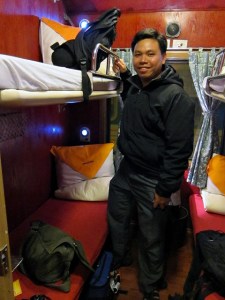
When we found our cabin, the first thing we noticed was how small it was. there were four sleepers, two on each side, and they were designed for the local standard size (i.e., pretty short). For Kristi, it wasn’t a problem since she’s pretty small in posture. For me, it’s just about to fit. If anyone 6 ft or taller travels in this cabin, it would be very difficult to travel on the top sleeper. Even if you take the bottom sleeper, a tall person would probably need to sleep with his/her feet on the ground. Adding the constraint of the small cabin space was the space for luggages. You can slide the luggage under the bottom sleepers, but the space was barely enough for luggages from two people. Both Kristi and I each had a backpack. That we had to keep with us on our sleeper. I used it as extra head rest next to my pillow. Other than that, it was a clean cabin with pillows and blankets provided.

Not long after we settled in our cabin, the other two passengers in our cabin arrived. They were a couple from Montreal, Canada, named George and Gol who like us were in the middle of exploring Northern Vietnam. We had a fun conversation talking about our trips so far. George said their trip didn’t start well as they got stranded in Hong Kong for an extra day because their United Airlines connecting flight got canceled and they had to spend almost a whole day at the airport waiting for the next flight to Hanoi. After making it to Vietnam, the first part of their trip was to go to Ha Long Bay for a cruise, and they said they really liked it. They’re planning on spending some time in Hanoi when they get back from Sapa. So it was a little bit in reverse compared to our itinerary — we spent time in Hanoi, then Sapa, then Ha Long Bay. It was great though to hear that the next destination for both our parties were going to be good.

As it got closer to midnight, everyone was ready to get some rest and sleep for a few hours. We had the light turned off and not long after I heard George started snoring a little bit and I could tell Gol and Kristi were already asleep as well. Somehow I had difficult time sleeping, so I ended watching a movie that brought in my netbook and I wanted to watch before the trip to Cambodia, but never had a chance to… The Killing Fields. So there it was, I spent the next three hours or so watching this movie about the Khmer Rouge atrocity in Cambodia. Since we visited the Tuol Sleng Prison and the Choeung Ek Killing Field while in Phnom Penh, I had a better idea of what had happened in real life, and made me appreciate how well the movie was done to reflect what really happened in Cambodia. Eventually after finishing the movie, I got tired enough and could finally fall asleep.

The photo below was taken from outside the cabin looking in. You could see me in the middle of cabin in between the sleepers. I might look big here, but it’s actually the cabin that was small. For size comparison, you could also see my backpack on the top sleeper and Kristi’s bag on the bottom sleeper. I ended up taking the top left sleeper.
Train cabin

Hanoi Train Station

The first part of our journey from Hanoi to Sapa was to go to the Hanoi Train Station and get on board of our train. Our contact person, Mr. Viet, whom we met at the Six on Sixteen Hotel, got us a taxi cab, and he told us that he would ride his motorcycle separately and meet us at the train station.

When we arrived at the Hanoi Train Station, Mr. Viet was already there, and he told us to follow him. I read about some horror stories of travelers getting scammed when trying to obtain their train tickets at the station, so I was glad that we had someone who knew what he’s doing taking care of this for us. We reached the entrance of what looked like a waiting area, and Mr. Viet told us to wait there while he retrieved our train tickets. He disappeared for a moment, and Kristi and I waited there until he came back. After few minutes, he was back with a couple of tickets in his hands. He gave them to us, and asked us to follow him.

We went through the waiting lobby and continued through the train platform. Mr. Viet told us to follow him to our train car; he escorted us all the way to the exact one we needed to board, and then told us that we just have to look for our exact cabin on board. Before he left, he gave us his business card. It looked like he’s a business partner of the proprietor of the Sapa Rooms and Six on Sixteen Hotels who specializes in arranging transportation for travelers from Hanoi to various destinations in Vietnam, including Sapa. He told us that we could contact him for any transportation needs in Hanoi in the future.

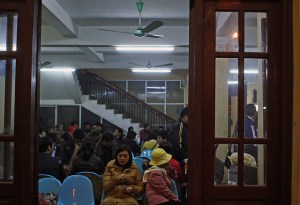
I took the photo below before walking into the waiting lobby at the train station. It would be quite an adventure — one that I probably didn’t care to experience — to have to figure out all of these on my own while making sure that I didn’t get ripped off and not missing my train.

Waiting lobby

6 on Sixteen

After a full day of sightseeing in Hanoi, Vietnam, we were ready to continue on with the next leg of adventure during our Southeast Asia trip. So far we’ve traveled by air, land (car, light rail train, bicycle, tuk-tuk, minivan), and water (river boats). The next leg of the trip is to travel by overnight train, and continued with a minivan. That was the most convenient way of getting to our next destination, Sapa. But before we embarked on this adventure, we had to first get in contact with a gentleman in Hanoi who made the arrangements for our trip to Sapa. That in itself was an interesting experience.

After deciding that Sapa is one of our destinations in Vietnam, we started planning out the trip up there. The easiest, most convenient way of planning this would be to get a travel agency to arrange the trip for you. They’ll take care of the transportation and lodging arrangements. We decided to be a little more adventurous and plan the travel a little bit independently. I used TripAdvisor to look at various boutique hotels in Sapa to consider as places to stay. We ended up selecting a place called Sapa Rooms. When we looked at booking the room to stay there, they mentioned that they could also help arrange the trip from Hanoi to Sapa and back. The only route to go to Sapa (north of Hanoi, near the border with China) was to take train from Hanoi to Lao Cai, then take a minivan or bus from Lao Cai to Sapa. The train typically leaves Hanoi in the evening and arriving at Lao Cai in early morning. Then it’s about one hour drive up the mountains to Sapa. We thought we were adventurous, but trying to do all of these without anything pre-arranged would be a bit too much adventure to take. And trying to book the train ticket on our own was quite a confusing process. So we decided to just book our travel through Sapa Rooms as well.

It turned out that the Sapa Rooms owner, an Australian gentleman, also had a business in Hanoi. Few months before our trip (when we were in the planning stage), he had a place in Hanoi that was meant to be a quick rest stop for independent travelers to freshen up before they head to Sapa. But just shortly before our trip, that place was closed, and instead he opened up a new boutique hotel in the heart of Old Quarter Hanoi called 6 on Sixteen (they had only six rooms, and it’s on 16 Bao Khanh Street). This was the place that we were instructed to go to by a certain time to meet the gentleman named Mr. Viet who would get us to the train station, provide us with our train tickets, and ensure that we get on the right train to Lao Cai. I read many horror stories about people getting scammed at the Hanoi Train Station, so I thought even though this arrangement sounded a bit outside my comfort zone, it seemed to be safer than trying to do it myself.

We arrived at the Six on Sixteen around 6 pm, just like what we were instructed. As we got there, I told the hotel staff that we were there to see Mr. Viet before our trip to Sapa. The hotel staff mentioned that Mr. Viet will usually come around 7 pm, and in the mean time we were welcomed to hang out at their restaurant/lounge.

The ground floor of the small boutique hotel was pretty much a long, narrow room with wooden tables and benches and a bunch of plush pillows to sit on around a lounge table. Since we knew we’re going to travel overnight on the train, we thought it would be better if we had something to eat before we leave. I thought this was quite a smart arrangement by the hotel’s proprietors; get the travelers to come a little early before their trip, and offer them some food and refreshments before their journey. We ordered a couple of Vietnamese appetizers and some mixed fruit drinks (which we came to love during the next couple of days staying at Sapa Rooms/6 on Sixteen).

Around 7:30 pm, finally Mr. Viet arrived (after I got nervous and checking with the 6 on Sixteen staff several times). After quickly greeting us, he stopped a taxi cab, told the driver that we’re going to the Hanoi train station, and told us to get on the taxi and he would meet us at the train station as he rode his motorcycle separately. The memorable trip to Sapa then started…

The photo below was taken at the 6 on Sixteen lounge area while we were waiting for Mr. Viet to arrive. You can see the dimly lit area, and the long and narrow place.

Six on Sixteen

Cafe in Hanoi

When we were in Hanoi, Vietnam, our plan for spending the afternoon watching the Water Puppet show had to be changed because the tickets for the day’s performances were already sold out. So we found ourselves with several hours of open time, as we were not supposed to leave for the next leg of our trip until that evening.

We went back to our hotel to ask the staff there for suggestions on good places to go to hang out for few hours. We saw many coffee shops in the city as we walked around the Old Quarter area, so we asked the lady at the front desk for her recommendation on a good place to go that was within walking distance from the hotel. She mentioned that there was a good cafe near a particular intersection, though she didn’t remember the name of the place or the exact address. She pointed the area on the map, and off we went walking towards the area to find the cafe.

We reached the area on the map, but we couldn’t find the cafe as she described. So we decided to continue walking around the area, and finally when we saw a cafe, we decided to just go there to rest and hang out for a little bit.

The cafe looked like a typical one found in Hanoi. It’s a little dark inside, with seating areas set up like a lounge. There was food on the menu as well, though it looked like most people went there to have drinks (coffee, cocktails). While resting and waiting for our drinks, Kristi and I looked at our Blackberry phones and saw that we could get some open wi-fi connection there (from a nearby hotel). So we were able to check emails there while enjoying our drinks. We started ordering coffee, but then we decided to also get some mixed fruit drinks.

We would’ve stayed there for a little longer had we not been bothered by one thing.. it’s not a smoke-free environment, and many Vietnamese smoked cigarettes. We kind of got sick from the second-hand smoking after a while, so we decided to finish our drinks, paid up, and continued our walking tour.

The photo below was taken at the cafe. Here is Kristi checking emails on her Blackberry. You can see the drinks we had there.

Cafe in Hanoi

Vietnamese Coffee

When we walked around the Old Quarter area in Hanoi, Vietnam, we passed quite a few stores that sell coffee in bulk as well as many coffee houses where the locals go. It’s pretty clear that coffee is a big part of Vietnamese culture.

I was introduced to Vietnamese (style) coffee back in the United States many years ago by a Vietnamese friend whom I often hung out with. Whenever we went to a Vietnamese restaurant, he would suggest cà phê sữa đá (iced coffee with condensed milk) as a drink to accompany our meal. The coffee was usually quite strong; in the United States, however, the Vietnamese often get coffee from Louisiana as it had similar flavor profile to the Vietnamese coffee and it’s easier to get in the US. Not until this trip to Vietnam that I finally tried the real thing.

As I read up about Vietnamese coffee, I learned a couple of interesting facts about coffee production in Vietnam. Coffee was introduced in Vietnam by the French in mid-19th century when Vietnam was a French colony. Today, coffee is one of the major agricultural products being exported from Vietnam, second only to rice. Vietnamese coffee also account for around 14% of world’s production, making it the second largest coffee producing countries in the world after Brazil. You don’t hear it as much even when you drink a lot of coffee, however, because 97% of the Vietnamese coffee production is of the Robusta kind, which is generally considered as lower grade compared to the Arabica kind that dominates the gourmet coffee market. The Robusta coffee is typically used as fillers for lower grade coffee mix or as main ingredients for instant coffee.

One interesting kind of coffee that my Vietnamese friend mentioned as ‘highly priced’ is what’s called the ‘weasel coffee’ in Vietnam. This is similar to what’s known as ‘kopi luwak’ or civet coffee in Indonesia. It’s highly-priced coffee that was the result of ‘special processing’ — the weasel or civet knows how to select the ripe coffee berries. They would eat the berries for their fleshy pulp; the beans would go through the civet’s digestive tract, and somehow the enzymes help change the characteristics of the coffee bean so when it came out as a whole, cleaned, and roasted, the resulting coffee is more aromatic and less bitter. This coffee (the real one) is noted as the most expensive coffee in the world — it could fetch as high as USD $160 per pound.

Given the high price that the civet coffee can fetch, there is a lot of folks who claim they have these even though it might be counterfeit. When we walked around Hanoi, in many of the coffee stores we saw tubs of coffee with ‘weasel coffee’ written on them like on the photo below. The price was more expensive than ‘regular coffee’, but nowhere close to the priced civet coffee price in Indonesia. And seeing the abundance of those (every coffee store claimed to have some), you wonder if they are real or not.

Coffee store