World Largest McDonald’s

We left early in the morning on our third day of the trip with the goal to cover more than 800 miles and reach Chicago area before midnight. As such, we tried to to be efficient as we also wanted to stop at several places along the way. Since we decided not skip The Rock Cafe for breakfast, we looked for an alternative place to get a bite to eat without spending much time. As I looked for options along the way, one caught my eye as the ‘perfect’ place to stop given the situation. It was right on Interstate 44 that we would pass, very likely would be a fast service, and yet it sounded interesting… the McDonald’s in Vinita, OK.

What’s so special about going to McDonald’s, you might ask. Well, according to the Route 66 guide books that I had in hand, this particular McDonald’s at one point claimed to be the largest McDonald’s in the world. Formerly a restaurant called The Glass House and built in 1959, it occupied about 30,000 square feet. I learned that in 1990 there was a bigger McDonald’s opened in Russia that supposedly contended for the ‘largest’ title, and more recently another McDonald’s in Orlando, FL, actually beat both locations hands down as the largest restaurant. Oh well.. it’s a (former) largest restaurant — still some history to be proud of there I guess.

When we reached Vinita, we saw the familiar McDonald’s golden arches from a distance, and the restaurant actually sat like a bridge across the Interstate highway. It was pretty much like some of the rest area / travel plaza that you find in some Interstate Highways; except that typically it would be a shared space with many stores, restrooms, and a visitor center. I thought for a moment, the arch of the bridge was painted McDonald’s yellow, so I suppose if the whole bridge was one big McDonald’s then it would make sense that it’s the largest one you could find.

It turned out that when you get inside the building, the space inside the large structure was shared with several other stores, and the actual McDonald’s restaurant portion was about the same size as an average McDonald’s store you could find anywhere else. There seemed to be a lot of unused spaces as well. A little disappointing for those like me who were expecting something different given the ‘hype’ but I suppose business sense prevailed that you should only scale the restaurant to be as big as the demand, and it had probably gone passed its glory days.

We had our standard McDonald’s breakfast, served in efficient manner as a reminder to the modern ‘on-the-go’ culture. On the way out, at the parking lot we did see a group of colorful hot rod cars. They looked like the real life version of the Hot Wheels toys, and reminded me to the characters that Lightning McQueen encountered on the highway just before he veered off and ended up at Radiator Springs. So there was something interesting found at this stop after all.

Former largest McDonald's

Blue Whale

For the coast-to-coast road trip through the old Route 66, I set a goal to visit a place and have something to remember from in each of the states that we passed along the route. In the state of Oklahoma, we thought that place would be The Rock Cafe in Stroud, but unfortunately we ended up not visiting the place.

Still determined to find a landmark that can represent our journey through Route 66 in Oklahoma, I went through my Route 66 guidebooks to find ideas for any place we can visit that wouldn’t be too much out of the way since we had a tight schedule for the day trying to reach Chicago area by that night. I found one quirky landmark that I fit that criteria and seemed to be a good representation of Route 66 in Oklahoma, a place with literally a Blue Whale structure in Catoosa.

What was a whale doing in Oklahoma, you might ask. I had the same question, and not until I read about the history of this place. The structure was built by a gentleman named Hugh Davis. Mr. Davis was a retired zoologist who used to work at the Tulsa Zoo. He and his wife loved animals and kids. So in their property was on Route 66 he built a facility to educate people about nature. First he built an ark with cut-out wooden animals where kids could celebrate birthdays. Then he opened up an alligator ranch and a small zoo with live alligators, snake pit, and prairie dog village.

In the late 1960s Mr. Davis started working on an idea of having a ‘fish’ at the pond. This evolved to a whale. It took him two years to build the whale, and in 1972 he completed it and presented it as an anniversary gift to his wife Zelta.

The Blue Whale then became a popular attraction on Route 66. People could picnic near the pond, swam in the pond, and use the smiling whale as jumping board or slide to the pond. In 1988, the Blue Whale was closed because Mr. Davis’ had arthritis and was not able to maintain the place anymore. He died two years later, and his wife died in 2001. The place is now owned by their daughter and her husband. The Davis’ son and grandsons keep the grounds maintained and the gates open so people can continue to enjoy the Blue Whale.

In the last 15 years, the community around Catoosa has also been working on restoring the landmark. When we stopped by, there were no one there, but we could see that the whale and the benches around the pond had vibrant colors from fresh coat of paint, and it didn’t feel like it was an abandoned landmark.

Our visit was brief, and it might not happen had we not decided to skip The Rock Cafe. But looking back I’m glad we did visit the place that not only is a distinct landmark along the route but also had a wonderful story behind it.

Blue Whale

Cars Inspiration

When I was planning for the coast-to-coast trip tracing through the old Route 66, I learned that the animated movie Cars was inspired by the Mother Road and the people who lived along the route. I had watched the movie before on the big screen, but not until I watched it again in DVD format that I came to appreciate the difference between this movie than others Pixar had made. In the extra footage on the making of the movie, I learned that the Pixar team did a road trip on Route 66 to visit the places and meet the people who lived along the route, and they based the characters in the movie on real-life characters they met during the research trip. One such character was Sally Carrera, the blue Porsche sports car that ran the Cozy Cone Motel in the movie. The inspiration behind this character was Dawn Welch, a lady who owns a restaurant along Route 66 in Stroud, OK, called The Rock Cafe.

In the movie, Sally Carrera told the story how she ended up at Radiator Springs. She was a lawyer in Los Angeles living a fast-paced life, but was unhappy with life and decided to get away from the city. She had a flat tire near Radiator Springs, and the folks in town helped her getting fixed up, and took her in as their own. She ended up staying there and being part of the tight community.

In real life, Dawn Welch was originally from Oklahoma, but she worked in the cruise ship industry which took her to many places outside the US. She was planning on opening a restaurant in Costa Rica, and came to Stroud to look for an old grill to purchase for her restaurant. She learned about The Rock Cafe that had been a landmark on the historic Route 66 since 1939. Charmed by the historic building and the people she met, she ended up staying and running the restaurant ever since. She is actively involved in the local community, and the Rock Cafe in a way becomes an integral part of life in the small town of Stroud. She has also been involved in promoting the preservation of the historic Route 66. In 2001, the Pixar team stopped by at the restaurant during their research road trip. John Lasseter and his team learned about her life story and decided to make that as part of the story for Cars and based the Sally Porsche character on Dawn.

When I read up more articles about Dawn and the Rock Cafe, I also learned that in 2008 tragedy hit and the restaurant was destroyed in a fire. But Dawn with the help of her family and the community persevered and restored the historic building in the next year, and just few months before our trip, it had reopened again. That story increased my interest in checking out the place and experience that community feel first hand.

The night when we reached Oklahoma, we stayed in another town not far from Stroud with the intention to stop at the Rock Cafe for a breakfast before we continued our trip. We did find the restaurant, but unfortunately it might have been too early that it was not open yet for the day. Since we had quite a long journey planned for the day, we decided to continue on. But I did get a shot of the Rock Cafe’s neon sign before we left.

Rock Cafe

The World’s Best Known Roadside Sculpture

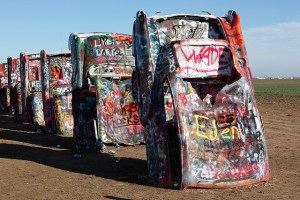
Few miles west outside the city of Amarillo, Texas, on Interstate 40, if you pay attention on south side of the road, you can see an interesting artwork in the middle of the field. It’s the Cadillac Ranch, a sculpture built as a tribute to one of the most iconic American cars. In 1974, a group of artists called the Ant Farms built this ‘sculpture’ by taking ten Cadillac automobiles ranging from 1949 to 1963 models and burying them halfway into the ground nose first. A local millionaire named Stanley Marsh 3 let the artists built the sculpture on his land. In 1997, the sculpture was moved about 2 miles away to where it is located today to accomododate the growth of the city of Amarillo. Today the sculpture still remains there on the side of the Interstate, and anyone is welcomed to stop by and check out the sculpture. In addition, writing graffiti on the cars with spray paint is also encouraged, so you would surely see something different when you visit it at different time.

This was one of the landmarks that we thought we should try to find and see in person during our coast-to-coast road trip. But spotting it was not easy as we had never been there before and we had been driving for quite a while since we left Santa Fe, NM, with a brief stop in Tucumcari. We also wanted to make sure we get there before it gets dark.

As we got closer to Amarillo, I asked my brother to look to the side of the road for any sign of the sculpture. Finally we saw several cars parked on the side of the frontage road on the side of the Interstate highway. In a distance, we saw the 10 Cadillac cars that made up the Cadillac Ranch. We found the nearest exit and parked our car on the road side, and went through the unlocked gate into the pasture and joined several other people who were also checking out the sculpture.

While we were there admiring this unique artwork, we saw a group of people coming. It looked like a wedding party as we saw many of them dressed up, and sure enough the bride and groom came not long after. They came there to do some photoshoot near the sculpture. Quite an interesting location for a wedding photoshoot. I suppose beauty is in the eyes of the beholder, and those seeing the photos would surely identify the place as something unique to Amarillo. Yet another quirky find on Route 66.

Cadillac Ranch

The Big T and Colorful Signs

Tucumcari is a small town in northeastern New Mexico. It is located along the modern day Interstate 40 and the historic Route 66. The town is the first town of significance in New Mexico if you’re driving west bound from Texas. For the Route 66 enthusiasts, the town is a higlight of any road trip as there are many businesses along the main road through the town that have colorful neon signs outside the stores. The town is often considered as among the best representation of what Route 66 was like in its heyday with many stores and motels along the way that provide unique merchandise or services to the travelers on the route.

I first learned about Tucumcari when I was researching Route 66 before the road trip. There were several Route 66 landmarks in Tucumcari that many suggested to look for, such as the Tepee Curios shop that had an entrance shaped like — you guessed it — a tepee, and the Blue Swallow Motel, a local motel with a neon sign outside that had been photographed in many Route 66 literature. These landmarks were among the many that served as inspirations when the Pixar animators created the fictional town of Radiator Springs in the movie Cars. There was also a big T sign on the Tucumcari Mountain that can be seen from the Interstate highway as well as from the town. This was the inspiration for similar vista behind Radiator Springs in the movie (with the big with RS on the side of the mountain).

We reached Tucumcari after a few hours drive from Santa Fe. I remembered the drive on Interstate 40 prior to reaching Tucumcari because, well, I didn’t want to remember it. It was driving on a long stretch of very straight highway that seemed to continue forever to the horizon, and the sun was shining through the windshield and it got really warm after a while at the front seat. The combination of warm and somewhat boring ride meant I had a challenging time to keep myself from falling asleep. So it was quite a nice relief reaching Tucumcari and stopping at a local gas station to fuel up and freshen up with some nice cold drinks. I suppose that’s part of the experience of doing such road trip. The sight of a town with a gas station selling fuel for both the car and the passengers, as well as options to stop for a meal, shopping souvenirs, or even staying overnight are quite welcomed by the travelers. And for the locals, they welcomed the travelers as to some, these were the main source of income.

Aside for taking photos of some of the landmarks that we passed on the drive, we ended up just continuing our drive to our next destination. I thought that brief drive and visit through this small town really drove the point about the impact of the Interstate Highway on the livelihood of towns that were previously dependent on being on the Mother Road. I’m glad we took the little ‘detour’ to exit the Interstate highway to see the town, rather than just driving pass it on the Interstate like most of the modern travelers do.

Below is a photo of the Tepee Curios shop, one of the landmark businesses on Route 66 in Tucumcari. It was like a scavenger hunt driving through the town and looking left and right for these landmarks that we read in the guidebooks.

Tepee Curios