Off the Beaten Path

After a few hours traveling on the Interstate highway from Los Angeles, we reached Needles, CA, the last exit on I-40 east bound before entering Arizona. Most people would pass this exit unless they need to stop for fuel at the gas station nearby. We exited the Interstate highway here because we wanted to take an alternate, ‘scenic route,’ the old Route 66 between Needles and Kingman, AZ.

We decided to explore this segment of Route 66 because it’s among the best representation of old, historic route that ended up getting bypassed and replaced by the modern Interstate Highway. The old route goes through a winding road on the Black Mountains area. It’s scenic, but not the fastest way. The Interstate highway cuts through another part of the mountainous region and provide a shorter and faster route for those who need to speed up to get through the area.

Another reason why this old route was interesting to us is because it passes two points of interests, a ghost town called Oatman, and a restored rest stop called Cool Springs. Again, more historical look at what Route 66 looked like back in its heyday.

After we passed the town of Needles and entered into the state of Arizona, we followed the road sign to Oatman. Gradually we went from driving on a busy four-lane highway to a smaller two-lane road that led towards the mountain. It felt like we’re alone in the middle of nowhere and heading to a dead end, until we saw a sign indicating we’re on the historic stretch of Route 66 and we’re only few miles away from Oatman.

The photo below was taken as we’re getting closer to Oatman. You can see that the road is not much traveled anymore, and there is the historic Route 66 marker.

Off the beaten path

Life is a Highway

We started our coast-to-coast road trip with a visit to the Santa Monica Pier to find the official west end of Route 66. We found the official plaque that marked the end of the road. The actual Route 66 itself now only exists in segments, so we used a couple of books on Route 66 that traces the route along today’s modern highway.

Before leaving LA area, we made a couple of stops, first in Beverly Hills area to attend a service at Mosaic, then on the way out of suburban LA we stopped in Monterey Park to eat lunch in the Chinatown area. After lunch, we’re off for our first day of the trip.

We had roughly five days to complete the journey from Santa Monica to New York City. So, on the first day, our target was to reach somewhere in northeastern part of Arizona. Along the way, we wanted to take a segment of the old Route 66 in Arizona that according to the books on Route 66 still provided good representation of what it was like in the heyday of the Mother Road. Since the route supposedly went through pretty steep incline/decline grade on the mountains, we thought it would be a good idea to try reaching the area before it gets dark.

The road we took that afternoon consisted several segment that were pretty much a straight shot drive. It could get boring after a while and I found myself keeping myself alert by listening to songs, observing what’s around, or thinking about something. The first part of the trip in the eastern California towards Arizona reminded me to the song Life is a Highway by Rascal Flatts. The first part of the song went like this:

Well, life’s like a road that you travel on
There’s one day here and the next day gone
Sometimes you bend, sometimes you stand
Sometimes you turn your back to the wind

I did think about the lyrics of the song above and how that might be a good metaphor of what life is like as the song suggests. I think there is some good pictures there.

When driving on a highway, at times we go through straight segment where we can go fast, and then we encounter curves where we have to slow down. Life also goes like that. At times, things go well and we can progress fast. At other times, we face obstacles or challenges and we have to slow down the progress or even take a step back.

On the highway, we might pass other automobiles with people going to different destinations and with different reasons of traveling — some for leisure, others for business, and yet others for other different reasons. Some are still in the early part of their journey, others are already close to the end of theirs. Similarly, with life we encounter different people who are in the middle of life journey to achieve certain goals (studying at school, building a career, starting a family, retiring, etc.), and they might be at different stages of getting towards their goal.

Another interesting metaphor is to think about how one goes through the journey. On the highway, you can focus on getting to the destination in the shortest amount of time, and end up seeing the journey as the necessary means to reach the end (the travel experience becomes a blur or, worse, an exhausting experience you just want to get over with). Or, you can also have a destination and a plan / route to get there, but consider the journey as part of the experience to remember and even look forward to. It may not get you to the end in the fastest way possible, but you enjoy the journey more.

That was essentially the theme of Pixar’s animated movie Cars. As I did my planning before the trip, I came to learn that the inspiration for the movie was Route 66, its history, and many people who live along the road. Behind the great animation and funny characters there was a great story and message about cherishing life’s journey and the people you share it with.

I took the photo below during the drive on one of those long, straight stretches on I-40 eastbound. You can see the straight road, and other cars around us. One car in front of us had a U-Haul trailer on the back; it’s likely someone who was in the middle of a journey to move to new place, just like my brother.

Life is a highway

Santa Monica

Santa Monica is a city about 14 miles west of downtown Los Angeles, California. It is known for its beach, and as an affluent area where some of the Holywood rich and famous live. Many people probably recognize the Santa Monica Pier, a landmark in Southern California with the little amusement park at the pier, white sandy beach nearby, and the row of expensive beach front homes. And the image of people at the beach and the lifeguards in red swimsuits were made famous worldwide with the TV series Baywatch.

I didn’t know much about the area until few years ago when my brother got a job with a company located there. During a couple of years that he worked and lived there, I had several opportunities to visit him, and came to appreciate the place. My brother lived in an apartment about 5-minute walk from the beach, and from his living room of his apartment we could actually see the beach in a distance. The temperature is pretty constant about few degrees cooler than in the inland, and the area enjoys around 310 days of sunshine a year. Despite of being in a driven metropolitan like Los Angeles, life seems to be more laid back as you get closer to the beach.

Few months before my brother moved back to the East Coast, I had a major life event happening, and my brother suggested that I took a little break and came over to California at least for a few days. I did that, and not only it was nice to hang out with my brother for a few days, but it’s also nice to just walk around the beach simply to get fresh air, watch life goes on around, and think about the next steps I would take in my life. What we didn’t know was that my brother himself would go through similar situation not long after, and he ended up making decision to move back to the East Coast afterwards.

The last time I went there was to mark the beginning of the road trip back to the East Coast with my brother. Now that I don’t really have anyone I know living there, I’m not sure if I have any reason for going there to visit. But at least the place has more meaning to me than simply a place you see on TV shows.

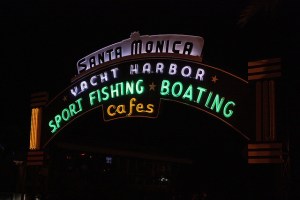
The photo below was taken the night before we started our road trip. This was the neon sign at the famous Santa Monica Pier.

Neon sign

Hainanese Chicken Rice

Some of the best dishes I’ve had were among the simplest in terms of the list of ingredients used. When done well by the masters, these ‘simple dishes’ can be among the tastiest you ever had, and they highlight the flavor of the main ingredient. One of such dishes is a dish that is so popular in Singapore among the locals and visitors that it’s often considered as ‘the national dish of Singapore,’ the Hainanese chicken rice.

The Hainanese chicken rice is essentially boiled chicken served with rice steamed with chicken broth. It was originated from the Hainan province in China (thus the name), but it’s quite popular in Southeast Asian countries.

For me, this dish is one of those things that evoked childhood memories. I don’t remember much from my toddler days, but one thing I remember was having lunch at my aunt’s home and being served boiled chicken with chicken broth and steamed rice. Very simple dish, but it’s one that highlights the chicken flavor very well. It’s also meaningful for us as we heard stories from my aunt and my dad about having this dish for special occasions when they grew up, as their family was poor and couldn’t afford to buy chicken meat frequently.

During our short stop in Singapore, I wanted to try out the Hainanese chicken rice dish there. One of the stalls at the Maxwell Road Hawker Centre near Singapore Chinatown happened to be a famous place to get Hainanese chicken rice, Tian Tian Hainanese Chicken Rice stall. This was the place visited by Anthony Bourdain to have his Hainanese chicken rice dish in his Singapore episode of No Reservations.

We stopped there for early lunch before going back to the hotel to head to the airport. Since it was still pretty early, there was no line yet at the stall, and we were able to get our order quite quickly. The food was good and lived up to the high expectations, though unfortunately we had to eat quite quickly as we’re running late to head to the airport for our flight back to Indonesia.

Here was the Hainanese chicken dish from Tian Tian, just before we consumed it in minutes. It’s really good, and definitely highly recommended.

Hainanese chicken

Buddha’s Tooth

One place in the Chinatown area of Singapore has an interesting name that caught my attention when I checked out the neighborhood map to chart the course for our walking tour, the Buddha Tooth Relic Temple and Museum. Some questions came to mind: Do they really have Buddha’s tooth there, or is it just a name for the temple? In either case, why is the tooth a significant and revered artifact / relic? If it is a temple and museum, can non-Buddhist visitors come and check it out? What do they show in the museum?

All of these questions were answered as we stopped there after we walked around the neighborhood. The building itself was pretty easy to spot; it’s a seven-story building right across from the Maxwell Road Hawker Centre that unmistakeably looked like a temple, but at the same time you could tell it’s a modern structure (it was built in 2002).

We had some time left before we had to head back to our hotel, so we decided to at least looked closer at the building’s architecture from outside. As we were taking photos outside the building, we saw other visitors walking into the building, and they looked like tourists. So we decided to follow them, and then found out that we’re welcome to come inside and visit. There was a worship session going on, but we could come in to observe from a distance, and we were allowed to check out the Buddha statues on the perimeter wall of the main floor as well as going up to the museum on the higher floors.

This was the first time I entered a Buddhist temple and witnessed a live worship session. There were about 20-30 people sat on several rows of tables, and a couple of monks up front leading the congregation chanting. It was similar to visiting a Cathedral while there was a mass going on and the priest leads the congregation singing or praying. There was also another area where a worshipper could come and meditate in front of a Buddhist statue. We saw several folks doing that instead of participating in the group session.

You were also allowed to go up several other floors of the building. On the second level, there were some more Buddha statues to see, and you could see a bird’s eye view of the worship session on the ground floor from several windows that opened up to the worship area.

One of the higher floors was marked as the floor where the Buddha’s tooth relic was housed. We went up there, and found out that we could come in and see the relic, though we had to take our shoes off in reverence, and only 1-2 visitors at a time could go in to see it for few minutes and photography was not allowed inside. When we went in, there was a monk in the room who was watching the room, and up front there was a glass chamber with a small golden stupa where the Buddha’s tooth was stored. We couldn’t really see the tooth itself, but we just have to trust that it’s there. Later on I learned that the reason why the tooth is an important relic is because when the Buddha’s body was cremated after he died, the tooth did not burn down. So it’s considered as a sacred relic to be used in worship.

There was also another floor in the building that had a museum display that told the story of Siddhartha Gautama, the founder of Buddhist faith, and also the explanation about what the Buddhists believe and about the various manifestations / reincarnations of Buddha. I spent some time trying to take it all in, but at the end it was very complex and it would take some time to internalize. But I appreciated the welcoming and nice display set up in this museum to help people learn about the Buddhist faith.

The photo below was taken right after we entered the main floor while we observed the worship session going on. You could see here the worshipper sitting and chanting. The monks who led the worship session sat near the golden Buddha statues upfront.

Worship session