Ao Dai

The ao dai is the national costume in Vietnam worn by women typically during special occasions, including weddings, holidays, and any formal occasions. The attire includes silk form-fitting tunic worn over a trouser. The word ‘ao dai’ was originally attributed to the outfit worn at the court of the Nguyen dinasty in the 18th century. It was modernized in the 20th century to be the style typically seen today, which took some cues from Parisian fashions at the turn of century. I think today when you see a woman with ao dai, it would be as recognizeable as a national costume like the sari for Indian women and the kimono for Japanese women. One thing unique about it is that it’s pretty much custom fit to the individual since it’s form-fitting. Since most of the Vietnamese women are pretty small and slim, generally this looked very good, elegant, and graceful on them. I’m not sure how that would look if you have some of the large-sized women from the western countries try to wear these costumes…

I first saw women wearing ao dai in the United States at the Vietnamese culture centers (like a Vietnamese strip mall I occasionally visit), especially around important holidays (like Tet, the Vietnamese lunar New Year) or when there is an important ceremony (like a wedding). When I was preparing for the Southeast Asia trip, I read information blogs about the destinations. One of them was a very informative guide on travelblog written by a Vietnamese lady with the username theRedRiver (taking the name from the Red River that passes through her hometown city of Hanoi). In the travelblogs not only she gave information about Vietnam and the cities and culture there, but also she wrote about her adventures traveling to other countries. One of the things she liked to do when visiting places is to get her photo taken in her red ao dai costume.

When we visited the Temple of Literature in Hanoi, since it was the 2nd of January, we saw signs to celebrate the New Year there. And since it was also a Sunday, we also saw many visitors, and among them were some Vietnamese ladies in ao dai that came with photographers. It looked like they came to get their photos taken with the traditional architecture as background. You can see in the photo below two of those ladies walking by in their ao dai costumes after they finished with their photoshoot.

Girls in Ao Dai

Ancient Hall of Fame

One interesting part of the Temple of Literature in Hanoi, Vietnam, is the third couryard where you find a pool in the middle named The Well of Heavenly Clarity that is flanked by rows of large stone stelaes. There are 82 of these stelaes, and each record the names and native places of more than 1,300 graduates who passed 82 triennial exams between years 1442 and 1779. These were set up to commemorate the achievements of those who had passed the royal exams, and to encourage the present and future generations to study.

The stelaes of the doctor laureates were placed on top of giant stone turtles. Turtle is one of the sacred animals in Vietnamese culture and it’s a symbol of longevity. Placing the stone stelae on top of the turtle symbolizes the everlasting respect to talent. I thought it’s interesting that these stone stelaes are still there almost 300 years later. So these doctor laureates’ accomplisments indeed are recognized for quite a long time.

The photo below captures an interesting practice we observed there. Some folks would come and rub the head of the stone turtle. The practice supposedly brings good fortune (especially to those about to study for exams I guess)…

Rubbing turtle's head

Temple of Literature

The Temple of Literature (Văn Miếu in Vietnamese) is a temple of Confusius in Hanoi, Vietnam. It is still an actively used temple, but it was also the place where the Imperial Academy where the talented men, including the crown princes studied. It was established as the first university in Vietnam in the year 1070 by the King Lý Nhân Tông, and it functioned for more than 700 years until year 1779 when the King from the Nguyen Dinasty moved the Imperial Academy to the new capital in Huế. Today it is still an actively used Confusius temple, and it’s a popular tourist destination for the locals and foreigners alike given the long history of Vietnamese culture that it represents.

We went to the Temple of Literature after our visit to the Ho Chi Minh Complex. When we reached the entrance, we had to wait for a little bit to enter as it was quite packed with visitors. As compared to the Ho Chi Minh Complex, we saw more foreign visitors at the Temple of Literature. Perhaps it’s because of its location that’s closer to the Old Quarter, or because it’s perhaps more interesting for the foreigners to learn about the history and culture rather than about (propaganda on) the life of Ho Chi Minh.

When we entered inside the walled complex, it felt like we’re transformed to a different world from the busy modern Hanoi. It was quite peaceful and tranquil in there. The atmosphere reminded me to scenes from Chinese martial arts drama series that I used to watch in Indonesia when I was little — places where people would go to retreat from the world, being trained in the martial arts and religious practices, going through tests to prove what they had learned, and then come out as wiser and more skilled persons (for little kids… think Kung Fu Panda).

I thought it was quite remarkable to think that the university was established so long ago, in year 1070. As comparison, the first university in the English-speaking world, Oxford University in England, was established around year 1090, and the first university in America, Harvard University, was established in 1636. That speaks for the rich history that the Vietnamese culture has.

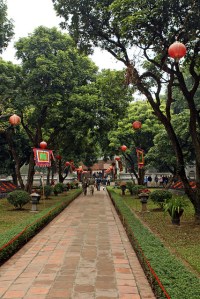
The photo below was taken as we entered the first courtyard inside the Temple of Literature Complex. You could see the nicely landscaped courtyard that encouraged visitors to slow down from the hectic pace of life, and perhaps spend time to reflect and meditate.

Courtyard

Ba Dinh District

The Ba Dinh district is an area in Hanoi that used to be called the French Quarter as there were many buildings with French colonial architecture in the area. Today this is where many government, political, embassy buildings, and some museums are located, including the Ba Dinh Square (where the Ho Chi Minh Complex is) and the Temple of Literature at the southern edge of the district.

After our visit to the Ho Chi Minh Complex, we continued our Hanoi sightseeing trip with a walk to the Temple of Literature, our next destination. The walk was not that far, about 3-4 large city blocks on the map that took us around 15 minutes or so. During the walk we noticed the difference in the landscape as compared to the Old Quarter where we stayed. The Old Quarter was very dense with small streets and narrow buildings, and the area seemed to evolve organically over the time. The Ba Dinh district area on the other hand seemed to be more spread out, with lots of trees around, and it seemed to be laid out in a planned manner. We also saw that many of the buildings that we passed during the walk were government buildings, and I think we also passed a couple of embassies along the way. This reminded me to the Menteng area in the Central Jakarta that shared similar characteristics, very green and filled with important government buildings and foreign attaches.

Another interesting observation was seeing the banner saying ‘chúc mừng năm mới 2011’ on many of the buildings. They are all written in yellow scripts on red background — two colors that were prevalent everywhere in the city. I didn’t know the meaning, but the 2011 part gave it away — it was ‘Happy New Year 2011’ sign (as it was January 2nd, 2011 when we visited the city). I didn’t expect to see this as widely celebrated as from what I read, the biggest celebration of the year is actually the Vietnamese Lunar New Year (Tết) which usually is celebrated around the same time as the Chinese Lunar New Year. I guess with Hanoi becoming a popular tourist destination, the western/international culture also influenced the locals.

The photo below was taken during that walk. It was one of those signs that we saw. I couldn’t help to notice the color selection. Both colors apparently are quite important colors in the Vietnamese (and its Chinese influence) culture. Red symbolizes joy or happiness and yellow symbolizes wealth — both are what you wish for the new year. However, they’re also the standard colors for the international communism, so I guess they might have double meanings here.

Happy New Year!

Tourist Scam

One thing to be aware of when you’re visiting a foreign country is the possibility of getting scammed. I think when visiting a foreign place, sometimes we looked at things from a rose-colored perspective, expecting the best from the locals we meet and hoping that we would meet hospitable people. While that is certainly a good view to have (rather than the alternative), I think it is also important to be smart and watch for yourself, in case anyone unsuspecting tries to take advantage of the situation.

When we were in Bangkok, we encountered a possible scam near the Wat Pho temple and the Royal Palace. In Hanoi, I almost became a victim of another scam when we were walking around near the Ho Chi Minh Mausoleum to take photos after our visit to the complex. Kristi and I walked near the open grass fields far away from the Mausoleum to take a panoramic view of the area. I guess the cameras gave it away that we were tourists. As I was taking photos, a young Vietnamese lady approached me, and started engaging me in a conversation in English. She introduced herself, and said that she’s a student currently studying to learn about other cultures. Her English was actually quite good. She asked me where I came from, and I told her that I was from Indonesia originally but I now live in the United States. She smiled, and we talked a little bit about the Ho Chi Minh Complex and Hanoi in general, but somehow at one point the conversation turned into her asking me if I could contribute some donations to a fund to help with her education. I was a bit surprised with that request, and politely said no. She smiled again, thanked me for my time, and left. What a bizarre experience…

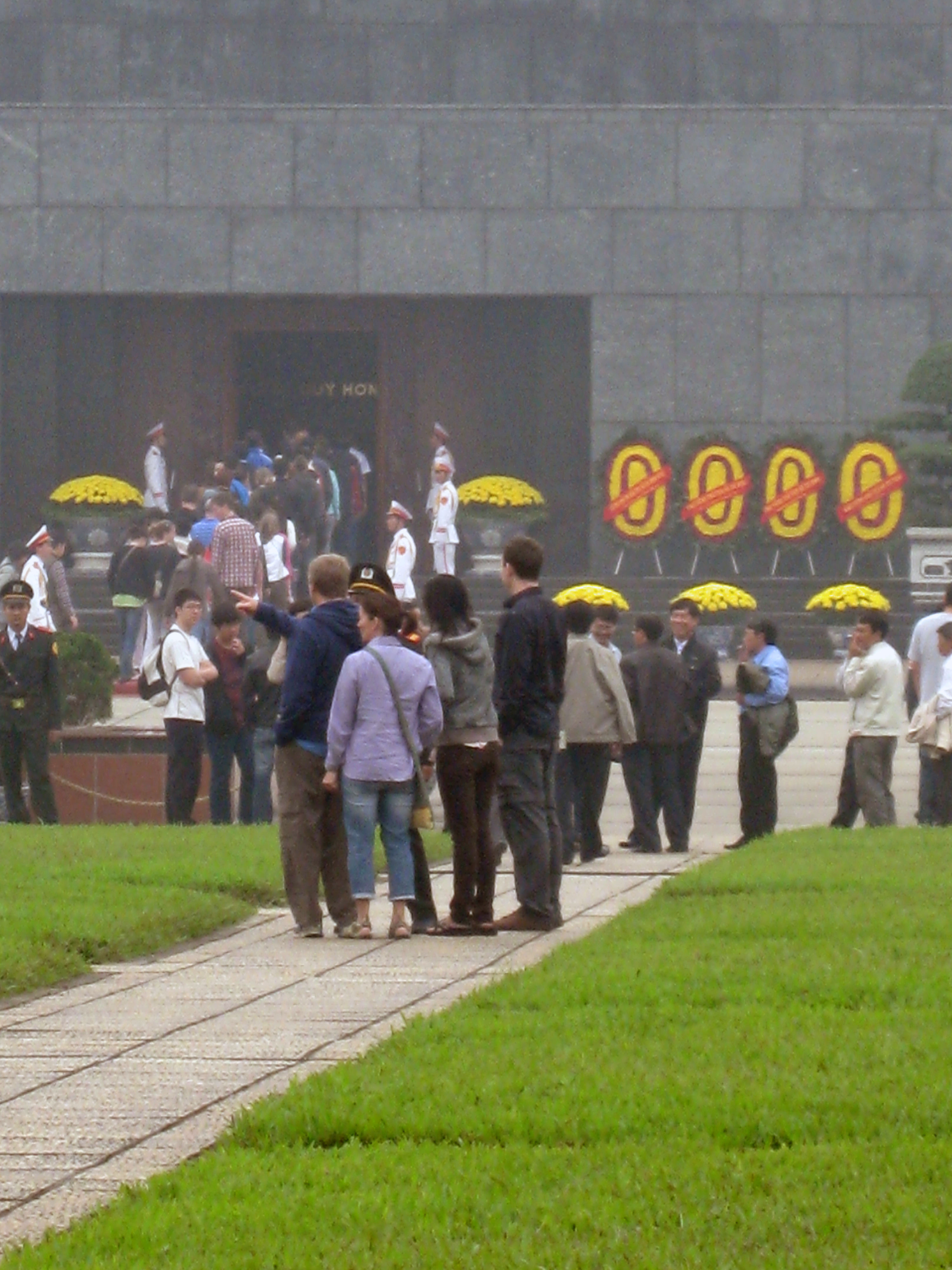
The photo below was something that we observed from far away at Ba Dinh Square in front of the Ho Chi Minh Mausoleum. Several western tourists walked across the open grass field in front of the Mausoleum not knowing that they’re not supposed to do that, and that the entrance to the complex was actually elsewhere. They were stopped by a guard whose job was to watch the open field and prevent people from trespassing. That could be another way that you could get into trouble in a foreign country — not knowing what you can or cannot do.

Confused tourists