Pub Street

Pub Street is a street in downtown Siem Reap, Cambodia, that is well-known among the foreign tourists as a place to visit in Siem Reap. It is located only a few blocks away from the Old Market (Psar Chaa). From its name, you can guess that on this street you can easily find places to eat, drink, and socialize. It reminded me to the area near Sisowath Quay in Phnom Penh or Khao San Road in Bangkok. While you can see activities during the day, the place is even more crowded at night as the foreign visitors who go to the temples of Angkor Archaeological Park during the day come here to have dinner, shop, and relax. The area is popular as a late night destination as well with its clubs and other establishments that open late.

We went to the Pub Street area on our second night in Siem Reap. Initially we thought we might eat at one of the restaurants there as many of them were mentioned in the guidebooks. However, while we were waiting for our hotel shuttle to take us to downtown, we met a British couple who was staying at the same hotel and had been in Siem Reap for several days, and they recommended a restaurant on the Market Street to try out (close to the Pub Street, but not exactly one of the more well-known Pub Street restaurants). We wanted to have dinner at a Cambodian restaurant serving Khmer dishes, not at one serving Western foods. Apparently the restaurants on Pub Street are more catered to the western audience, so while it might be a good place to find dishes like pizza or steak, you might be better off going elsewhere for more authentic Khmer dishes.

We did walk through the street on the way to the restaurant where we had dinner. Pub Street is not that long to cover in a few minutes of walking, and when we went through there it was still early in the evening that the places had only started getting visitors, and in comparison it was not quite as crowded as Khao San Road in Bangkok when we visited few days before. But later on in the night it did get more crowded, especially as the pubs and restaurants on the street were getting ready to welcome the New Year at midnight that night.

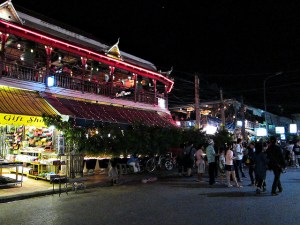
The photo below as taken as walked through the street. This is the Red Piano Restaurant, one of the well-known restaurants on Pub Street that is popular among the tourists. It’s known as the favorite place of Angelina Jolie and her crew to hang out when they were in Siem Reap filming the movie Tomb Raider. Many people said the food there was mediocre quality, but it’s a great place to people watch given its strategic location.

Red Piano

Psar Chaa

Psar Chaa or the Old Market is a market in downtown Siem Reap, Cambodia. The market is quite popular with the tourists in Siem Reap as it is a traditional Southeast Asian market closest to the touristy area where you can experience going to a market just like the locals do. For foreigners who have never been to such marketplace, it could be quite an interesting experience and perhaps even shocking to the senses, as you would see, hear, smell, and if you like, taste things from the market that is quite different from the more sanitized/sterile environment found in modern supermarkets/grocery stores. At Psar Chaa you can also find souvenirs, and the experience of shopping for those and haggling for good price in itself is an interesting activity to do for some tourists.

Kristi and I had been to similar markets in Indonesia, so this was not necessarily in our plan to do, especially since we already found our souvenirs from Cambodia early on during the day. After our full day of sightseeing at the Angkor Archaeological Park, we had the evening free. It was also New Year’s Eve, so we thought we should at least explore the downtown area of Siem Reap for dinner and to see if there were any activities planned out to welcome the New Year. Our hotel, The Kool Hotel, was located about 15-minute drive from downtown, but they had a shuttle van going down there periodically until around 10 pm. We thought we would take the shuttle on the way there, and depending on the time we’re ready to head back to the hotel, we would either take the shuttle back if it’s still available or take a tuk-tuk.

The hotel shuttle drop point was near Psar Chaa, and to go to the main street where the restaurants are located, we would have to walk pass the street where Psar Chaa was located. It was already around 7:30 pm by then, and most of the market stalls were already closed, but there were still some stores that were open and we could get a glimpse of what could be found there.

The photo below was taken as we walked through the street near Psar Chaa. We saw this store that had sausage links and dried seafood hanging. It looked like this lady was looking at the store’s display, though I doubt she would get something from here to take home as souvenir.

Sausage links and dried seafood

Khmer Massage

While traveling, sometimes you may encounter unexpected opportunities to ‘do what the locals do’ that may be out of your comfort zone, but if you keep an open mind and just go with the flow, you might come away with a unique experience.

As we finished our day trip, our guide Vanna mentioned that he was planning on getting a traditional Khmer massage after dropping us back at our hotel. He said he usually went for massage about a couple of times a week — which was good rest and relaxation time for him given his job as tour guide that required lots of walking. He asked if we would be interested in trying that. Kristi wasn’t feeling well and wanted to go back to the hotel, but she encouraged me to try that out since we had plenty of time before dinner time. Back when we were at Wat Pho in Bangkok, Thailand, we skipped the opportunity to try out traditional Thai massage, so she said I should give the Khmer version a try.

It was an interesting experience. I was taken to a room with a row of mattresses, and was given a t-shirt and a pajama pants to change to in the nearby wash room. Once I changed clothes to that, the masseur came in and asked me to lay down on one of the mats. He said ‘hi, how are you doing?’ in English, but pretty quickly I found out his English was not that good and he barely understood what I told him. So I stopped talking and let him do his job.

The traditional Khmer massage is essentially a full body massage that addresses the muscles and the joints of the body. The masseur started stretching, pulling, and pressing various muscles of my body to loosen up any part that was stiff. He didn’t say much while doing it, but he said one word many times, ‘pain?’, whenever he thought he ‘tweaked’ my muscles or joints too much. It wasn’t really painful, but I learned that I’m pretty ticklish at some parts of my body. The massage lasted about an hour, and it did help relax the body after the full day of walking. It was also a unique experience that I didn’t even plan and normally I wouldn’t even think of doing.

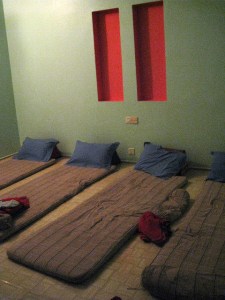
I took the photo below before I left the room after the massage was done and I changed back to my street clothes. You can see the row of mattresses in the room.

Khmer massage

Souvenir

One consideration to make when you travel somewhere is whether to purchase souvenirs for your relatives or friends at home, and what to get for them that would be worth getting and spending your money for. Souvenir means ‘remembrance’ or ‘memory’, so it’s something that would remind you or the recipient of the place where it came from (or the person giving the souvenir). So you would like it to be something that the recipient would appreciate to get, and if it’s from a place you visited, it’s something unique to the place or represents the place. Other obvious considerations would be the cost, and potentially the size and weight of the souvenir to carry with you on your travel (perhaps also whether it’s legal to bring those back to your home country). Another not so obvious consideration is the source where you’re getting the souvenir from. Most people don’t really care as much about this factor (in the US, often times we would look for souvenirs from famous landmarks/places like the Empire State Building or Washington DC’s National Mall and find that those were manufactured overseas where the cost was much lower). But when you visit a developing country like Cambodia, sometimes this could make a big difference for the local people who make the souvenirs as you help provide them with the income they need.

After a whole day of touring around the Angkor Archaeological Park, we ended our day after visiting the Bayon temple inside the Angkor Thom complex. Before we headed back to our hotel, on the way our tour guide Vanna asked us if we would like to stop to look for any souvenirs from Cambodia, knowing that the following day would be another full day of sightseeing and we would go directly to the airport to leave Cambodia after that. I was thinking of possibly looking for some souvenirs for my friends later that night around dinner time, but I thought why not, we had some time and if it’s on the way, we could stop by to look around. So Vanna and Hour our driver took us to a store called D’mouj in Siem Reap on the way to back to our hotel.

Vanna said they would wait for us in the van while we spend some time checking out the goods at the store. When Kristi and I entered the store, we were greeted by the store manager, an Indian gentleman who welcomed us and asked us if there was anything particular that we would look for. The store had all kinds of objects of arts and handicrafts on display, but the main collection seemed to be carpets and various textile-based products. From reading the guidebooks, I knew that Cambodia was quite well-known for its silk products, so I thought for some of my friends it would be nice to get silk scarves if the price was reasonable, as those would be quite light and easy to pack and carry in our travels. The store manager showed us the section of his store where he had the selection of silk scarves. They were quite beautiful and looked very nice. After picking some that we thought would match the color and patterns that our friends would like, we looked at the price, and found out that they vary quite a bit. I asked the manager why that was the case, and he said though all of the silk products there were hand-woven, they varied in quality, and also some were made locally in Cambodia while others were imported from his homeland, the Kashmir region of India. And though I couldn’t tell the difference as much, some of the scarves were silk, and some were actually cashmere wool. Either way, they’re high quality products.

We asked the manager to point us to selection that was made of silk and came locally from Cambodia, as we wanted to bring back souvenirs that are actually from Cambodia, not just bought in Cambodia but made elsewhere. We found the ones that were reasonably priced (expensive for Cambodian standard, but reasonable in comparison to the price overseas).

When the manager had his staff processing the credit card payment for our purchase, we had a nice conversation with him. He asked us where we’re from and where else we were going to go. When we mentioned that we’re from Indonesia, and we’re going to go to Vietnam and Singapore next, he mentioned that he’s been to Indonesia before, and that his family actually had another store in Hanoi, Vietnam, as well. He mentioned that though his family was originally from Kashmir, India (the region that had its share of war / conflict in the last few years), they had been away from home and lived and did business in Southeast Asia for years. He also said that he liked living in Siem Reap and going around the Southeast Asian region in general, and hoping that they would be able to expand their business to other cities in the region.

After finishing our purchase, we said goodbye to the store manager and left the store. We got the souvenirs that we wanted to get, so at least that’s one thing less to think about before continuing our trip. Now looking back, I thought it might be better had we gone to more ‘local’ store that was owned and run by Cambodians where we know the proceeds from the sales go to the locals, and who knows, Vanna and Hour might’ve taken us to that store because they got some kickbacks from the store for the purchase we made (pretty standard practice in tourism everywhere). Oh well… at least we had an interesting experience to remember, and we did get souvenirs that we were looking for and that the recipients did appreciate.

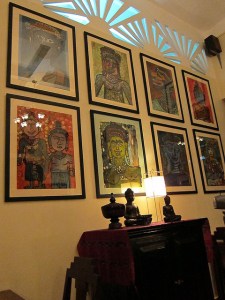
The photo below was taken during our dinner at a restaurant in Phnom Penh called Romdeng. It’s a restaurant run by an NGO with a purpose of providing street kids in Phnom Penh with some training in the hospitality business. The artwork hanging on the wall were done by some these street kids, and they had them for sale with proceeds going towards improving the welfare of the kids and their families. It’s an example of a socially-responsible tourism.
Romdeng Artwork

Bayon

Bayon is a temple at the center of the walled city of Angkor Thom in the Angkor Archaeological Park near Siem Reap, Cambodia. The temple was built sometime in the late 12th century or early 13th century by King Jayawarman VII, who also built the capital city of Angkor Thom as well as some other temples like Ta Prohm, Preah Khan, and Banteay Kdei. The temple is known for its 216 stone faces that adorned 54 towers, and a couple of elaborate bas-relief galleries depicting mythological, historical, and day-to-day scenes from that era. Since it’s one of the last temples built in Angkor, it was also the only temple built primarily as a Buddhist shrine, as compared to most other Angkor temples that started as Hindu temples but then converted into Buddhist temples.

We visited Bayon after we’re done visiting the Elephant Terrace inside Angkor Thom. As we’re entering the temple, we immediately saw the stone faces. Our guide Vanna explained how it’s still debated among historians about whose face that was depicted on these towers. It could be the face of Buddha, but some said it could also be the face of King Jayawarman VII, or it could be both as in the tradition in the Khmer Empire some kings considered themselves as devaraja (god-king). Vanna also noted something interesting in terms of the numbers. There are 216 stone faces on 54 towers, and Angkor Thom is 3 km x 3 km (9 km2 in area). Notice that the digit in the numbers (2+1+6 = 5+4 = 9) all add up to 9. Not quite sure what the significance of the numbers, but it’s pretty neat to see how symmetrical and precise the measurements are.

The other interesting thing to note was the bas-relief galleries that we saw at Bayon. It clearly depicted the life in Angkor at that era, and also commemorating events that happened that represented the high points of the Khmer Empire (e.g., scenes showing the defeat of the Chams by the Khmers).

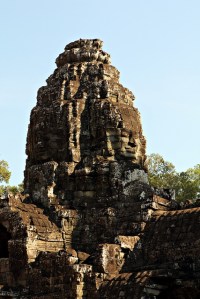
The photo below was taken as we climbed up the stairs of the temple. It was one of the 54 towers with the four faces on. Along with the towers of Angkor Wat and the forest-consumed Ta Prohm, Bayon is among the most recognizable sights in the Angkor Archaeological Park especially due to these stone faces on its towers.

Bayon