Amok trei

After visiting Ta Prohm, it’s time for us to take a lunch break before continuing our visit in the Angkor Archaeological Park outside Siem Reap, Cambodia. Instead of taking longer time to drive to Siem Reap for lunch and back, our tour guide Vanna suggested that we should go to a restaurant located not far from Ta Prohm called the Khmer Village Restaurant. By the time we arrived at the restaurant, it was already 1:30 pm or so, so some of the lunch crowd had already left, but the restaurant was still quite full. Given its location pretty much inside the Angkor Archaeological Park, you could tell that it catered mostly to the visitors of the Park.

We wanted to try another traditional Khmer dish while we were there, and one dish I read that is a popular dish in Khmer cuisine is amok. Amok is a curry dish with coconut milk-based gravy that is cooked in banana leaves. It can be served with various kinds of meats, but the popular one in Cambodia is with fish, called amok trei. I wasn’t sure what kind of fish was used for ours, but I’m guessing it’s likely from fresh water fish like most things in Cambodia. When the dish was served and we tasted it, like some other dishes we had in Cambodia, we could taste something new and unique to Khmer cuisine, but at the same time it seemed familiar as parts of the dish were similar to dishes we have in Indonesian cuisine. I think it was somewhat like in between gulai (the gravy was not as thick and strong flavored) or opor (it wasn’t as soupy). It also resembled a Thai curry dish — not surprising given the regional influence of these cultures on each other.

The photo below was the amok trei dish that we had just before we tried it out. It wasn’t served in banana leaves container, but it had all the flavors that you would expect.

Amok trei

Ta Prohm

Ta Prohm is a temple in the Angkor Archaeological Park north of Siem Reap, Cambodia. The temple was built in 11th century by King Jayawarman VII, the same king who built the city of Angkor Thom nearby. This temple is famous among the temples in the Angkor Archaeological Park given that it had been consumed by the nature around it. Trees and vegetations grew on top of the ruins. The French organization that worked on preservation of the Angkor temples in the early 20th century decided to leave Ta Prohm alone as an example of how nature took over the land from man-made structure after centuries. In more recent years, this temple was also made famous by the movie Tomb Raider with actress Angelina Jolie, as scenes of the movie were filmed there.

We visited Ta Prohm in early afternoon before we went for lunch. The traffic near Ta Prohm was still pretty heavy, but it was better than the hours before or after that as many visitors were at lunch around that time. Along with Angkor Wat, this was one of the main sites we wanted to visit given its unique scenery. It was quite surreal to see large trees standing firm on and around the temple ruins, as if they were in the process of ‘eating’ the structure. We also found the spot where the famous scene of Angelina Jolie coming out of the temple ruins was filmed for Tomb Raider. It was quite easy to locate, as there were many visitors around there waiting to ‘reenact’ Angelina Jolie’s scene and got their photos taken. We didn’t do the same, but I did take a photo of other visitor doing the reenactment.

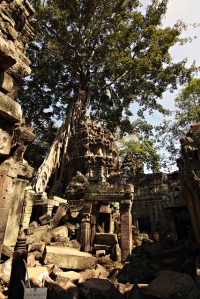
The photo below was taken inside the temple complex. You can see the big tree standing on top of the temple ruins, looking like they are well integrated with each other.

Ta Prohm

Safety Issues

When visiting a foreign country, one thing to consider is the issue of personal safety. Prior to our trip to Cambodia, I did some readings on the safety issue for visitors there, and tried to be knowledgeable and prepared. One important thing to get prior to an international travel like this is a travel insurance, which for a reasonable price could cover potential cost in the event of emergencies (like health issues, theft, etc.). I think regardless where you go, that should be something you should have for your peace of mind.

Specifically on Cambodia, some concerns/risks typically mentioned are: crime (especially in big cities like Phnom Penh), malaria (in rural areas), and landmines (leftover from the war time, but still present especially in rural areas). For us, we were not worried about malaria as we’re only visiting for a few days, and we’re mostly in Phnom Penh and Siem Reap. The landmines risk was not a concern either as we’re traveling with tour guide and on well-traveled path (not going to the jungle on our own). As for crime, I wasn’t too worried initially, but I did have quite expensive photographic equipment in my backpack that might be of a risk for theft. One of the guidebooks I read even said to be careful carrying expensive camera in Phnom Penh as there had been reports of people getting their camera snatched by people on motorbike while walking on the sidewalk.

I asked our tour guide Vanna about that, whether we need to worry about theft. Vanna said that he thought Siem Reap area in general was a safe place to be; we need not worry about getting mugged or anything like that. He said generally when things were lost, people were pretty honest and items were found or returned, though if you have cash in a wallet, for example, those might not be recoverable.

I didn’t think much about this, until after our trip to Banteay Srei. After we visited the temple, we stopped near the public restroom area as Kristi needed to use the restroom. Vanna and I waited for her outside, and we had pretty good discussions about some things. After Kristi was done, we went to our van to continue our day trip. We had been driving away for about 15 minutes or so when I realized that I didn’t have my DSLR with me. I looked around my seat in the van, and couldn’t locate it. So we immediately took a U turn and rushed back to Banteay Srei. The restroom area was the last place I remembered having the camera with me.

When we reached Banteay Srei, Vanna and I ran to the restroom area, and when we got there we saw a local Cambodian family holding my camera, and trying to figure out who the owner of it was. I went to them and use hand gestures to told them that it’s mine, and then showed them a couple of photos on the camera that had my photo on it to prove that it was mine. I thanked them for keeping the camera, and we left Banteay Srei to continue our trip.

Vanna said that I was very fortunate that we got back in time to retrieve the camera, and that there were these honest people there who ‘kept’ the camera until the time we came and retrieved it almost half an hour after we left there. Afterwards, I thought about the whole situation, and I wondered how I would’ve felt had I lost my camera. Though obviously there would be the monetary lost — the lens on the camera was more expensive than everything else I carried during that trip combined — I think what I would’ve lost even more were the shots I had in the memory card that couldn’t be replaced. So I would agree with Vanna — I was very fortunate — and it also taught me some lessons: 1) always back up your memory cards, 2) you should have travel insurance in case the unfortunate event happened to you, 3) if you’re not careful with your belongings, you can lose it, no matter where you are, and 4) there are honest people everywhere and don’t have stereotype or assumption that because you’re going to a developing country, people are after your expensive belongings.

The photo below was taken that morning at Banteay Srei as we entered the temple. The crowd size was still pretty reasonable in the morning — there were more people coming later in the day.
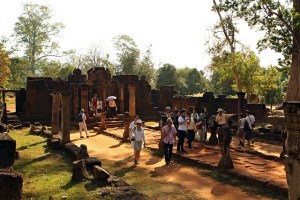
Crowd at Banteay Srei

Banteay Srei

Banteay Srei is a temple located about 25 km north east of the main temple complex of Angkor Thom in the Angkor Archaeological Park area near Siem Reap, Cambodia. The temple was built in 10th century and it was dedicated primarily to the Hindu god Shiva. The temple was built largely of red sandstone, a medium that allowed for very elaborate wall carvings that are still observable today. Even though the size of the temple is much smaller compared to others in the Angkor area, because of its intricate details it is popular among tourists to visit. The name Banteay Srei means ‘the citadel of women’ or ‘the citadel of beauty’, supposedly referring to the intricate details in the temple and the many devata (female deity) figures carved into the wall of the buildings.

We went to Banteay Srei as our first destination to visit during our day trip in Angkor Archaeological Park after the sunrise viewing at Angkor Wat and breakfast at nearby restaurant following that. Our tour guide Vanna suggested to go to Banteay Srei first and then work our way back closer to Siem Reap during the day. We hoped to beat the crowd there by going in the morning.

The drive to Banteay Srei from Angkor Wat took us through the Angkor Thom complex. We got a glimpse of the many temples that made up this ancient city. After passing Angkor Thom, we drove through several villages on the way to Banteay Srei. Vanna explained that the typical houses in the villages were built on stilts above the ground to provide clearance for the times in the rainy season when the area might get flooded. It also provides protection for the pets from wild animals, and practically, it provides some shade during the hot sunny day.

When we arrived at the temple, there were already a lot of other visitors there coming before us. We had our entrance passes checked before entering the temple, and then spent some time inside observing the intricate details of the temple. Since the size of the temple is smaller compared to other temples in Angkor area, there were many areas where we had to took turns with others to get closer and take photos. That’s why Vanna wanted to get there as early as we could so we didn’t have to contend with bigger crowd.

Vanna also told us again about the stories and myths behind the Hindu gods. Again, after a while things got blurred in my head — all I remembered was that Shiva and Vishnu were the two gods that seemed to be prominently represented in many of the temples, and Vanna said Vishnu was his favorite one given his role as the one who provides sustenance to the world.

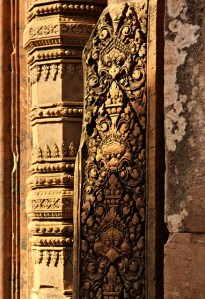
The photo below was taken as we toured inside Banteay Srei. You can see the intricate details of the wall carvings. The morning visit was also nice from photography perspective as the light was not too harsh.

Intricate details

Sunrise at Angkor Wat

After a good night rest following a long day that started with a trip from Phnom Penh to Siem Reap, followed by a visit to Angkor Wat and Phnom Bakheng, and completed with attending an apsara dance performance over dinner, we’re ready for another day full of activity in Siem Reap area. We started very early in the morning, leaving our hotel around 6 am when it’s still dark. The first activity of the day, back to Angkor Wat to watch the last sunrise of year 2010.

This activity was as popular among tourists as going to Phnom Bakheng to watch the sunset. It was still dark when we arrived at the entrance gate to the Angkor Archaeological Park, but we could tell that it would be quite a crowd judging from the line of cars waiting to get the entrance passes checked by the officials.

When we arrived inside the Angkor Wat complex, there were already many people in there, mostly waiting near the pond in between the library and the main temple building. That seemed to be a popular spot to wait for the sunrise as from there you could see the silhouette of the temple with the sun rising behind it, and the temple reflected on the pond.

The area near the pond was already full of people, so I decided to set up my camera and tripod a little bit further to the side so I had room to capture the image with long exposure at low light with the tripod support. It worked pretty well, though there were several takes that had to be redone because I had people walking in front of my camera setup as they didn’t realize I was taking photos there.

After a little while, the sun had been rising for a few minutes and it’s getting brighter. Many people had left the pond area, so Kristi and I decided to get closer there to take photos of the temple reflected on the pond. I was able to still get the effect of sun rising by changing my shutter speed to be very high. That allowed me to take some photos like one below without the aid of tripod — very helpful as there were people around me that made it difficult to do any set up at all that require space. It was a great experience, and I was glad that it was a nice, clear sky and we could see the sunrise nicely as we hoped for.

Sunrise at Angkor Wat