Sunset at Phnom Bakheng

Phnom Bakheng is a temple in the Angkor Archaeological Park near Siem Reap, Cambodia. The temple is located on top of a hill, thus from the temple one can get a nice panoramic view of the surroundings, including Angkor Wat not far away from there. This temple is one of the oldest in the area, being built in late 9th to early 10th century. Today it is becoming a popular place to go especially around sunset time. Given its age and the high volume of visitors, it is among the most threatened monuments in Angkor.

We went to visit Phnom Bakheng right after finishing our tour in Angkor Wat. It was a pretty short distance to go from Angkor Wat to the base of the hill where Phnom Bakheng was located. From there, we joined hundreds of other visitors hiking up the hill (about a mile or so) towards the temple. When we get to the base of the temple, our tour guide Vanna told us that he would wait there while Kristi and I climb up to the temple. He’s been there many times, and there were so many people going up there that he said it’s better for him to just wait there while we go up and enjoy the panoramic view.

The steps to climb up to the temple were quite steep; we had to go up very very carefully. Once we got up there, we saw so many people already waiting for the sun to go down. We followed suit and just waited, and took photos around the sunset time just like everyone else. I lost my directional bearing while up there and couldn’t really locate where Angkor Wat was, as I was hoping to be able to see Angkor Wat complex from higher elevation. Only later on after I got back to my hotel and looked at the area map that I realized most people were so focusing on the sunset in the west, that not many people were really looking at Angkor Wat that was located southeast of Phnom Bakheng.

After the sunset was done, we continued with a careful stepping down to the base of the temple. Again, it was quite steep, and with many people trying to go down around the same time (before it gets too dark), it was quite an interesting experience. I understood then why Vanna didn’t want to go up there…

The photo below was taken around sunset time when everyone was enjoying the view of a beautiful sky and the sun setting in the distance. I decided to take the photo to include the people around me taking photos. It was impossible to get just the photo of the temple and the sunset without the crowd; having them as part of the photo actually gave it a ‘sense of place’ that helps tell the story about the experience up there with other folks at sunset time.

Sunset at Phnom Bakheng

Worship at Angkor Wat

When visiting Angkor Wat, most foreign visitors come to see a magnificent monument / structure and the intricate details of the bas reliefs in the galleries of the main temple structure. One thing to note, however, is that Angkor Wat is still actively being used as a place of worship by the Cambodians. As such, I think it is important to have the proper respect and reference when coming to visit the place.

As we walked around the main temple building, we saw tourist groups accompanied by their guides visiting the galleries and looking at the details. When we reach certain parts inside the temple, however, we noticed that there were not as many foreign tourists there, but instead you see local Cambodians coming and setting up mats in front of statues of Buddha, and brought with them offerings to use for worship. In one of the guidebooks I read, it mentioned that during the Lunar New Year time, this was even more pronounced as the locals would come in numbers to worship, and this might be the time for tourists to yield to the locals and instead observe the use of the temple as it is intended to be rather than simply as a historic monument.

I think it’s also important that before coming to visit places like Angkor Wat that has special meanings to the locals to be reverent and pay the due respect to the traditions and culture. Often times you see visitors who come and think that because they’re the guests who paid their way to come and visit, they should be treated like royalty and they can do whatever they want. That’s very insensitive, and it’s what often times give certain group of people bad stereotypes from the locals.

The following photo was taken from a little distance when I saw the locals in the process of doing their worship ceremony. We watched silently from a bit of distance to ensure that our presence did not cause any distraction or interruption to the worship ceremony that was in progress.

Worship

Tourism at Angkor Wat

When visiting Angkor Wat, one thing you’re sure to notice is that you’re not alone; there are thousands of other tourists from all over the world coming to see the same sights in the area. So if you’re imagining having the place for yourself and take photos like what you might have seen in guidebooks, well, good luck…

The increase in tourism in the area in the recent years is definitely welcomed economically for a country like Cambodia that is in the process of recovering from years of civil war. But I thought it’s interesting to observe this first hand, and to hear the thoughts from a local Cambodian like our guide Vanna.

It’s pretty easy to notice the official tour guides in Cambodia as they are required to wear a uniform (tan-colored, long-sleeve shirt). What’s interesting is when you listen closely to the tour guides talking to to their guests, you might actually hear these Cambodian tour guides speaking fluently in many foreign languages. Vanna was very fluent in English; he even volunteered as an English teacher during his time off from guiding. During our tour around Angkor Wat, we also overheard other Cambodian tour guides talking in German, French, Japanese, and Chinese to their respective guests. Vanna said each tour guide pretty much decides what language he/she wants to master, and then they would look to guide tour groups that speak that language. English, French, and German were pretty popular languages for most visitors from Western countries, but apparently in the recent years there were quite an increase of tourists coming from other Asian countries like Japan, China, and Korea.

I asked Vanna if he had any particular group of people that he preferred or liked guiding. He said generally the Europeans and Americans were pretty nice. The Japanese were generally quite generous. He didn’t like the Koreans because typically they came in big groups with their own Korean tour guide, and his words were translated into Korean by the guide and most of them wouldn’t listen anyway.

Another thing I noticed was there were many little kids and locals trying to sell snacks, drinks, and bootlegged guidebooks to the tourists. During a hot day, sometimes those bottled waters might be nice even though they might be overpriced. And I’ve read that the bootlegged guidebooks, though might be a bit poor in print quality, might be a good, informative reference to have especially if you’re exploring on your own. What’s impressive though was to hear even some of the kids that must have been the age of 5 to 10 years old being able to promote their goods in fluent foreign language like English, and they could have conversation with the tourists when asked about what they have to sell.

One thing I also thought was the interesting contrast between the tourists who have come from far away to see such a magnificent sight, perhaps for that one time in their lifetime, and the locals who live nearby and have seen Angkor Wat on daily basis. It’s no longer a special place, and I suppose when you’re trying to make ends meet, the last thing you think about is learning about the history of the temple…

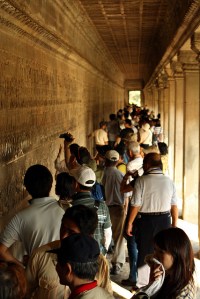
The photo below was taken as we walked through one of the galleries at the temple. You could see the tourist groups, each listening to a tour guide wearing tan long-sleeve shirt.

Tourists at Angkor Wat

First Visit to Angkor Wat

So you plan to visit one of the world’s famous monuments like Angkor Wat in Siem Reap, Cambodia, and now you’re finally there… now what? I think for most first-time visitors coming to Angkor Wat, what they’re expecting to see is something that’s big, grandeur, magnificent, as that’s what you read about or even see in travel programs featuring the place. But just like many other iconic places like that in the world (the Grand Canyon and Statue of Liberty came to mind), you really need to come and see it in person to be able to put your own words on the experience. And I think a combination of having done some homework to learn about the place, having a knowledgeable guide to accompany you experiencing the place, and being observant of what you’re seeing around you (the details, other visitors’ take on the experience, the locals, etc.) would enhance your experience there.

For me, prior to coming to Angkor Wat, I had done some cursory readings of guidebooks on Cambodia (the ones from Lonely Planet and National Geographic Traveler are quite good) and watched a couple of travel programs on TV on Angkor Wat / Cambodia. So in my mind, I had quite an expectation of seeing something ‘grand’ and ‘large in scale’. As I mentioned yesterday, the initial approach to Angkor Wat was not what I expected. After getting our entrance pass to visit the temples, we continued our drive, and we saw what looked like a lake or river on the side of the road. I asked Vanna our tour guide if that was a lake, and he said, ‘No, that’s the moat that surrounds Angkor Wat. You’re looking at Angkor Wat across the moat.’ From the distance, we only saw trees in a forest across the moat; there were no magnificent temples to see from the ground level. But few minutes after, we approached the west side of the complex where the entrance gate and bridge was located, and then I saw the outer part of the magnificent temple complex for the first time.

Our driver dropped us near the bridge, and after showing our newly-printed entrance pass to an official who checked that near the bridge, we walked across the bridge just like hundreds of other visitors to enter the temple complex. Honestly, at that moment, with so many visitors who are clearly tourists (a large number of them came as part of large tour groups in big tour buses), it felt more like walking in from parking lot to the entrance of an amusement park. Fortunately we didn’t have to wait for a long time to go through the gopura (gate) to get to the pathway towards the main temple building. This was where you could hear the ‘oooh’ and ‘aaah’ from the visitors and they saw the panoramic view of the magnificent temple building for the first time.

The next thing I noticed was that there were a lot of tourists there. We came to visit towards the end of the year where it was somewhat of a ‘high tourist season’ there, so that was somewhat expected. But there were a LOT of them… So we had to work our way around large tour groups as we walked into and toured the interior of the temple building.

We spent about three hours walking around the temple interior. Vanna turned out to be quite knowledgeable about the history and the details of the temple — I could tell he’s done his own study on the topic, and had done the tours many times before). He gave us an overview of the history of the Khmer Empire around the time when Angkor Wat was built. King Suryawarman II built the temple as his state temple and capital, and since he dedicated the temple to the Hindu god Vishnu, some said that was the reason why Angkor Wat complex is oriented to the west, contrary to most of other temples in the area that had eastward orientation.

Around the temple interior visitors can observe the galleries of bas-reliefs that depicted stories from Hindu epics Ramayana and Mahabharata and one section depicting King Suryawarman II and the life in the Khmer kingdom at the time. As we went through these galleries, Vanna gave pretty good overview of the scenes/stories that were depicted on the wall. I tried to follow along, but honestly there were so many details that after a while things kind of blurred together in my head, so I thought I’d just remember the main themes, and focus on taking detailed photographs of parts of the bas-reliefs that seemed to be good representatives of the story, and moved on. I think that’s probably similar case for most of the visitors who came there — they didn’t spend as much time looking for the details because they were part of large tour group that had to keep moving on, or they didn’t care as much learning about the details. If you really want to take in as much as you can and appreciate what you’re seeing there, I think it’s probably best if you allocate at least a day of your visit to be go there on your own and just take your time to observe the details.

The photo below was taken as we toured the interior of the temple. This was one of around 3,000 apsara (celestial dancer) figures that were carved on the temple walls. This particular one looked like she was looking from behind the wall of carving, and the afternoon light came through at an interesting angle from the left.

Apsara behind the wall

Angkor Wat

Angkor Wat is a temple complex within the Angkor Archaeological Park, located about 6 kilometres north of Siem Reap, Cambodia. It was built almost 1,000 years ago, and it is among the most well preserved among the temples in the area. It remains to be used as a major religious center in Cambodia (it was a Hindu temple, now it’s a Buddhist temple). Given its grandeur, it has become the national symbol of Cambodia, and it’s the country’s primary tourist attraction today.

The temple complex was designed in a Khmer architectural style, with a site plan that resembles temple mountains (temples inside that looked like pyramids, with the center part elevated representing the sacred Hindu mountain, Mount Meru, and having the temple complex surrounding by a moat representing the ocean). The temple buildings are also decorated with intricate bas reliefs depicting several stories from Hindu myths.

Angkor Wat was the first temple we visited during our visit to the Angkor Archaeological Park. Our guide Vanna suggested that we visited Angkor Wat first before visiting the other temples not only because it’s the most magnificent to see, but also to provide good overview of the history and the Khmer architecture style.

When we approached the complex for the first time, from a distance we saw what looked like a lake. I didn’t realize that it was moat that surrounded the Angkor Wat complex. Once Vanna mentioned that, we saw the front entrance to the temple — full of tourists from all over the world.

The photo below was taken as we entered the temple complex. You could see the large crowd of tourists, and in the distance part of the temple towers were covered with construction nets as it was in the middle of restoration works. It’s unfortunate that it looked like an eyesore, but it was necessary to preserve this magnificent structure so it can be enjoyed by future generations.

Angkor Wat