Wat Phra Kaeo

The Wat Phra Kaeo or the Temple of the Emerald Buddha is a Buddhist temple located inside the complex of the Grand Palace in Bangkok, Thailand. This temple is considered as one of the most sacred sites in Thailand, but given its location at the Grand Palace and also its quite ornate architecture, it is a popular destination for both the locals and tourists alike.

When you visit the Grand Palace complex, you would enter through the part where the Wat Phra Kaeo is located. First you would have to go through a security line that also doubles as a checkpoint for the visitors’ adherence to the strict dress code for visiting the temple. During our visit we actually saw some foreign visitors being asked to go back to get the appropriate coverings before entering the temple area.

Once you’re inside the temple area, you can see a long wall around the temple area that is decorated with murals depicting the story of Ramakien (Thai’s version of Hindu epic Ramayana). The murals are divided into 178 scenes. They are so intricate, and they are well maintained. When we visited, we saw a gentleman in the process of meticulously hand painting parts of the murals with his fine brush.

The central part of the temple complex is the Wat Phra Kaeo itself, a large building housing the Emerald Buddha statue. The building itself is quite impressive; it has rich marble floor, and the walls and pillars are inlaid in colorful mosaic. From the entrance, you have to walk to the other end of the building to see the entrance to temple. You can walk in and see a section reserved for worshippers in front of the Emerald Buddha that sits on top of a big mound. The Emerald Buddha statue itself is a pretty small statue made out of jade. Given that this is an actual worship site, you have to be reverent and watch quietly while worship session is going on. Photography is not allowed inside the temple.

Outside the temple, there is another area also where worshippers perform ceremonies. I thought it was interesting to see so many people around, mixed between locals who came to worship and tourists who came for sightseeing. I wonder how one could concentrate and focus in worshipping when you have many foreigners around observing and taking your photos.

The temple grounds also include some large pagodas to its immediate north, including the Phra Si Ratana Chedi, a large golden stupa that’s probably the most recognizable feature of the temple complex. There is also a miniature scale model of Angkor Wat, the most sacred religious site in the Khmer Empire (Cambodia). Quite curious to see this in the complex — it was started by King Mongkut and completed by King Nangklao as the memorial of Angkor Wat and Kingdom of Cambodia that have been occupied by Siam for many hundred years until the colonization of Kingdom of Cambodia by France. I couldn’t help to think of this in comparison to the name of the area where Angkor Wat is located, Siem Reap (which in Khmer it’s translated to ‘the defeat of Siam’). Both the miniature model of Angkor Wat in Wat Phra Kaeo complex and the name of the area in Cambodia give you hints about the animosity between the Thai and the Khmers, two neighboring kingdoms that were in war with each other for long period of time.

The photo below was taken outside the Wat Phra Kaeo temple building. You can see the intricate decoration of this building. It’s awesome to look at as a whole, but it’s even more impressive to look at the intricate details of the decoration.

Wat Phra Kaeo

Grand Palace

The Grand Palace in old, downtown Bangkok, Thailand, is the official residence of the King of Siam since 1782. Though the present King, King Bhumibol Adulyadej, now resides in a different palace, the Grand Palace is still used for many formal functions. The complex includes The Temple of Emerald Buddha and several buildings that are used by the royal offices. It is now open to public as a museum, and it is one of the popular tourist attractions in Bangkok.

If you like to visit the Grand Palace, there are some things to note. First, as mentioned in a blog post a couple of days ago, beware of anyone that tells you outside the complex that the Grand Palace is closed for ceremony or for any functions. Often times these were scammers who will then try to offer you alternative to go elsewhere for sightseeing. You should go to the main entrance of the palace and check it for yourself; if you can’t get in or the ticket office is closed, then it is indeed closed. In our case, we ignored a couple of people who told this to us, to find the main entrance was full of tourists visiting the Palace.

Second thing to note is that there is a strict dress code for those who want to visit the Grand Palace complex, especially the Temple of Emerald Buddha area. Men must wear long pants and shirts with sleeves — no tank tops. If you’re wearing sandals or flip-flops you must wear socks (in other words, no bare feet.) Women must be similarly modestly dressed. No see-through clothes, bare shoulders, etc. If you show up at the front gate improperly dressed, there is a booth near the entry that can provide clothes to cover you up properly. You must leave your passport or credit card as security.

Another thing to note is that the Grand Palace is not easily reachable from the Metro system in Bangkok, but it is close to one of the piers of the Chao Phraya Express Boat. So you can take the BTS SkyTrain to the Saphon Taksin station, then embark on the ferry boat at the Central Pier on the river bank not far from the SkyTrain station.

We spent some time inside the Grand Palace complex, mostly near the Temple of Emerald Buddha area. I think our ticket also included a visit to one of the halls, but we ended up skipping that part of the complex as it was already around noon, it was hot and humid, and we still needed to walk to another area in downtown Bangkok to look for lunch place.

The photo below was taken inside the complex, near some of the big halls. They’re quite elaborate and large buildings — I couldn’t capture them easily in one photo frame.

Grand Palace

Thai King

When you visit a foreign country, you should come prepared and learn a little bit about their culture. One important thing in a foreign culture to learn is about the cultural do’s and don’ts — make sure you know what they value, and avoid doing things that are considered as disrespectful. In Thailand, one of these etiquettes is in talking or referring to the Thai King. There is actually a law that considers speaking ill about the King, the Queen, and the Heir Apparent as crime, and it’s serious enough that those found guilty of this violation can be sentenced to anywhere between three to fifteen years in prison.

For those coming from countries like the United States where there is so much emphasis on ‘freedom of speech’ (which in politics sometimes are taken quite far to even stretching the truths and saying negative things about other people), this ‘lese majeste’ rule seems to be too much. But I think you should consider looking at this from the point of view of the Thai people. They see their King as someone to admire, as he has many accomplishments and is known to be very committed to improve the conditions of the poor and unfortunate in his country. King Bhumibol Adulyadej has reigned since 1946, making him the world’s longest serving current head-of-state and the longest reigning monarch in Thai history. Throughout his reign, the King has accumulated a long list of royal nation-building projects ranging in scope from health to agriculture to education. In return, the nation displays their dedication to the King in their daily lives. You see the King’s photo in front of offices and on the wall of homes and stores, and people voluntarily wear yellow on Mondays to honor the day of the week when the King was born.

During our visit to Bangkok, we saw the photo of the King everywhere — what was interesting for a photographer like me was to see that on some of these posters, the King was shown with his Nikon camera hanging on the neck strap. Apparently photography was one of his hobbies. He is also an accomplished jazz musician and composer (known for his works on alto saxophone), an accomplished sailor and sail boat designer (he had won sailing races and designed several small boats), and a patent holder (for waste water aerator and rainmaking equipment). So quite an illustrious life — and no wonder his subjects revere him. During a tour while in Bangkok, our tour guide mentioned the Thai’s reverence to their King by telling the story about the city of Bangkok preparing fireworks and big celebrations for the King’s birthday so he could see those from his hospital bedroom (the King has been hospitalized since 2009 with various ailments).

The photo below was taken outside a building near the Grand Palace. We saw this as we walked from Wat Pho to the Grand Palace entrance. It was the first among many we saw around the city during our full day in Bangkok (which happened to be on a Monday — the day of the week when the King was born).

Poster of King Bhumibol Adulyadej

Wat Pho

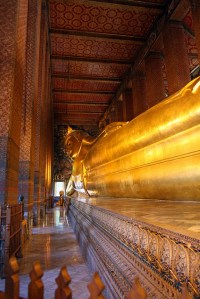
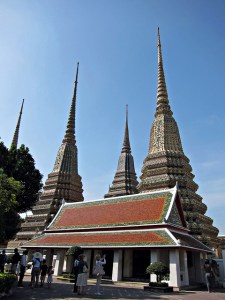
Wat Pho is a Buddhist temple in central Bangkok, Thailand, near the Grand Palace. It is one of the oldest temples in Bangkok, and is a home of more than 1,000 Buddha images, including the large Reclining Buddha measuring 50 ft in height and 160 ft in length. The temple complex is more than 250 years old, and at one point it was the site of center of education for Thai traditional medicine. The temple complex also includes 91 chedis (mounds or stupas) that commemorate members of the Royal Thai family. There are four large chedis in the middle that commemorate the first four Thai Kings.

We visited Wat Pho as the first stop on our full day in Bangkok during the Southeast Asia trip in 2010. Kristi had been there before, so she just waited outside while I went in to check out the large Reclining Buddha. To go in, you first need to purchase a ticket, then you go in line to walk in. You have to take your footwear off and put them in one of the open slots on the long shoe rack outside the temple, as you have to go barefooted inside the temple (it’s pretty much a Thai cultural practice to take footwear off before entering a temple or even a house — to keep the interior floor clean). You can then walk inside and spend as much time as you like going around the large Buddha statue. Most people would go in to take a photo of it (it’s allowed), and then leave. On one side of the temple, there are 108 bronze bowls that represents 108 characters of Buddha. It is said that dropping coins into every single one of the bowls would bring in good luck (the proceeds would help the monks maintain the temple).

After that, we spent some time in the temple complex admiring the colorful buildings and chedis. There are also some writings and pictures on stone wall that illustrates instructions for traditional Thai medicine — helpful for those who back then could not read.

One activity you could also do at Wat Pho if you like is to get a Thai massage. After all, this place is said to be the birthplace of traditional medical practice. I was considering that as an interesting activity to do, but we ended up skipping that and moved on to visit the nearby Grand Palace instead.

The photo below was taken inside the temple. I tried to get as much as I could of the Buddha, and took the photo quickly before other people came and get into the field of view.

Reclining Buddha

Kindness of a stranger… or a scam?

Another part of experiencing a culture is the interaction with the people. You can learn about the good and the bad of a culture from the experience interacting with the locals during your stay. It is helpful, however, to read up about the culture before you go. Many guidebooks (and online travel guides) have good information about what to expect when meeting the locals, and some also warn you on what to avoid.

Our first interactions with the locals during our visit to Bangkok, Thailand, were true to what was said about the Thai. They were very friendly, kind, and you’re met with smiles. We were off to a wonderful start during our full day in Bangkok with an unexpected birthday gift for my cousin Kristi from our hotel staff. We also received helpful advice before we left and the hotel provided us with a map that covers the areas that we wanted to visit. The hotel manager also gave us a curious warning when visiting the Grand Palace: beware of anyone saying that the palace is closed and that you need to go back later. I wasn’t really sure why anyone would tell that to tourists…

When we walked closer to the temple of Wat Pho, a gentleman standing at the street corner came and said hi to us in English. I guess it was obvious that we were tourists — our backpacks, cameras, and maps gave it away. The gentleman asked us where we’re from, our impressions of Bangkok, and where we’ve visited. He also asked where we were going to go. When we mentioned that we’re on our way to Wat Pho, he said Wat Pho was closed at that time of the day due to a ceremony, and that we should come back at later time. Then he asked me for my map, and started pointing out places on the map where there are other temples to visit. He suggested that we visited those first, and then come back to Wat Pho when the ceremony was over. He also said that he could help us finding tuk-tuk to drive us to these other temples as they are a bit too far to visit on foot. We had quite a packed schedule for the day and were planning on being elsewhere for a scheduled tour later on that day, so I politely declined the offer. We were about to continue walking towards the entrance of the temple when he told us to go to the other direction — he said there was nothing to see in the direction we were headed to. I just smiled and continue walking to find out that we were heading to the right direction. The temple was open, and there were other tourists around visiting as well.

Later on, on our way out of the temple to go to our next destination, the Grand Palace, we were stopped by another gentleman at the temple exit. He asked for our tickets, and when I gave him those, he marked the tickets and asked me where I was going next. When I said we were heading to the Grand Palace, he told us that the Grand Palace was closed around noon time for a ceremony, and he suggested that we should visit other tourist attractions before coming back. Sounds familiar? It was the same thing… another scam to get independent tourists to go on tuk-tuk ride elsewhere in the city.

So I think the lesson learned from that experience is to expect the best from your experience interacting with the locals, but don’t let your guard down and be a victim of scams… It’s always good to learn about this beforehand by reading guidebooks or learning from other people’s experiences.

The photo below was taken inside the Wat Pho complex. The large stupas were built to commemorate the first four Thai kings. As you might have guessed… there was no ceremony going on that morning, and tourists were free to come and visit the temple.

Wat Pho