Coast-to-Coast Road Trip

A while ago I wrote a blog post about Route 66, based on a road trip that I did with my brother three years ago. For the next series of blog posts, I’ll write about our experience doing this ‘once-in-a-lifetime’ trip.

When my brother asked me if I would be interested in doing a road trip with him from California to New York, it didn’t take me long to say yes. I had done long road trips in the US before, including some with my brother, but the thought of doing a coast-to-coast trip across the continent sounded intriguing, and I think it would be one of those that we would remember for the rest of our lives. We wanted it to be a good, lasting memory, so we tried to be planned accordingly to make the best use of our trip time.

The main reason for the trip was my brother’s relocation from Santa Monica, CA, to New York City. He had some belongings that couldn’t be easily transported coast-to-coast without paying significant shipping cost, so he thought it would be more cost effective to rent a car for one-way trip, load it up with his belongings, and drive it across the country. Given the long distance, he didn’t want to do it alone.

Since my brother was very busy with the logistics for getting things wrapped up in California before he officially moved for good, he asked me to plan out the trip. I always enjoyed the planning aspect of the trip, so I agreed to take on the task.

The first decision we needed to make was the route we would take for this road trip. The start and end points of the trip were fixed, and we also had a time constraint. My brother had just started with his new work position, so he didn’t have much vacation time that he could take. More over, he had to be back in New York City for an event. Altogether, we had about maximum 6 days time to complete the trip. Considering the distance and safe traveling time, we pretty much had to take one of the direct routes between the two end points without much detours.

Even with the constraints above, we still had decision to make in terms of the route to take. There were several possible routes we could take that would meet the travel time criterion. I used a book by Jamie Jensen called Road Trip USA that was quite helpful in providing overview of the major routes across the country. We decided to take one that is roughly tracing the famous ‘Mother Road,’ Route 66, and then finish out with a route that was pretty familiar to me in the Midwest / Mid-Atlantic area. For the Route 66 part, there were also several books I read to learn about places along the route to decide roughly where we would stop.

Beyond the route planning, we made rough arrangements to meet some people we knew who lived in the places that we passed during this trip. But other than that, we left everything else open as we wanted to keep the trip somewhat flexible.

We ended up going around 3,300 miles over 16 states in five days. The map below shows the route and the stops that we took along the way.

Coast to coast route

Kings Canyon

Kings Canyon National Park is another national park in the Sierra Nevada that is north of the Sequoia National Park. The two parks are contiguous and are connected by a highway. Kings Canyon National Park consists of two parts. One part is the General Grant Grove, which has a smaller concentration of giant sequoia trees compared to the area in the Sequoia National Park. The General Grant Grove includes the General Grant Tree, the largest in the the park and the second largest by volume after the General Sherman Tree in Sequoia National Park. Another part of the Kings Canyon National Park is the backcountry area east of the General Grant Grove, which comprises 90% of the total area of the park. This includes the namesake of the park, the Kings Canyon, which at the maximum depth of 8,200 feet is one of the deepest canyons in the United States.

I visited the Kings Canyon National Park right after visiting the Sequoia National Park. We drove through the General Grant Grove area and continued eastward until we reached the end of the paved highway. It was towards the end of the day, and there were hardly any other visitor in the area, so it really felt like we’re alone in the middle of the nature. It was very quiet and peaceful out there.

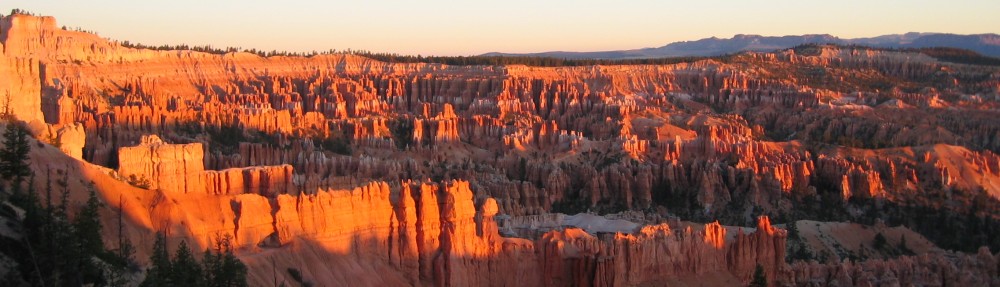
The photo below was taken when we stopped at the east end of the paved highway through Kings Canyon. In the distance is the Kings Canyon and the mountain range around it. We didn’t go on any hike down the canyon, but even just from this overlook we could imagine it would be quite an experience going through the backcountry and experiencing the nature there.

Kings Canyon

Sequoia

Sequoia National Park is located in the southern part of the Sierra Nevada mountain range in California. The national park includes Mount Whitney, which at 14,505 ft is the highest point in the contiguous United States. But it’s most famous for its giant sequoia trees, including the General Sherman Tree, the largest tree by volume on earth.

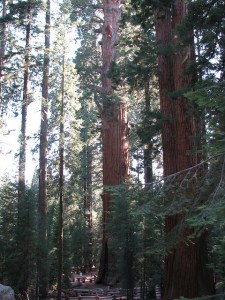
I went to Sequoia National Park on a road trip with my mom and uncle. We drove from LA area where my brother lived at that time. It took about four hours to drive to the national park. We spent an afternoon driving inside the park, starting with a winding road with great view of the Sierra Nevada mountains around, and ended with a drive through the giant sequoia forest among the very large trees. It was quite surreal driving with these giant trees around us; I felt like the scale proportion (between us/our car and the trees) was off. We stopped at a couple of places to observe the trees from up close, and we did the short hike to get to the General Sherman Tree.

The photo below was taken during our hike to see the General Sherman Tree. The tree in the middle is the famous tree from some distance. At a glance, it looked like a normal tree, until you see the little specs at the foot of the tree — those are adult-sized humans around 5′ 5″ – 6′ tall! Here are some statistics that would put this tree in perspective: It is not the oldest, highest, or widest tree in the world, but with a height of 83.8 metres (275 ft), a diameter of 7.7 metres (25 ft), an estimated bole volume of 1,487 cubic metres (52,513 cu ft), and an estimated age of 2,300 – 2,700 years, it is among the tallest, widest and longest-lived of all trees on the planet.

General Sherman Tree