Tonle Sap

Tonle Sap is a combination of a lake and river system in Cambodia that has very significant impact to the lives of people in the country. It is the largest fresh water lake in Southeast Asia. It is also very unusual for two reasons: its flow direction changes twice a year, and the lake expands and shrinks dramatically between seasons. For most of the year, the lake is fairly small and shallow, around 1 meter deep and about 2,700 km2 in area. However, during the monsoon season, the Tonle Sap River reverses its flow and pushes water from the Mekong River into the lake, increasing its area to 16,000 km2 and its depth up to nine meters, flooding the surrounding area. The floodplain provides a breeding ground for fish, and the area is among the most productive fisheries areas in the world. It supports a population of around three million people, and it accounts for 75% of annual fish catch in Cambodia.

After we had a little bit rest after the sunrise trip to Angkor Wat, we packed up and checkout from our hotel for our last day of sightseeing in Siem Reap area that would end at the airport as we would continue our trip to Vietnam at the end of the day. The first place on our agenda was to visit a floating village on the Tonle Sap in an area called Chong Kneas. We drove about an hour southwest of Siem Reap to get to the port before boarding a small chartered boat that would take us to the floating village. On the way to Chong Kneas, we passed villages with houses high on stilts. Our tour guide Vanna explained that they needed to do that because these villages would be flooded during the monsoon season as the Tonle Sap expanded to cover a much larger area.

Vanna showed us the map of the Tonle Sap area to give us an idea the area comparison of the lake surface between the low and the high season. On the map, the area in blue marked as Tonle Sap lake is what it’s like when it’s in low season. The red lines around the lake are actually National Highways, but the reason why they’re built where they are (further out from the lake) is because during the monsoon season, the lake size is roughly close to where those red lines are located. That’s definitely quite unique, and the people who live around the lake had learned to adapt to the changes, and hey are also dependent on the lake to support provide sustenance and as a major source for the regional economy.

Tonle Sap

Camrys

When visiting Cambodia, one thing you will notice on the street is the popularity of a Toyota Camry. It seems that if you go anywhere, if you go on a sedan, it’s likely to be a Toyota Camry. Not really sure how that came about, but these days a lot of used Camry, mostly five years old or older, are imported from other countries like the United States and sold in the used car market in Cambodia.

During our visit in Cambodia, when we were in Phnom Penh we had two separate drivers who took us around on the first couple of days there. Both drove Camrys. When we were in Siem Reap, we went around in passenger vans, so those were not Camrys. But we still saw many of them around also in Siem Reap. On the New Year’s Eve night, while waiting for our hotel shuttle to arrive, Kristi and I looked around for the cars passing by to see if indeed Camry was the most popular car in Cambodia, and sure enough, I think more than half of the cars we saw that were not buses or passenger vans were all Camrys. We also noticed another model that was pretty common, Lexus RX300. Knowing that Lexus is made by Toyota mostly for the US market, my guess is that these cars were originally used in the US, but then in its later part of life it was sold and brought into Cambodia.

I asked our tour guide Vanna about this. He said, yes, Camry definitely is the car of choice in Cambodia. He said there are three brand names that are household names in Cambodia: Nokia, Honda, and Toyota. Most people own a cellular phone, and while you might find Blackberrys and Apple iPhones occassionally, the most popular brand of phones was undoubtedly Nokia. Not many people can afford to buy cars, so for personal transportation it’s more common that people would buy a scooter, and the most popular brand for scooters in Cambodia was Honda. And for those who have enough money to purchase a car, the popular choice was a Toyota Camry. Vanna said one day he wished he would have enough money to get one.

I looked for a photo among the collection I took during our trip in Cambodia for one that best used for this post. Below is one that didn’t make it to my photojournal album for the trip, but I think it’s a good example of what you see in Cambodia. This was taken from the back seat of our car (a Camry) during a drive in Phnom Penh after we visited the Killing Fields. The scene that caught my attention was the motorcycle on the left carrying bags full of lime, a key ingredient in Khmer cuisine. But you can also see on this photo in the background on the opposite side of the street several other people in scooters (quite a common sight in Southeast Asian countries), and on the right, another car right in front of us, and you guessed it, it’s a Toyota Camry.

Bags of lime and Camry

Breakfast with the Crew

When traveling with a chartered tour group, typically there might be a tour guide and support crew (e.g. driver) who would take the group from place to place. But when it comes time to a meal time during the tour, when the group goes to a restaurant or a particular place to eat, the crew would either be the ones serving the food, or else they would leave the guests eating at the restaurant while they would go separately or wait elsewhere. I noticed that during our first couple of days in Siem Reap; our tour guide Vanna and driver Hour would take us to a restaurant, and then would leave us there to enjoy our meal and meet us outside the restaurant once we’re done.

On our last day in Siem Reap, after we spent the early morning at Angkor Wat experiencing the first sunrise of the year, it was time for us to head back to the hotel to pack up and later on continue with our tour for the day. However, since it’s a private tour and we got to call the shot on the itinerary for the day, I asked Vanna and Hour if we could go to a good place where local folks would go for breakfast, and I told them that Kristi and I would like to have them join us for the meal — our treat. The only ‘requirement’ was that the place we would go to has to be one that both of them would go themselves if they were to go out on their own.

Vanna suggested a restaurant in downtown Siem Reap that was popular with the locals. The price was not cheap for them, but it’s still reasonable enough that he said he would go there once every few weeks or so when he would like to eat out. So we went to a restaurant called Kids Plaza — named that way because it had indoor playground for the kids. Vanna said it’s one of his favorite restaurants in the city, especially good for breakfast.

We had really good breakfast there. Good food (noodle soups, rice porridge, fresh juice) and also good conversations. We found out that our driver Hour used to be a driver at the Amansara, an ultra-luxurious but low key resort in Siem Reap. The Amansara is part of the Aman Resorts, which is a small but among the highest rated hotel groups in the world. The founder of Aman Resorts, Adrian Zecha, is part Indonesian. Hour told the story how Mr. Zecha was very down to earth and friendly to his employees and guests.

The photo below was taken right before we enjoy our meal together. It was a nice experience as we got to thank them for their service taking us to places during our visit to Siem Reap. We also got to learn about their life stories; now we consider them as friends rather than simply people who serve us during our trip. I think if you can, that would be a great idea to do when visiting a place, try to make it personal by building friendship / relationship with the locals you encounter. It makes for a unique, unforgettable experience.

Breakfast with the crew

First Sunrise of the Year

After going to bed early the night before, we woke up early for the experience we had been planning for the trip, seeing the first sunrise of the year 2011 at Angkor Wat. We were ready to go before 6 am when it’s still dark. Our tour guide Vanna and Hour came on time to pick us up. They looked quite sleepy; it turned out that they actually went to celebrate New Year’s Eve in downtown Siem Reap as well, and they stayed there until after midnight.

The short drive from the hotel to Angkor Wat went like the day before — we waited a little bit at the entrance of the Angkor Archaeological Park to get our entrance passes checked. When we arrived at Angkor Wat, however, we realized that there were significantly more people compared to the previous morning. We’re not the only ones with the idea of going to see the first sunrise of the year at Angkor Wat. Perhaps some people even went directly from celebrating in downtown Siem Reap to end their New Year’s celebration with watching sunrise at Angkor Wat.

The picturesque north pond near the temple was already surrounded by the crowd waiting for the sun to rise and seeing the reflection of the temple on the pond. We decided to go to the south pond across the walkway instead. It was less picturesque as the pond’s water surface seemed a little murky, but there were not that many people there. So I set up my tripod and camera to wait for the sunrise. As we waited for the sunrise, we saw a group of Cambodian children with some adult chaperones gathering near us. It seemed like they were a group doing a field trip — perhaps children from villages or from an orphanage. They seemed to have fun; entertaining and great to see on the first day of the year.

The sun finally came up. The sky was a little cloudy, so the sunrise was not as clear as the day before. I was glad we were there the previous day and got the nicer photos already, but it’s still nice to fulfill our plan of celebrating the beginning of the year at Angkor Wat. It’s definitely a New Year’s Day to remember.

The photo below was taken after we took some photos on the south pond. We walked to the other side to watch people watching the sunrise there. You can see the crowd waiting to see the magical moment near the pond.

New Year's crowd

New Year’s Eve

New Year’s Eve is one of the unique times of the year when you have an event that is celebrated widely around the world. There are some iconic places in the world where the passing into the new year would be celebrated and likely shown to others around the world on television (e.g., Times Square, Sydney Harbor, Eiffel Tower, Moscow Red Square), but regardless where you are, there is likely some special events organized to celebrate this event.

When planning for the Southeast Asia trip, Kristi and I knew that we would be passing into the new year somewhere during the trip. So we decided to pick a place that would be memorable to do so; we thought it would be neat to experience the first sunrise of the year at one of the most recognizable landmarks in Southeast Asia, the temple of Angkor Wat. That was the anchor place on our itinerary, and the rest of the travel plans was put together around that. And that means the New Year’s Eve would be spent in the nearby city of Siem Reap.

After a full day of visiting the temples of Angkor, we went to downtown Siem Reap for dinner, and after a nice dinner at the Angkor Palm Restaurant and dessert at the Blue Pumpkin, we walked around in the Old Market area for a while to see the activities around. There were a lot of people around, but that’s probably quite normal in that touristy area especially at that time of the year that’s considered a high season for tourism. When we got closer to the popular Pub Street, however, we started seeing places decorated and crowd started building up as it’s getting closer to midnight. We walked passed the street earlier in the evening and it was still quite empty. As we continued on to another street nearby, we passed an area where there were restaurants set up on the side of the road with open kitchen where cooks were preparing grilled foods. The aroma of the food cooking on the grill was very inviting for the passersby; too bad we already had our dinner.

We decided to head back to our hotel after that, around 9 pm or so, since we didn’t want to oversleep and miss the moment we’re planning to experience the following morning. So we celebrated the passing into the new year… but with the folks in Australia on television.

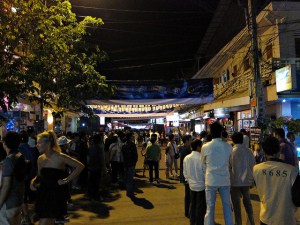
The photo below was taken near the Pub Street. You can see the crowd starting to build up for the New Year’s Eve celebration.

New Year's Eve