Ho Chi Minh Museum

The last building one would see in a tour of the Ho Chi Minh Complex in Hanoi, Vietnam, is the Ho Chi Minh Museum. This big, imposing building was built in the late 1980s and it was inaugurated in 1990 to mark the birth centennary of Ho Chi Minh. The building was built in a shape of white lotus flower. At the center of the building there is a large auditorium that is used for meetings and conferences. The main exhibition floor shows documents and show pieces that highlight Ho Chi Minh’s life and his revolutionary cause.

By the time we reached the museum, I think we’ve gone through enough displays on Ho Chi Minh that we were not that interested in spending more time there. We decided to rest a little bit, and took photos outside the museum, and then looked for the entrance where we came from to find the place where we could claim our backpacks that we left there before coming in.

I’m not sure what the Vietnamese government officially promoted this museum to be, or what the Vietnamese people think of the content of the display. But considering the stereotype of a communist government, and given everything else that we could see that promoted Ho Chi Minh as a national hero (or even higher status than that), I couldn’t help to think that this place might be part of a propaganda campaign to promote the communism values. It’s still interesting to think that even with such government control in place, life in Vietnam (especially in Hanoi as we saw it) seemed to be nothing different than what we see elsewhere — the signs of economic progress and capitalism could be seen everywhere and it didn’t seem that the local Vietnamese felt oppressed by the government.

The photo below was taken outside the museum. I thought it was interesting to note the sculpture at the front of the building prominently showed the hammer and the sickle, the symbol of communism, and there was also the Vietnamese flag in the front (red flag with yellow star). Not that often you would get a picture taken with such symbols in the background.
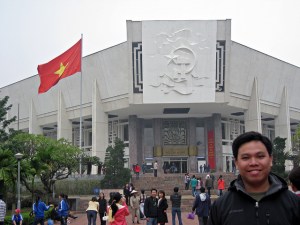
With hammer and sickle

Ho Chi Minh

When we visited the Ho Chi Minh complex, our main reason for the visit was to check out the mausoleum and learn a bit about communism and culture in Vietnam. We knew Ho Chi Minh was an important figure in Vietnamese history, but honestly we didn’t think much about learning about the person. But as I recalled our experience visiting the Ho Chi Minh complex, and read about the life of this historical figure, I learned some interesting facts about Ho Chi Minh that I thought is worth writing about.

Ho Chi Minh was born Ngunyen Sinh Cung. He grew up going to a French school in Vietnam, then he got a job as a cook’s helper on a ship that took him to the United States. He lived for a few years in New York City and Boston area, working various jobs including as a baker at a hotel. Then he made his way to England, where supposedly he trained as a pastry chef to the famous chef Auguste Escoffier. After that, he lived in France where he started learning about communism, and then he moved on to Moscow, Russia, and Canton (present day Guangzhou), China. In China he was involved in the political movement, but he also met a Chinese woman and got married there. Then when the anti-communism coup happened in China, he went into an exile in Moscow, then made it back again to Asia by the way of Paris, Brussels, Berlin, Switzerland, and Italy. He stayed in Thailand for some time, then moved to India and back to China. The British government arrested him in Hong Kong, then quietly released him, and he ended up in Milan, Italy, working at a restaurant there before returning back to China. Then as an adviser to the Chinese communist forces, he also led a Vietnamese independence movement that led to the proclamation of independence and the establishment of the Democratic Republic of Vietnam in 1945. Later on he also led the North Vietnam to fight against the South Vietnam and eventually resulting in the Vietnam War. While the war was still going on, in 1969 Ho Chi Minh died from heart failure, but his followers continued on the fight, and he was still revered as their leader, and his body was embalmed and until today can be found on display at the Mausoleum in Hanoi. After the war, the city of Saigon in South Vietnam was renamed Ho Chi Minh City in his honor.

It’s pretty interesting to observe that the majority of visitors to the Ho Chi Minh complex when we went there were Vietnamese. I didn’t ask what these folks thought of Uncle Ho, as he affectionately was known and respected in the Vietnamese culture, but it’s clear that the government really put him on pedestal as their national hero (though interestingly Ho Chi Minh himself when he was alive supposedly was quite a humble man and did not seek the honor himself).

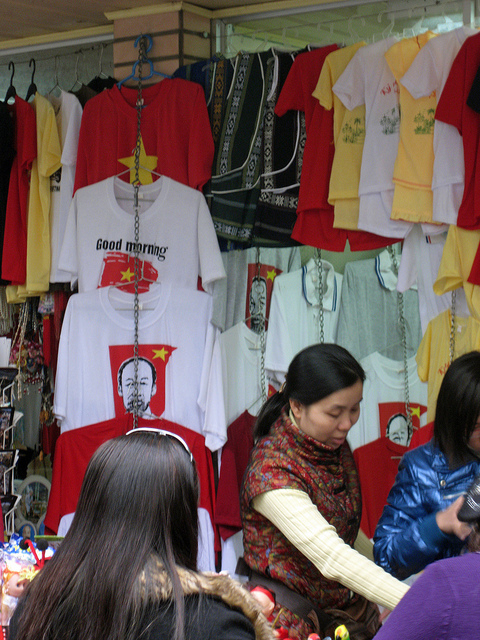
On the way out of the complex, however, we saw a souvenir stall selling t-shirts for tourists. You could see from the photo below that they had the communist flag and even a caricature figure of Ho Chi Minh on the t-shirts. I’m guessing only western tourists would get these (I couldn’t see a Vietnamese wearing one of these and not feeling irreverent or uncomfortable among their countrymen), but I thought it’s interesting that in the end it seems that even in this communist country at such an important landmark you could see the idea of capitalism was present.

Ho Chi Minh T-Shirt