King Father Norodom Sihanouk

I wrote a post last month about the Thai King. Cambodia is also a Kingdom, and it has a King as well. The King’s role is mostly ceremonial, but similar to the Thai people, the Cambodians also revere their King. Their current King is King Norodom Sihamoni, who became King in 2004 replacing his father King Father Norodom Sihanouk who abdicated his Throne due to health reasons. If King Bhumibol Adulyadej of Thailand is the longest reigning monarch in the world, King Father Norodom Sihanouk held the world record for the number of positions that he held during his lifetime. The Guinness Book of World Records identifies him as the politician who has served the world’s greatest variety of political offices. These included two terms as King, two as Sovereign Prince, one as president, two as prime minister, and one as Cambodia’s non-titled head of state, as well as numerous positions as leader of various governments-in-exile.

When Kristi and I visited the Royal Palace in Phnom Penh, we saw an exhibit at the museum dedicated to the life of the King Father Norodom Sihanouk. He was born in 1922 (so he’s 90 years old this year) and first became King in 1941. At the exhibit, there was a photo of him with the first Indonesian President, Soekarno, not long after Indonesia gained its independence. That’s how long he’s been around. People in Cambodia revered him, as evident to him being restored to his position as the King of Cambodia in 1993 after years of being in exile during the Khmer Rouge era.

The photo below was taken when we visited the Banteay Srei temple near Siem Reap. It was the photos of the current King Norodom Sihamoni on the left, the King Father Norodom Sihanouk in the middle, and Queen Monique on the right.
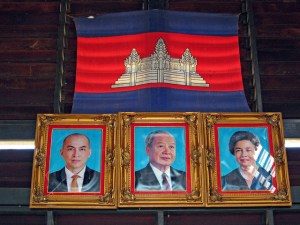
Cambodian Royal Family

Khmer Empire

The most popular place to visit in Cambodia is the Angkor Wat. While in itself it’s already quite impressive being the largest religious structure in the world, it’s even more impressive to learn that it was only one of many temples in an area called Angkor that at one time was the largest pre-industrial city in the world (about 1,000 square kilometres in area — more than 10 times the size of Manhattan). This was during the heights of the Khmer Empire, between the 9th and 15th centuries. The Khmer Empire at its height spans all the way to modern day Thailand in the west, the modern day Laos in the north, and the modern day Vietnam in the east.

During our visit to the Royal Palace in Phnom Penh, we also saw some museum display that showed artifacts from the Khmer Empire era, and particularly interesting to me was seeing a map of the Khmer Empire superimposed on the geographical map of the modern world — clearly showing how vast that empire was. I couldn’t help to think of the contrast between seeing this map that in a subtle way saying the Khmer culture is more superior than its neighbors the Thai and the Vietnamese, and seeing the model of Angkor Wat at the Grand Palace in Bangkok, Thailand, which was built to commemorate the time when the Thai conquered the Angkor area. It’s interesting to think of these two cultures that are both deeply rooted in Buddhism (thus advocating peace and not being confrontational), but they still have the nationalistic pride when comparing themselves with their neighboring countries.

The photo below was taken at the museum in the Royal Palace. It was the Khmer Empire map I mentioned above.

Khmer Empire map

Cambodian Traditional Music

When you’re visiting a foreign country, one way to appreciate the local culture is by by listening or watching traditional performing arts like dances and music. Some cultures have traditional music instruments that might be unique only to their culture, while others may have traditional instruments that are similar to other cultures in the same geographic region. Some of the music pieces are performed among the common people, while others are more for formal, royal functions.

When we were visiting the Royal Palace complex in Phnom Penh, Cambodia, while walking around the Silver Pagoda we heard some sound of music playing in a distance. We walked towards the sound source, and found a pavilion where several people were playing traditional musical instruments as an ensemble. Later on I learned it’s called the pinpeat ensemble, which plays music during ceremonies at the royal court or the temples. The ensemble includes wooden xylophones, a circle of small gongs, and a couple of drums. The music sounded similar to the gamelan ensemble from Indonesia.

As we stood near the pavilion and listened to the group performing, several more tourists came to join us enjoying the performance. Then one of the performers looked at the crowd, and motioned to one of the visitors to come over, and he let her played the instruments for a little bit. I thought that was a wonderful way of letting visitors learn and appreciate your culture.

The photo below was taken as we listened to the group performing. I thought it was great that one of the guys actually looked at us while playing and smiled — showing that it’s not all about being serious and the music was meant to be enjoyed.

Pinpeat ensemble

Thai Buddhism

When visiting Thailand, a very visible aspect of the culture that you will encounter is its main religion, Buddhism. Nearly 95% of Thailand’s population is Buddhist of the Theravada school (the oldest surviving school of Buddhism — conservative and close to the early Buddhism). The religion has been part of the Thai people since the beginning of its history, and it very much influences the culture. Just like you find churches everywhere in Rome, you will find Buddhist temples everywhere in Bangkok. You’re likely to see monks with their orange or red robes everywhere; that’s because becoming monks is considered as a rite of passage for young Thai men. When you interact with the Thais, you will notice their mannerisms that reflect the teachings of Buddha — gentle, respectful, and full of smile.

Before our visit to Bangkok, I learned about this aspect of the Thai culture from reading guidebooks and talking to my cousin Kristi who had some Thai friends and had been in Thailand before. I wondered if this might be somewhat ‘in your face’ and might make a visitor feel uncomfortable or out of place. On the contrary, I thought we had a good experience immersing ourselves in the culture, and it brought out an interest in me to learn more about the culture and appreciate its rich history. What’s sad is that many foreigners (‘farangs’ as the Thai would call them) come to Thailand to look for white sandy beaches or the party scene (or even the darker side — sex tourism) and leave the country completely ignorant of this wonderful aspect of the culture that is rooted in their beliefs.

The photo below was taken in front of a store near the Sao Ching Cha neighborhood of Bangkok. We walked to this neighborhood after visiting the Grand Palace. On the way there we passed a street lined with stores selling statues of Buddha, ranging from the small ones to life-size. I suppose people will purchase these statues for their homes.

Buddha statues

Thai King

When you visit a foreign country, you should come prepared and learn a little bit about their culture. One important thing in a foreign culture to learn is about the cultural do’s and don’ts — make sure you know what they value, and avoid doing things that are considered as disrespectful. In Thailand, one of these etiquettes is in talking or referring to the Thai King. There is actually a law that considers speaking ill about the King, the Queen, and the Heir Apparent as crime, and it’s serious enough that those found guilty of this violation can be sentenced to anywhere between three to fifteen years in prison.

For those coming from countries like the United States where there is so much emphasis on ‘freedom of speech’ (which in politics sometimes are taken quite far to even stretching the truths and saying negative things about other people), this ‘lese majeste’ rule seems to be too much. But I think you should consider looking at this from the point of view of the Thai people. They see their King as someone to admire, as he has many accomplishments and is known to be very committed to improve the conditions of the poor and unfortunate in his country. King Bhumibol Adulyadej has reigned since 1946, making him the world’s longest serving current head-of-state and the longest reigning monarch in Thai history. Throughout his reign, the King has accumulated a long list of royal nation-building projects ranging in scope from health to agriculture to education. In return, the nation displays their dedication to the King in their daily lives. You see the King’s photo in front of offices and on the wall of homes and stores, and people voluntarily wear yellow on Mondays to honor the day of the week when the King was born.

During our visit to Bangkok, we saw the photo of the King everywhere — what was interesting for a photographer like me was to see that on some of these posters, the King was shown with his Nikon camera hanging on the neck strap. Apparently photography was one of his hobbies. He is also an accomplished jazz musician and composer (known for his works on alto saxophone), an accomplished sailor and sail boat designer (he had won sailing races and designed several small boats), and a patent holder (for waste water aerator and rainmaking equipment). So quite an illustrious life — and no wonder his subjects revere him. During a tour while in Bangkok, our tour guide mentioned the Thai’s reverence to their King by telling the story about the city of Bangkok preparing fireworks and big celebrations for the King’s birthday so he could see those from his hospital bedroom (the King has been hospitalized since 2009 with various ailments).

The photo below was taken outside a building near the Grand Palace. We saw this as we walked from Wat Pho to the Grand Palace entrance. It was the first among many we saw around the city during our full day in Bangkok (which happened to be on a Monday — the day of the week when the King was born).

Poster of King Bhumibol Adulyadej