Snails

When eating at a restaurant with very extensive menu, sometimes the difficult part is to decide what to order. There are so many choices, and only a few you can pick especially when you’re going in a small group. Such was the case when we were at Quan An Ngon restaurant in Hanoi, Vietnam. We ended up selecting several dishes, all were dishes that we don’t think we would get at other places in the next few days of our trip in Vietnam. One of the dishes was one that may be considered as a bit exotic to some people: snails.

Though snails may not be common food to eat where I live in the United States, and perhaps is known as gourmet food, in many parts of the world it is actually commonly eaten in poor communities since it’s easily harvested in the fields and it’s a very good source of protein. First time I had snails was at a French bistro in the United States, in the form of the gourmet dish (escargot cooked with garlic butter and herbs). At Quan An Ngon, we noticed the various ways snails (oc in Vietnamese) were prepared — grilled, broiled, steamed, in noodle soup, etc. — and it seems to be pretty popular there. Later I found out that it’s considered as one of the popular beer foods, appetizers that you would have while you’re having drinks with friends. The dish that we decided to get, steamed snails with lemongrass, seemed to a common preparation method as well.

Below is the photo of the dish that we ordered. It came in a claypot and accompanied by several bamboo skewers to use to get the meat out of the snail’s shell. The snail meat itself has unique texture — chewy, crunchy, a little rubbery — that might be a bit difficult for some folks to enjoy. But I thought it was quite a delicious dish, and the broth was refreshing.
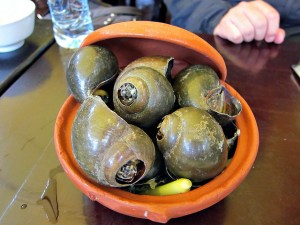
Steamed snails with lemongrass

Food Stands

One unique experience found at Quan An Ngon restaurant in Hanoi, Vietnam, is the concept of having representation of street foods from various regions in one place. You can peruse the very extensive menu to order your meal, or you can walk around and look at the food stalls that were set up similar to how street vendors set up their makeshift restaurants. One thing nice for foreigners is that you can find the dish that looks interesting and delicious and order it from the menu without having to worry about the language barrier in ordering the food, and for locals, you can find good variety of dishes that could cater to everyone’s taste when you come in a large group.

You can also see how a typical street vendor sets up their stand. The set up has to be completely portable, and in many cases the vendor would come with a cart or in double-basket carriers with everything they need to operate the establishment for the day (or night). At Quan An Ngon this is obviously not the case, but they represent the set up quite well to demonstrate how that set up is done.

The photo below shows the stand for pho ga, the chicken noodle soup dish. You can see the stack of steam chickens on the right side, and other ingredients needed to make the dish on the left and front side. Imagine if your the vendor setting up the food stand and having to do the preparation, load up your double basket carrier, and carrying the whole thing on your shoulder to the location where you set up your stand.

Pho ga stand

Quan An Ngon

Quan An Ngon is a restaurant in Hanoi, Vietnam, that serves an extensive variety of authentic Vietnamese dishes. We went there for our first lunch in Hanoi after spending the morning visiting the Ho Chi Minh Complex and the Temple of Literature. The restaurant was mentioned in many travel guides and travel/food blogs on Hanoi, so we thought it would be a safe bet to try out.

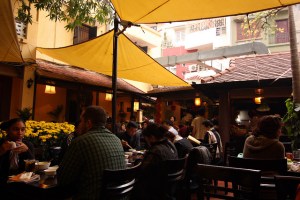
We came to the restaurant around lunch time on a Sunday, so the restaurant was quite packed. But they had a large seating area, so it didn’t take long for us to get seated (sharing a long table with other guests). The setup of the restaurant was pretty unique; the seating area was mostly outdoors, surrounded by open kitchen set up like street food vendor stalls. Even though we were given menu to order from, we could walk around and see the food getting prepared. This was nice especially if the description of the dish on the menu was not enough to convince you to order the dish.

The menu was so extensive that we had a hard time narrowing down our selection for the meal. We ordered lotus rhizome salad with shrimp & pork, steamed snail with lemongrass and ginger fish sauce, and grilled beef ngon style. They were all very delicious.

I think this was an excellent restaurant to get authentic Vietnamese food especially if you’re new to Hanoi and not comfortable going out to eat at the street food vendor yet, or if you want to find a large selection of dished in one place, or if you’re coming with a large group of people. The best place to find Vietnamese food is at the street vendors, but most of them specialize only on a particular dish, and very likely they only have limited seating. So, as an alternative, Quan An Ngon would be a good place to go. The place seems to be popular among foreign tourists and locals alike, as we observed from the tables around us.

The photo below was taken from our table right in the middle of the outdoor seating. You could see around the courtyard there were stations with open kitchens where you could look around and order dishes as if you were finding street vendors selling a very specific dish.

Quan An Ngon

Snakehead Fish

I first heard of the snakehead fish about ten years ago, when it made news in Washington, DC, area where I lived. The snakehead fish, which is native of Africa and Asia, was found spawning in a pond in Maryland not far from the Potomac River. The snakehead fish is a priced delicacy in Asian countries, so someone tried to grow them in the US and then released them to the wild. The snakehead fish is known to be a ‘top-level predator’ meaning it doesn’t have natural enemies outside its natural habitat. They also have the capability of surviving out of the water for up to four days, and by wriggling their bodies and fins they can ‘walk’ on the land up to 1/4 miles. So there was fear that the fish would cause havoc to the ecosystem at the nearby Potomac River if it had made it there. The National Geographic Channel had a short video about the snakehead fish as the ‘fishzilla.’

After visiting the floating village of Chong Kneas, we went to a restaurant to have lunch before continuing our sightseeing in the afternoon. When we looked at the menu, we found out that this particular restaurant served steamed snakehead fish (which is quite common as delicacy in Southeast Asian countries like Thailand and Cambodia). Neither Kristi nor I had ever had this fish before, so we decided to give it a try.

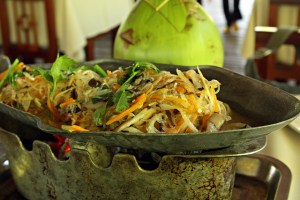
The photo below was our steamed snakehead fish dish when it was served on a fish-shaped metal dish. The fish was indeed very tasty; no wonder this was such a priced delicacy.

Steamed snakehead fish

Breakfast with the Crew

When traveling with a chartered tour group, typically there might be a tour guide and support crew (e.g. driver) who would take the group from place to place. But when it comes time to a meal time during the tour, when the group goes to a restaurant or a particular place to eat, the crew would either be the ones serving the food, or else they would leave the guests eating at the restaurant while they would go separately or wait elsewhere. I noticed that during our first couple of days in Siem Reap; our tour guide Vanna and driver Hour would take us to a restaurant, and then would leave us there to enjoy our meal and meet us outside the restaurant once we’re done.

On our last day in Siem Reap, after we spent the early morning at Angkor Wat experiencing the first sunrise of the year, it was time for us to head back to the hotel to pack up and later on continue with our tour for the day. However, since it’s a private tour and we got to call the shot on the itinerary for the day, I asked Vanna and Hour if we could go to a good place where local folks would go for breakfast, and I told them that Kristi and I would like to have them join us for the meal — our treat. The only ‘requirement’ was that the place we would go to has to be one that both of them would go themselves if they were to go out on their own.

Vanna suggested a restaurant in downtown Siem Reap that was popular with the locals. The price was not cheap for them, but it’s still reasonable enough that he said he would go there once every few weeks or so when he would like to eat out. So we went to a restaurant called Kids Plaza — named that way because it had indoor playground for the kids. Vanna said it’s one of his favorite restaurants in the city, especially good for breakfast.

We had really good breakfast there. Good food (noodle soups, rice porridge, fresh juice) and also good conversations. We found out that our driver Hour used to be a driver at the Amansara, an ultra-luxurious but low key resort in Siem Reap. The Amansara is part of the Aman Resorts, which is a small but among the highest rated hotel groups in the world. The founder of Aman Resorts, Adrian Zecha, is part Indonesian. Hour told the story how Mr. Zecha was very down to earth and friendly to his employees and guests.

The photo below was taken right before we enjoy our meal together. It was a nice experience as we got to thank them for their service taking us to places during our visit to Siem Reap. We also got to learn about their life stories; now we consider them as friends rather than simply people who serve us during our trip. I think if you can, that would be a great idea to do when visiting a place, try to make it personal by building friendship / relationship with the locals you encounter. It makes for a unique, unforgettable experience.

Breakfast with the crew