Wall Street

Not far from the Battery Park in New York City where you can board the ferry to the Statue of Liberty and Ellis Island, you can find the center of American financial industry, the New York Financial District with its famous street, Wall Street. On 11 Wall Street you can find the New York Stock Exchange building. The NYSE is the world’s largest stock exchange by market capitalization. Inside the NYSE building is the trading floor where the day-to-day business of the stock market is being conducted. Since the September 11 attacks, the trading floor is closed to public. Today if you want see the action inside in person, you can follow one of these suggestions on eHow: go on educational program or visit as part of a college class, apply for an internship at the NYSE, get a trading license and become an actual stock trader, or start a company and take it public.

I’ve only visited the NYSE as part of a walking tour in the area outside. Just right across the street from the NYSE building, there is another building that is also historically significant, the Federal Hall. The Federal Hall was the site where George Washington was sworn in as the first President of the United States, and the building was also home of the first Congress, the first Supreme Court, and the first Executive Branches. It’s worth the visit especially given its significance in the birth of the United States of America as a country.

The photo below was taken in front of the NYSE building. It’s the pediment part of the NYSE building facade, designed by John Quincy Adams Ward. Entitled “Integrity Protecting the Works of Man,” it depicts the 22-foot figure of Integrity in the center, with Agriculture and Mining to her left and Science, Industry and Invention on her right, representing the sources of American prosperity. The waves on either extreme of the pediment symbolize the ocean-to-ocean influence of the Exchange.

NYSE Building

Washington Monument

The Washington Monument, located in the National Mall area, is one of the most recognizable landmarks in Washington, DC. It was built to commemorate the first US President, George Washington. The monument is the tallest stone structure and the tallest obelisk in the world, standing at around 556 feet (close to 170 m). It is also the tallest structure in Washington, DC (there is a city ordinance in Washington, DC, that does not permit a building to be taller than 110 feet). Upon completion it was the tallest structure in the world, until the Eiffel Tower in Paris, France was completed in 1889.

I have never been inside or taking the elevator up the Washington Monument, but like other people living in Washington, DC, area, I have walked the grounds of the monument many times. During the summer months, the grassy area around the monument is used by locals for playing sports or to hold events/festivals. It is also located centrally when you’re walking around the National Mall area to visit many of the monuments and other buildings around, so there are usually good number of people walking around there.

The photo below was taken on a cloudy day in the spring time. You can see the tall monument with some flag poles around and visitors at the base for scale comparison.

Washington Monument

Mount Rushmore

In addition to the 58 national parks that were set aside to preserve the nature in the United States, there are also other properties managed by the National Park Service for other reasons, such as monuments or historical sites that are preserved to commemorate historical events or figures. In the next few days, I will add posts about some of these places that I’ve visited.

The first one to mention is a monument located within few hours from the Badlands National Park in South Dakota, Mount Rushmore National Memorial. This monument is a sculpture of four American presidents on a granite mountain — very recognizable monument, though given its location in South Dakota, unless you happen to pass the area during a road trip or you live in the state, chances are that you’ve never seen this monument in person. In fact, initially the idea of building this monument was to increase tourism to the state of South Dakota.

The four presidents represented on the monument — George Washington, Thomas Jefferson, Abraham Lincoln, and Theodore Roosevelt — were selected by sculptor Gutzon Borglum to represent the first 150 years of American history, and because of their role in preserving the Republic and expanding its territory. The figures were originally supposed to be carved head to waist, but it ended up to be only the heads due to insufficient funding.

I visited Mount Rushmore during a road trip from Rapid City to the Pine Ridge Indian Reservation. We only stopped briefly at the monument to take photos from a couple of different angles, but it was quite neat to see such a familiar monument in person.

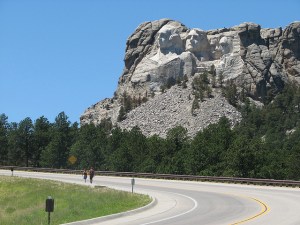
The photo below was taken at one of our stops near the monument. You can see the highway in front of the monument and a couple of visitors walking (to give you scale comparison for the size of the monument).

Mount Rushmore