Homecoming

One of the most vocal and lively members of our Ha Long Bay tour group was a lady named Mrs. Hoa. She’s a Vietnamese lady who married an American and then lived in Idaho, USA. She came with her son, two daughters, and their husbands. She was originally from Hoi An area in Vietnam, but in this trip she also wanted to visit many other areas in Vietnam.

It was interesting to observe her and her entourage during the trip. She was very outgoing and pretty much spoke her mind whenever she saw or experienced something. In many cases it provided somewhat a funny interaction, especially when she had conversations and joked around with our guide Smiley who also had quite an outgoing personality. The other interesting interaction was with her son-in-law David, who had his Canon DSLR camera and took photos of everything he found interesting, kind of like the stereotype of Japanese tourists with cameras.

I thought it must be nice for her to be able to come back to her home country, accompanied by her grown up children and in-laws and to be able to share with them the experience that they might not have before back home in the United States. It’s also not something that most Vietnamese immigrants elsewhere could do; I know of many Vietnamese in the United States who had never been able to come back home since they left their home country decades ago.

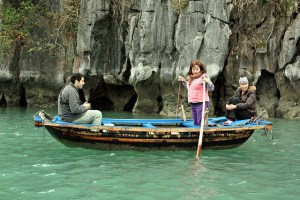
I took the photo below from our boat as we passed Mrs. Hoa and David’s boat. Here was Mrs. Hoa trying to row the boat, and her son-in-law taking the photos of this interesting moment.
Mrs. Hoa

Row Boats

After Smiley finished with his overview of the floating village, he told us to meet back in the lower deck in a few minutes to leave for the floating village visit. He didn’t tell us how we would be getting to the village; I presumed it would be on a tender like how we got to the junk boat from the pier.

Kristi and I went back to our room for a few minutes. While we were in our room, we saw through our window an interesting sight: several small row boats coming from the village direction towards our boat. What made it even more curious, as they got closer we noticed that all of the rowers were women.

Smiley told us to board a row boat in pairs; it worked out pretty well as we had even number of people in our group. After all of us got on board on the row boats, we slowly moved away from our junk boat and went towards the village.

What I learned later on was that these women were from the village we were about to visit. Their husbands worked as fishermen during the day, so we didn’t see them around. The Indochina Junk company hired them to row the boats for the guests and this provided some extra income for the families in the village.

I felt a bit uneasy being on a boat and having a lady rowing it. But the more I thought about it, she probably had done this all her life and was able to do it quite effortlessly, at least compared to someone like me who had never done that before.

The photo below was taken from the top deck shortly after we noticed the boats coming and before we boarded on to the boats.

Row boats

Responsible Tourism

Just before we were ready to go to visit a floating village in Ha Long Bay, Vietnam, we gathered on the upper deck of our junk boat to get an overview about the floating village and the life there. Our guide Smiley started with mentioning a little bit about some of the background information that built upon some information I already learned from reading some materials that were provided as part of our cruise. But towards the middle of his presentation, Smiley talked about the unfortunate negative impact of human settlement and now increase of tourism on the nature. Quite unexpected to hear especially in a developing country especially when the tourism industry was booming in the area.

Smiley said that as the number of tourists increased, inevitably there was impact to the nature as pollution increased, rubbish produced and polluted the environment, and the traditional lives of the locals impacted with the constant visits of guests. In many cases, others looked to profit from such increased in popularity and demand for tourism, but neglected how their actions impact the actual nature that drew the visitors to come in the first place. He said the Indochina Junk, the company that owned and operated the Dragon’s Pearl and several other boats, was working with the local government to launch a program called ‘For a Green Ha Long Bay’ which aimed at educating the locals and the tour operators to help reduce the negative impact tourism has on the nature and the lives of the locals. They helped with rubbish collection, and also educated and provided more environmentally friendly materials to use in the floating homes. He also mentioned that parts of the proceeds from our tour actually went to the village that we’re visiting.

When I heard this presentation, while on one hand I was happy to hear that we seemed to go with a tour company that was environmentally responsible, on the other hand I was wondering how sincere that was, or whether this was all just a presentation to the foreign tourists so they feel good about themselves, and potentially help market and recommend the company to other tourists. I hate to be that cynical, but I guess unless I see more visible activities (e.g., perhaps also offering a more voluntourism type trips where guests can also participate in activities that help improve the locals), it remains to be seen whether that’s all just a show or it really is because they want to be ethically responsible.

I took the photo below while Smiley was giving his presentation to our group. You can see the village we’re about to visit in the background.

Responsible tourism presentation

Floating Village in the Bay

After we finished our breakfast, our tour guide Smiley told us to get ready to meet up on the upper deck before we started our second day in Ha Long Bay, Vietnam, with a visit to one of the floating villages in the bay. There are four floating villages in Ha Long Bay area, with a population of around 1,600 people total living there. Most are fishermen and their families. The villages are located in sheltered coves at the base of mountainous islands. The islands provide a natural protection from bad weather condition especially during the typhoon season. These communities have been inhabiting the area for quite a long time. They still live mainly from fishing, selling their catch to the nearby Ha Long City where they also get their supplies. Now with the increasing popularity of tourism in the area, the villages are also opening up for visits from tourists. Some even provided special events for tourists who come to visit.

I didn’t have much expectation about what we would experience through this visit. One thing I was interested in finding out was the comparison between these floating villages to the ones we saw in Tonle Sap Lake in Cambodia. Obvious difference was that one was in fresh water lake while the other is in a bay close to open sea. Both live on fishing, but other thand that, I guess we would find out.

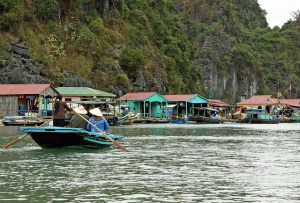
I took the photo below when we were about to enter the village. You could see here two of the tourists on a row boat, and the row of houses that made up one side of the floating village.

Floating village

Pho Ga

After spending some time out in the cold trying to take photos of the sunrise at Ha Long Bay, I went back to my cabin to get ready for the day. By then Kristi was already up as well, and we went to the dining room afterwards to meet others for breakfast.

The breakfast for the day was a traditional Vietnamese dish, pho ga (chicken noodle soup). For many of the passengers, it was unusual to have noodle soup for breakfast, but in Vietnam they pretty much serve pho all day long, and some would have it for breakfast. Coming from Indonesia, Kristi and I were also used to having noodle dishes for breakfast. I guess it must be a Southeast Asian or Chinese thing.

Since we arrived in Vietnam few days before, we’ve been constantly moving that we had not had the chance to try out pho, the Vietnamese dish that is well-known and available everywhere. So here was our first pho in Vietnam during this trip. The serving was pretty small in comparison to the portion they serve in the US, but it was just about the right amount; it was filling without making me feel bloated. And after being out in the cold for the morning, having the warm soup dish was definitely perfect for the occasion.

You can see on the photo below my bowl of pho. It was not that big but quite packed with chicken meat, noodles, and some greens.

Pho ga