Vietnamese Coffee

When we walked around the Old Quarter area in Hanoi, Vietnam, we passed quite a few stores that sell coffee in bulk as well as many coffee houses where the locals go. It’s pretty clear that coffee is a big part of Vietnamese culture.

I was introduced to Vietnamese (style) coffee back in the United States many years ago by a Vietnamese friend whom I often hung out with. Whenever we went to a Vietnamese restaurant, he would suggest cà phê sữa đá (iced coffee with condensed milk) as a drink to accompany our meal. The coffee was usually quite strong; in the United States, however, the Vietnamese often get coffee from Louisiana as it had similar flavor profile to the Vietnamese coffee and it’s easier to get in the US. Not until this trip to Vietnam that I finally tried the real thing.

As I read up about Vietnamese coffee, I learned a couple of interesting facts about coffee production in Vietnam. Coffee was introduced in Vietnam by the French in mid-19th century when Vietnam was a French colony. Today, coffee is one of the major agricultural products being exported from Vietnam, second only to rice. Vietnamese coffee also account for around 14% of world’s production, making it the second largest coffee producing countries in the world after Brazil. You don’t hear it as much even when you drink a lot of coffee, however, because 97% of the Vietnamese coffee production is of the Robusta kind, which is generally considered as lower grade compared to the Arabica kind that dominates the gourmet coffee market. The Robusta coffee is typically used as fillers for lower grade coffee mix or as main ingredients for instant coffee.

One interesting kind of coffee that my Vietnamese friend mentioned as ‘highly priced’ is what’s called the ‘weasel coffee’ in Vietnam. This is similar to what’s known as ‘kopi luwak’ or civet coffee in Indonesia. It’s highly-priced coffee that was the result of ‘special processing’ — the weasel or civet knows how to select the ripe coffee berries. They would eat the berries for their fleshy pulp; the beans would go through the civet’s digestive tract, and somehow the enzymes help change the characteristics of the coffee bean so when it came out as a whole, cleaned, and roasted, the resulting coffee is more aromatic and less bitter. This coffee (the real one) is noted as the most expensive coffee in the world — it could fetch as high as USD $160 per pound.

Given the high price that the civet coffee can fetch, there is a lot of folks who claim they have these even though it might be counterfeit. When we walked around Hanoi, in many of the coffee stores we saw tubs of coffee with ‘weasel coffee’ written on them like on the photo below. The price was more expensive than ‘regular coffee’, but nowhere close to the priced civet coffee price in Indonesia. And seeing the abundance of those (every coffee store claimed to have some), you wonder if they are real or not.

Coffee store

Navigating through Traffic

When visiting the Old Quarter area of Hanoi, Vietnam, you will need to navigate the busy city traffic. That could be a unique experience in itself, especially for visitors who come from lower density places or where there is strict traffic rules to adhere to.

There are several things to notice from the traffic in this area of Hanoi. First, the area seems to be quite busy at all times; you have cars, motorcycles, bicycles, and pedestrians continuously moving around you. Second, people generally follow the traffic signs and things move in orderly manner. However, it doesn’t take long until you realize that in some places you will need some courage and a little ‘know how’ to get to places where you want to go, as otherwise you would have to wait for a long, long time (or take a very long detour) to get to your destination.

We came across such situation at one spot near the northern part of the Hoan Kiem Lake. We needed to cross the street, and it was a 5-6 lane, one-street, and there wasn’t really any good place to cross the street. So what to do? We saw what other pedestrians did, and then mustered up some courage to do the same… jay walking. In many other countries around the world, this could get you in a lot of trouble as it’s breaking the traffic laws. In Hanoi, however, it didn’t seem to be the case. In fact there were some places where you see what looked like pedestrian crossings, but there were no traffic lights or stop signs that tell the incoming traffic to stop when there is pedestrian crossing the street. I learned that the way you cross the street whether at the place marked as pedestrian crossing or else where is by keeping alert of the incoming traffic, and slowly but steadily move across the street. Incoming cars and motorcycles will see you in the middle of the street crossing, and they will not stop and just go around you. The key is not to make sudden, unpredictable movement that could cause the incoming traffic to misjudge your placement and not having enough time to react.

If you dare enough to be on the other side and either drive a car or ride a motorcycle in this environment, the rule is essentially similar. You want to follow the traffic signs wherever possible, but at all times you need to be alert of what’s going on around you — other motorists, pedestrians, bicyclists, etc. — and be ready to slow down to avoid accidents. In most cases, given the high density of the traffic, you are moving at very slow speed anyway, so it’s easier to control your movement and even if there was accident, it’s less likely to be a fatal one. I learned this from going back to my hometown, Jakarta, Indonesia, and having to drive a car there. In a way it was similar to Hanoi; there were traffic regulations to follow, but more importantly, you need to be alert of what’s going on around you.

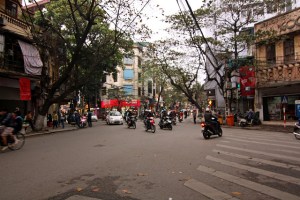
The photo below was taken as we walked around the Old Quarter. Here is an intersection with pedestrian crossing. Unlike in the United States where there is a clear 4-way stop and everyone takes turn and follow the convention called the ‘right of way’, in Hanoi it’s not as orderly, and you pretty much keep moving slowly across the intersection and be alert to not hit anyone coming from another direction (notice in this photo a motorcycle swerving a little bit to the right when crossing the road because there is traffic coming from the left side).

Intersection in the Old Quarter

Using Credit Card in Vietnam

Few days ago I wrote a post about our experience using cash as method of payment when visiting Hanoi, Vietnam. This time I’m writing about our experience using credit card during our travel there.

Using credit card is very convenient as it reduces the needs to carry cash around. It also provides extra security / protection as only the card holder should be able to authorize the purchase, and if the credit card is lost, you can get the card canceled and the account blocked to prevent fraudulent use of the card. For me, it’s also convenient to keep track of my spending as I would be able to see all of the transactions in my statement at the end of the statement period.

When traveling overseas with credit card, some planning could help you save and avoid extra charge or dealing with unpleasant experience. Some credit cards charge extra foreign transaction fee when you use the card overseas. I learned this the hard way during the planning for this trip when we purchased our airline tickets for Vietnam Airlines online. It turned out that the credit card I used added the foreign transaction fee (3% of the purchase amount) since essentially the card was used to make a purchase in Vietnam. After that, I got another credit card that was specifically designed for travelers (and explicitly mentioned the ‘no foreign transaction fee’ in its key features). I used this new credit card when booking for a tour through a Vietnamese-based tour agency. This time there was no extra fee charged, and we got our tour conveniently booked and pre-paid.

Another lesson learned was to know which of the credit card payment network is more widely available in your destination country. Usually it’s pretty safe to use either Visa or MasterCard as they are very widely used around the world. In United States, you also find people using American Express and Discover. I think American Express might also be accepted especially at multi-national travel-related companies (e.g., hotels, restaurants). Discover is probably the least available among these.

After walking around Hanoi for some time, we went back to our hotel, Hanoi Serenity Hotel, to rest a little bit. Though technically we already checked out in the morning, the hotel staff was nice enough to let us hang out at their breakfast area that was located near the front desk. While we were sitting there, we observed an interesting conversation between the front desk staff and an American guest.

The conversation started with the American guest who seemed to be in his first visit to Hanoi/Vietnam asking about options for sightseeing trips. The hotel provided a service to arrange tours for its guests, so the front desk lady started providing him some options for day trip. All went great, and the guest decided to go with the recommendation for a couple of day trips to take during his visit there. Then it’s time for him to pay for the trips, and he gave her his credit card. It was a Discover Card. In the United States, some people like to use Discover Card because it gives pretty generous cash back for the purchases they make. So this gentleman apparently was hoping that he could get quite a good amount of cashbacks from his purchases during the travel. This turned out to be a problem because the credit card machine at the hotel could only take either Visa or Mastercard. The front desk lady tried to explain that to the guest, but the guest didn’t want to accept the explanation and said there must be something wrong with the hotel’s credit card machine for not taking his credit card. Eventually he decided to cancel his trip bookings and went out to look for an ATM machine somewhere to get cash (it was a Sunday, so I’m not sure how difficult it was for him to find one — especially a place that accepts his Discover Card).

So, I think from that experience I learned to carry both my Visa and Mastercard credit cards with me (now I have one from each network that does not charge foreign transaction fee), and still have some cash as back up. It’s always good to have some cash in local currency, especially in small bills. And remember that you’re in a different country where the expectation about credit card usage might be different than what you’re used to.

The photo below was taken in the Old Quarter area of Hanoi. It was a restaurant that very likely would accept credit card as method of payment, and it’s recognizeable from its logo even though the name was translated to Vietnamese, Gà rán Kentucky (Kentucky Fried Chicken).

KFC in Hanoi

Hanoi Serenity Hotel

Hanoi Serenity Hotel is a hotel in the Old Quarter area of Hanoi, Vietnam. We stayed there on two separate nights, the first night upon arrival in Vietnam, and the last night before we left Vietnam. We found the hotel on TripAdvisor and booked the rooms online via Expedia.

A couple of days before our arrival, I contacted the hotel via email to arrange a pickup service from the airport. They responded in timely manner, and we didn’t have any problem meeting our driver even though our flight to Hanoi was delayed more than two hours.

The hotel building was laid out similar to most buildings in Hanoi Old Quarter area, very narrow, deep, and tall. This resulted in an interesting layout where to get to the rooms you would have to take the stairs up – not too bad if your room happens to be close to ground floor (our first room was on third floor), but it could be quite an exercise if your room is on the upper floors (our second room was on the sixth floor). This should be a consideration especially if you have little children or anyone who might have problem taking the stairs, since there was no elevator available.

On the ground floor, the hotel had a small breakfast area where every morning complimentary cook-to-order breakfast was served. You could get typical western-style breakfast fare like scrambled eggs, ham, and bacon served with a Vietnamese-style baguette. They also served fresh fruits and Vietnamese-style coffee (with condensed milk if you prefer).

The lady at the front desk was very helpful during our stay. She helped us providing directions to places we wanted to visit (they had complimentary map of the Old Quarter area — very helpful during our walking excursion in the area). She also allowed us to leave our packed luggage in our room for the day even technically we were already checked out. This allowed us to do sightseeing around the city without having to lug our luggage around. The front desk also served as concierge that could help guests arrange trips in and around Hanoi. We didn’t use their service other than for transportation from/to the airport, but many other guests seemed to do so.

The hotel room was pretty spacious, clean, and comfortable. There was Wi-Fi connectivity available, though the connection was a bit spotty at times.

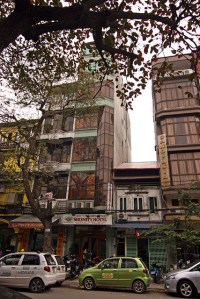
The photo below was taken in front of the hotel. You can see the tall but skinny hotel building that is quite common to see in Hanoi.

Hanoi Serenity Hotel

Hoan Kiem Lake

The Hoan Kiem Lake is a lake near the Old Quarter area of Hanoi, Vietnam. The name of the lake means ‘The Lake of Returned Sword’, marking an occasion in the legend where Emperor Le Loi returned a magic sword called ‘The Heaven’s Will’ to the turtle god at the lake after a victory against the Chinese in a battle.

Today the lake is a scenic destination in the city of Hanoi. When we walked around the lake during our visit to the city, we saw some interesting activities. In one corner of the lake, there was an old lady doing exercise (looked like tai chi). Not far from there, we saw several couples (looked like they were newly weds) posed for photos with the scenic lake in the background. Then we also saw many people like us who are tourists visiting the city.

Another interesting thing to note about the lake is that it’s the home of a rare, endangered species of giant turtle. Some folks had reported sightings of the turtle (so it’s real, not just a legend), but considering the story about the lake and turtle as a revered animal in mythology, that made the rare sightings of the turtle more interesting.

The photo below was taken around the southern edge of the lake. It’s a photo of the Turtle Tower, a pagoda built on a little island in the middle of the lake.

Turtle Tower