Street Vendors

When you read travel guides for Hanoi, Vietnam, you would likely find people mentioning about street-side vendors as part of the sights and sounds they experience especially when visiting areas near the Old Quarter part of the city. While this might be pretty common sight to see in many countries in Asia, it’s still an interesting experience to walk through streets and alleys lined up with the vendors as you can observe the daily life going on around you and giving you the feeling of being immersed in the local culture.

When we arrived at our hotel in Hanoi’s Old Quarter, it was already pretty late at night, and on the next morning, we left quite early in the morning, so we had not had any chance checking out the area yet. After visiting the Temple of Literature, we decided to follow our map to go to a restaurant called Quan An Ngon that’s highly recommended for its variety of authentic Vietnamese food. The restaurant location didn’t seem to be too far from the Temple of Literature, so we decided to walk there.

As we walked a couple of blocks away from the busy city street in front of the Temple of Literature complex, we found ourselves walking through a street that’s probably more like an alley since it’s pretty narrow and is hardly passable by cars. There were motorcycles, bicycles, and pedestrians passing by, and here we saw our first street-side shopping scene in Hanoi. We could see stores lining up both sides of the street, and in front of those stores, there were other vendors selling a variety of goods, including food, fresh fruits, vegetables, and even medicines. And we also saw some of the Vietnamese ladies wearing conical hats and carrying double baskets with a carrier on their shoulders — the scenes you often see in photos and are associated with Vietnam. We also saw many street-side vendors selling cooked foods, and since it was around lunch time, there were folks stopping by, parked their motorcycles, and ate at the makeshift ‘restaurants’ on the side of the road with little stools that pretty much required them to squat instead of sitting while eating their lunch.

The photo below was taken on that street while we were walking through the area. There were quite a lot of interesting sights that would make an interesting photo series, but I felt a little self-conscious with my camera at hand, so I only took a few photos there.

Street Vendors

Domestic Tourism

As we visited places in Thailand, Cambodia, and Vietnam, one interesting observation to make was the difference between the mix of local and foreign tourists at the popular tourist destinations, and the kind of activities they do there. I also wondered how much of domestic tourism is related to the economic condition or progress in the country — my guess is that when the country is more developed, more likely you have domestic tourists as they have more financial means to support the activities.

When we were in Hanoi, Vietnam, Kristi and I particularly noticed the domestic tourism both at the Ho Chi Minh Complex and at the Temple of Literature. At the Ho Chi Minh Complex, it was interesting to see that the majority of the visitors were Vietnamese. I think part of it could be that the local message (propaganda) of honoring Uncle Ho really worked, but perhaps it’s also because the protocol to visit the complex may be a bit intimidating for foreigners.

At the Temple of Literature, we also saw many domestic tourists. At this place, we did see significant presence of foreign tourists as well, but you could clearly see a better parity between foreign and local tourists. They pretty much blended in, though there were activities that specifically were done only by the locals, such as burning incense near the Confucius statue, or touching the head of the giant stone turtle at the Stelae of Doctors for good luck. It’s very different compared to visiting Angkor Wat in Siem Reap, Cambodia, for example, where you would see mostly foreign tourists, and the locals we saw were mostly those providing services to the foreign tourists (tour guides, drivers, souvenir sellers, restauranteurs, etc.). It was somewhat similar to seeing the Thais visiting the Royal Palace and Wat Phra Kaeo; many of them went there specifically to worship as the Temple was considered as one of the most sacred places in Thailand.

The photo below was taken in the inner courtyard of the Temple of Literature. Here you can see some domestic tourists burning incense near the statue of Confucius as a sign of reverence.

Burning Incense

Confucianism

Confucianism is an ethical and philosophical system that originated in China, but is now widely influencing Asian cultures and countries, such as mainland China, Taiwan, Korea, Japan, and Vietnam. It was developed from the teachings of Confucius. The core teaching is humanism, the belief that human beings are teachable, improvable and perfectible through personal and communal endeavour especially including self-cultivation and self-creation.

Confucianism focuses on the cultivation of virtue and maintenance of ethics, the most basic of which are ren, yi, and li. Ren is an obligation of altruism and humaneness for other individuals within a community, yi is the upholding of righteousness and the moral disposition to do good, and li is a system of norms and propriety that determines how a person should properly act within a community.

The main basis of the Confucius teachings was to seek knowledge, study, and become a better person. This explained why there core of the Temple of Literature in Hanoi, Vietnam was the temple/shrine for Confucius, and why it’s related to the other function of the place as the center for ancient education in medicine. Today when you visit the Temple of Literature, you could see a lot of local Vietnamese who believe and follow the Confucius teachings coming to pay respect or homage to the teachings of Confucius. I think one interesting thing to note is that there were debates whether one should classify Confucianism more as an ethical or philosophical thinking that is compatible with religious beliefs, as supposed to being considered as a religious belief in itself. Until I started reading and learning about this, I always thought that Confucianism is a religion. Now knowing a little more about it, it makes more sense to consider that more as a way of thinking that in some cases may evolve into what one believes to be true as an object of worship.

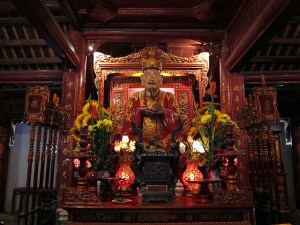
The photo below was taken at the inner temple inside the Temple of Literature complex. You could see a statue of Confucius prominently set in the middle where visitors could pay respect by burning an incense and place it on an urn outside the temple. This reminded me to similar practice observed in Indonesia among the Indonesian Chinese (makes sense as those folks are as much influenced by the teachings of Confucius as the Vietnamese).

Confucius

Ao Dai

The ao dai is the national costume in Vietnam worn by women typically during special occasions, including weddings, holidays, and any formal occasions. The attire includes silk form-fitting tunic worn over a trouser. The word ‘ao dai’ was originally attributed to the outfit worn at the court of the Nguyen dinasty in the 18th century. It was modernized in the 20th century to be the style typically seen today, which took some cues from Parisian fashions at the turn of century. I think today when you see a woman with ao dai, it would be as recognizeable as a national costume like the sari for Indian women and the kimono for Japanese women. One thing unique about it is that it’s pretty much custom fit to the individual since it’s form-fitting. Since most of the Vietnamese women are pretty small and slim, generally this looked very good, elegant, and graceful on them. I’m not sure how that would look if you have some of the large-sized women from the western countries try to wear these costumes…

I first saw women wearing ao dai in the United States at the Vietnamese culture centers (like a Vietnamese strip mall I occasionally visit), especially around important holidays (like Tet, the Vietnamese lunar New Year) or when there is an important ceremony (like a wedding). When I was preparing for the Southeast Asia trip, I read information blogs about the destinations. One of them was a very informative guide on travelblog written by a Vietnamese lady with the username theRedRiver (taking the name from the Red River that passes through her hometown city of Hanoi). In the travelblogs not only she gave information about Vietnam and the cities and culture there, but also she wrote about her adventures traveling to other countries. One of the things she liked to do when visiting places is to get her photo taken in her red ao dai costume.

When we visited the Temple of Literature in Hanoi, since it was the 2nd of January, we saw signs to celebrate the New Year there. And since it was also a Sunday, we also saw many visitors, and among them were some Vietnamese ladies in ao dai that came with photographers. It looked like they came to get their photos taken with the traditional architecture as background. You can see in the photo below two of those ladies walking by in their ao dai costumes after they finished with their photoshoot.

Girls in Ao Dai

Ancient Hall of Fame

One interesting part of the Temple of Literature in Hanoi, Vietnam, is the third couryard where you find a pool in the middle named The Well of Heavenly Clarity that is flanked by rows of large stone stelaes. There are 82 of these stelaes, and each record the names and native places of more than 1,300 graduates who passed 82 triennial exams between years 1442 and 1779. These were set up to commemorate the achievements of those who had passed the royal exams, and to encourage the present and future generations to study.

The stelaes of the doctor laureates were placed on top of giant stone turtles. Turtle is one of the sacred animals in Vietnamese culture and it’s a symbol of longevity. Placing the stone stelae on top of the turtle symbolizes the everlasting respect to talent. I thought it’s interesting that these stone stelaes are still there almost 300 years later. So these doctor laureates’ accomplisments indeed are recognized for quite a long time.

The photo below captures an interesting practice we observed there. Some folks would come and rub the head of the stone turtle. The practice supposedly brings good fortune (especially to those about to study for exams I guess)…

Rubbing turtle's head