Angkor Thom

Angkor Thom is a walled city complex in the Angkor Archaeological Park north of Siem Reap, Cambodia. The city was built by King Jayawarman VII in the 12th century, and the city was the capital of the Khmer Empire for several hundred years until it was abandoned sometime before year 1609. It is believed to have sustained a population of 80,000 – 150,000 people. The complex is about 9 km2, shaped in a square (3 km x 3 km), with five gates (one in the north, west, and south sides, and two in the east side). The surrounding wall is about 8 m high and flanked by a moat. Inside the complex, today visitors can find ruins of several temples and the royal palace and terrace. At the center of the city is the temple of Bayon, famous for its towers with their stone faces.

Our first encounter with Angkor Thom was during the drive from Angkor Wat to Banteay Srei. The modern highway actually goes through Angkor Thom. We entered through the South Gate, drove to the center past Bayon, and continued through one of the East Gates knows as the Victory Gate. We came back again and stopped at several parts of Angkor Thom on the way back after we visited Banteay Srei and Ta Prohm earlier in the day.

The photo below was taken as we drove throught the East Gate known as the Victory Lane. It was the entrance where the victorious Khmer army would march into the city after winning battles against their neighboring enemies (like the Chams). As we drove through the Victory Lane, I couldn’t help trying to imagine what it would like with thousands of people lining the entrance welcoming their victorious troops.

Victory Lane

Banteay Srei

Banteay Srei is a temple located about 25 km north east of the main temple complex of Angkor Thom in the Angkor Archaeological Park area near Siem Reap, Cambodia. The temple was built in 10th century and it was dedicated primarily to the Hindu god Shiva. The temple was built largely of red sandstone, a medium that allowed for very elaborate wall carvings that are still observable today. Even though the size of the temple is much smaller compared to others in the Angkor area, because of its intricate details it is popular among tourists to visit. The name Banteay Srei means ‘the citadel of women’ or ‘the citadel of beauty’, supposedly referring to the intricate details in the temple and the many devata (female deity) figures carved into the wall of the buildings.

We went to Banteay Srei as our first destination to visit during our day trip in Angkor Archaeological Park after the sunrise viewing at Angkor Wat and breakfast at nearby restaurant following that. Our tour guide Vanna suggested to go to Banteay Srei first and then work our way back closer to Siem Reap during the day. We hoped to beat the crowd there by going in the morning.

The drive to Banteay Srei from Angkor Wat took us through the Angkor Thom complex. We got a glimpse of the many temples that made up this ancient city. After passing Angkor Thom, we drove through several villages on the way to Banteay Srei. Vanna explained that the typical houses in the villages were built on stilts above the ground to provide clearance for the times in the rainy season when the area might get flooded. It also provides protection for the pets from wild animals, and practically, it provides some shade during the hot sunny day.

When we arrived at the temple, there were already a lot of other visitors there coming before us. We had our entrance passes checked before entering the temple, and then spent some time inside observing the intricate details of the temple. Since the size of the temple is smaller compared to other temples in Angkor area, there were many areas where we had to took turns with others to get closer and take photos. That’s why Vanna wanted to get there as early as we could so we didn’t have to contend with bigger crowd.

Vanna also told us again about the stories and myths behind the Hindu gods. Again, after a while things got blurred in my head — all I remembered was that Shiva and Vishnu were the two gods that seemed to be prominently represented in many of the temples, and Vanna said Vishnu was his favorite one given his role as the one who provides sustenance to the world.

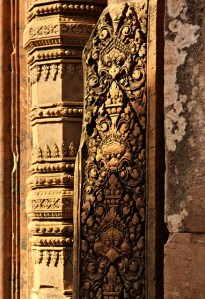
The photo below was taken as we toured inside Banteay Srei. You can see the intricate details of the wall carvings. The morning visit was also nice from photography perspective as the light was not too harsh.

Intricate details

Angkor Archaeological Park

The Angkor Archaeological Park is an area stretching over 400 square kilometres near Siem Reap, Cambodia, that contains many remains of what was the capital area of the Khmer Empire during the 9th to 15th century. It included one of the largest pre-industrial city in the world (the ancient city at its height was more than ten times the size of modern-day Manhattan borough of New York City). Today visitors come to the area especially to visit one of the finest ancient monuments in the world, Angkor Wat.

To visit the Angkor Archaeological Park area, if you’re not a local Cambodian, you would need to get a visitor pass that is valid for either one day, three days, or the whole week (we got the three-day pass, which cost USD$40 per person). You need to stop at the front gate, pay the fee, and get your photograph taken to get the pass. You will then need to carry the pass with you at all times. At the entrance of the temples, typically there is someone checking for the pass before you can enter. The pass has your photo on it, so you would have to carry your own to enter the temples.

Angkor Wat is the most popular temple in the Park, but there are others that are equally unique and worth visiting. There is Phnom Bakheng, a temple on top of a hill that provides a nice vantage point of the surrounding area especially around sunset time. You can also visit the ancient city of Angkor Thom with its temples inside. Or you can go to Ta Prohm, a temple ruin consumed by the forest trees that was made famous by the movie Tomb Raider.

The French did a lot to preserve the Angkor temples when they colonized Cambodia. Today two of the main routes for visiting the Angkor Archaeological Park, known as the Little Circuit and the Big Circuit, were routes that were established by the French to visit these temples.

The photo below was taken near the entrance gate while I was waiting to get my entrance pass processed. It’s an illustrated map of the Angkor region, showing the landmarks around that one can explore while visiting the Park.

Angkor map

Writing about Phnom Penh

If you’ve been reading the posts on this blog from the few weeks, you might have noticed that the majority of the posts were about the places I visited during the one full-day we had to do a day trip in Phnom Penh, Cambodia during my trip to several Southeast Asian countries with my cousin about a year ago. The reason why we included Phnom Penh in our itinerary in Cambodia was to learn about the country’s history. We did accomplish that, but what I personally didn’t expect was the impact it had on me after the trip was long over. So, before continuing on with more blog posts from other places we visited during this Southeast Asian trip, I thought I’d write a little bit about my experience remembering, processing, and reflecting about this one day visit to Phnom Penh.

A travel writer named Dave Fox wrote in a book called Globejotting about the meaning of the word souvenir as a remembrance (or something to remember an experience with). Coming into this trip, I had an objective of creating a photojournal about the trip that I could use to tell the story about my experience as I visited places and experienced the culture. So, during this trip, in addition to taking photos, I also took short notes using my Blackberry so I would remember the interesting details I learned from the visit or those that are important to remember (like the names of the people we met).

When I got back home in the United States and worked on the photojournal, the short notes were very helpful in remembering the details of the trip, as without it, I would’ve mixed up many details that were somewhat similar between places we visited (e.g., there is a wall with ramakien frescoes at the Grand Palace in Bangkok, and there is a similar looking wall with ramaketi frescoes at the Royal Palace in Phnom Penh). The one photojournal I wanted to create ended up to be too big to have as one album, so it ended up getting split up by cities that we visited. I was quite happy with this souvenir once it was done (around 600 photos divided into eight albums), but as I went through the process of putting together the captions to go with the photos, I realized that while a photograph may ‘speak a thousand words’ there are some things that it cannot convey (e.g., feelings, thoughts). So then I thought may be it would be an interesting exercise to take the short notes and the photos (including the thousands that didn’t quite make the cut for the photojournals) and retrace my steps during the trip and recount the experience in writing.

There is a site called TravelBlog that is similar to WordPress as a blogging site, but it’s specifically oriented towards travels (e.g., it’s indexed by travel locations). A lot of people use it to blog as they travel to provide a nice update to people they know who want to follow their journey as it happens (very nice especially for folks who are doing epic journeys like the Round the World travels). In my case, I didn’t use it during my actual travel, but I thought it would still be nice to write entries about my daily experiences during the trip after the fact.

I started writing the entries, and it went fine until I reached the day in Phnom Penh. The challenge with this one day is because of the emotional nature of the experience, and recounting the horror seen at Tuol Sleng and Choeung Ek was very difficult. If you go to TravelBlog and read entries from people who visited these places in Phnom Penh, the majority of them would either simply post photos they took there, or only summarize their experiences with words like ‘sad’, ‘angry’, ‘depressing’, or ‘appalling’. If you know even only a little bit about these places and their role in the Khmer Rouge genocide, those are the right words to describe these, but someone reading the story wouldn’t necessarily know much or learn about it beyond that. So rather than simply doing the same thing, I tried to write down more descriptively what I saw and experienced there, and added relevant facts around it so even those who had not heard of the Khmer Rouge atrocities (like I was prior to the trip) would at least take away something after reading it.

The process of writing the ‘one day travel entry’ for Phnom Penh ended up taking me almost three months to do. I could picture the experience very clearly in my head, but it was very difficult at times to find motivation to sit down and put those in writing, especially when it’s difficult to find words to express what I felt about it. In some cases, I ended up browsing through sites on the Internet to learn more about the historical aspects of this and the impacts it had on people, rather than writing the entry itself. It also caused me to reflect on what I think and believe about some very difficult topics that the Cambodian people had to struggle through, such as the idea of forgiveness and retribution, and how to deal with hardships.

In the end, I did manage to finish writing about that one day in Phnom Penh, and in the last few weeks, the posts in this blog, especially those that are related to Tuol Sleng and Choeung Ek, were largely based on what I wrote last year.

The photo below was one that I ended up selecting as the cover photo for my photojournal on Phnom Penh in flickr. It’s the memorial stupa at Choeung Ek that from far away it looked quite majestic, and served as a wonderful way to honor the victims at this site (it housed the remains of the victims found in the nearby mass graves).

Memorial Stupa

Khmer Rouge Tribunal

After finishing our tour of Choeung Ek and thanking our guide Mr. Chanteng for guiding us, we checked out a small museum on the Choeung Ek grounds that had more display to educate the visitors about the Khmer Rouge atrocities. In the museum, they had a display showing a sampling of tools that the Khmer Rouge used to kill people. There was also an exhibit showing the organization structure of the Khmer Rouge leadership, and some information about the Khmer Rouge tribunal that was still ongoing to put the ex Khmer Rouge leaders on trial for crime against humanity. It’s been more than 30 years since the end of the Khmer Rouge reign, but the tribunal process was still going on.

The tribunal process only put the leadership of Khmer Rouge on trial. The other ex-Khmer Rouge members were re-integrated into the Cambodian society as the organization was disbanded. I asked Mr. Chanteng how people dealt with this. He said most people didn’t really discuss much about it and moved on, so over time you wouldn’t be able to distinguish those who were part of Khmer Rouge in the past anymore. I also asked him if people thought these ex-Khmer Rouge cadres should also be punished for their role in the past atrocities. He said it’s not an easy decision to make, as many of the ex-Khmer Rouge cadres were young, uneducated people who were brainwashed by those in Khmer Rouge leadership, and many joined the Khmer Rouge out of need for survival (either they followed, or they would die themselves). So, the common position is to put the blame on the leaders, and let the others go.

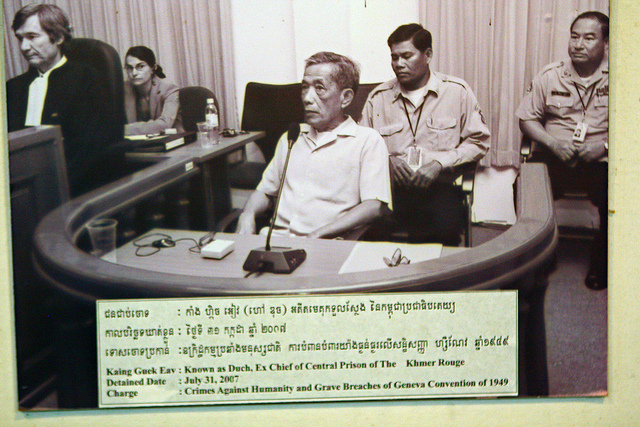
The tribunal process had been going on for several years and had cost more than USD$70 million, and only recently (July 2010) it yielded one guilty verdict (on Duch, the head of Tuol Sleng Prison, who admitted his guilt and was sentenced for 35 years in prison — considered inadequate sentence by many Cambodians). There were five more Khmer Rouge leaders currently waiting for trials — they were already in their 80s in 2010. Some people questioned whether the tribunal was worth doing, given that the large of money spent ended up consumed by a corrupt administration. In the meantime, many of the victims, the Cambodian people, still lived in poverty. Many suggested that the money would be better spent if used to build infrastructure in the country. Again, this was another difficult question that the Cambodians had to wrestle with.

After we’re done checking out the exhibits at the museum, we spent a little bit of time resting outside the museum before we left Choeung Ek. As we sat there, we saw in the distance the tall memorial stupa and a Cambodian flag flying next to it. It felt quite peaceful at that moment — I think it’s a good symbol for what the Cambodians hoped for the future: a peaceful and prosperous Cambodian society that doesn’t forget its past to ensure that the dark history will not be repeated again.

I saw the photo below at the museum in Choeung Ek. It’s a photo taken of Duch during the initial trial that’s mentioned above. One interesting development that happened since then (early this month, February 2012) was that he appealed the conviction under the arguments that he’s only following orders from those above him, but in a surprising turn of events, the appeal was denied, and instead his sentence was changed to life in prison instead.

Duch trial