Ellis Island

Ellis Island is an island on the New York Harbor area close to the Statue of Liberty. From 1892 to 1954, it was the main gateway for millions of immigrants into the United States.

Back then, immigrants arrived in ships from Europe, and the lower class passengers where taken by ferry boats to Ellis Island to be processed. Generally, those immigrants who were approved spent from two to five hours at Ellis Island. Arrivals were asked 29 questions including name, occupation, and the amount of money carried. It was important to the American government that the new arrivals could support themselves and have money to get started. The average the government wanted the immigrants to have was between 18 and 25 dollars. Those with visible health problems or diseases were sent home or held in the island’s hospital facilities for long periods of time. More than three thousand would-be immigrants died on Ellis Island while being held in the hospital facilities. Some unskilled workers were rejected because they were considered “likely to become a public charge”. About 2 percent were denied admission to the U.S. and sent back to their countries of origin for reasons such as having a chronic contagious disease, criminal background, or insanity. Ellis Island was sometimes known as “The Island of Tears” because of those 2% who were not admitted after the long transatlantic voyage.

After the Immigration Act of 1924 was passed, which greatly restricted immigration and allowed processing at overseas embassies, the only immigrants to pass through the station were displaced persons or war refugees. Today, over 100 million Americans – one third of the population – can trace their ancestry to the immigrants who first arrived in America at Ellis Island before dispersing to points all over the country.

I visited the Ellis Island a couple of weeks ago after I visited the Statue of Liberty. The ferry that goes to the Statue of Liberty makes a stop at Ellis Island before heading back to the pier. For many visitors, especially those who don’t necessarily have any ancestors who went through Ellis Island, may pass the visit to Ellis Island as just an old historical building to visit when you have extra time. My first visit to Ellis Island few years back was only to take some photos from the exterior of the building. This time I decided to actually spend some time to learn about the history behind the island.

While I couldn’t relate from the perspective of having ancestors who came through Ellis Island, I could relate from the perspective of being an immigrant who came from another country and stayed as a resident. I remembered going through the modern equivalent of the interview and inspection process; for me, it happened at the US Embassy in Indonesia when I went for interviews during the visa application process.

The photo below was taken inside the Main Hall where the immigration processing was done. The hall looked empty today, but imagine the huge hall filled with rows of seats where immigrants waited to get processed. Once the processing was done, at the end of the hall there were stairs with three lines: one line for approved immigrants who were heading to New York City area, another line for other approved immigrants who are heading to destinations outside New York City, and a third line for questionable immigrants who needed to be processed further (e.g., due to possible health issues). These were nicknamed the Stairs of Separation as some family might have members who had to stay while others were approved to leave, so they had to make quick decision whether to stay together as a family, or separate and leave someone behind.

Main Hall at Ellis Island

Statue of Liberty

The Statue of Liberty is perhaps the most recognizable monument in the United States. It is located on Liberty Island at the New York Harbor not far from Lower Manhattan part of New York City. The statue was a gift to the United States from the people of France to celebrate American’s independence. It was dedicated on July 4th, 1886. The statue has become a symbol of freedom and of the United States.

I’ve visited the Statue of Liberty several times over the years. My last visit was a couple of weeks ago during the Thanksgiving weekend. My brother now lives in New York City area, so I was in NYC for Thanksgiving and decided to spend the Saturday morning after Thanksgiving to visit the Statue of Liberty and Ellis Island again. Since I went alone and I didn’t have anything planned for most of the day, I was able to take my time and listen to the audio tour that provided the historical background behind the building of the Statue of Liberty. It’s quite interesting to hear what visitors from around the world think the Statue represents — freedom, new beginning, opportunity, the United States, and more recently after the 9/11 attacks, it became the symbol of resiliency for the city of New York and the American people in general.

The photo below was taken from the grounds of the Liberty Island as I walked around the statue and listened to the audio tour. From every angle, it seems that you can always get a majestic view of the Lady Liberty standing there holding the torch and the stone tablet.

Statue of Liberty

Independence Hall

The Independence Hall is a building in downtown Philadelphia, PA, that is the centerpiece of the Independence National Historical Park. It was the place where the United States Declaration of Independence and the Constitution were written in 1776 and 1787. Nearby you can also find the Liberty Bell (the bell that was rung to mark the reading of the Declaration of Independence on July 8, 1776) and historic buildings like the First Bank of the United States.

I visited the Independence Hall on a day trip from my home in Washington, DC, area about two years ago. I had traveled to Philadelphia area for work many times, but the travels were mostly to the suburban area of the city, and I had never visited the historic area in downtown before. So this visit was educational as I got to see the place where two of the important documents in the US history were written (you can see the original copy of these documents at the National Archives in Washington, DC). To visit the park, you can drive and park at the underground parking garage located near the Independence Visitor Center right across from the Independence Hall. To tour the inside of the Independence Hall you need to get a ticket at the Visitor Center (it’s free of charge, but you need a ticket as they have limit on the number of people that can go inside the building at a time).

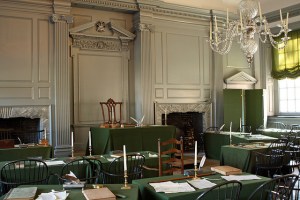
The photo below was taken during my visit. It’s the Assembly Room inside the Independence Hall building where both the Declaration of Independence and the Constitution were drafted and signed. The chair in the middle was the chair where George Washington, the first President of the United States, sat as he presided over the Congress during the deliberations and signing of the Constitution.

Independence Hall

Jefferson Memorial

The Jefferson Memorial is a monument located near the National Mall in Washington, DC. It is situated south of the White House and the Washington Monument, and near the Tidal Basin. The monument was dedicated to Thomas Jefferson, one of the American Founding Fathers (he was the principal author of the United States Declaration of Independence) and the third President of the United States. It is among the prominent landmarks in downtown Washington, DC, and it is usually the focal point of the annual Cherry Blossom Festival since the largest concentration of the cherry trees in downtown DC is located around the nearby Tidal Basin.

I’ve visited the Jefferson Memorial many times, most of the time around the time of the cherry blossom time as I walked around the Tidal Basin to photograph the scenery. It is definitely one of the landmarks that visitors to DC should visit. Not only you would be able to learn about one of the key figures in the founding of the United States as a nation, but also you can enjoy a beautiful scenery of Washington, DC. You can see both the White House and the Washington Monument straight across the Tidal Basin from the Jefferson Memorial.

The photo below was taken in the morning before the sun rises as I waited for a Washington Photo Safari tour during the Cherry Blossom Festival to take place. It was pretty quiet and you could see the monument by itself with the statue of Jefferson inside, without any of the visitors in the scenery.

Jefferson Memorial

Washington Monument

The Washington Monument, located in the National Mall area, is one of the most recognizable landmarks in Washington, DC. It was built to commemorate the first US President, George Washington. The monument is the tallest stone structure and the tallest obelisk in the world, standing at around 556 feet (close to 170 m). It is also the tallest structure in Washington, DC (there is a city ordinance in Washington, DC, that does not permit a building to be taller than 110 feet). Upon completion it was the tallest structure in the world, until the Eiffel Tower in Paris, France was completed in 1889.

I have never been inside or taking the elevator up the Washington Monument, but like other people living in Washington, DC, area, I have walked the grounds of the monument many times. During the summer months, the grassy area around the monument is used by locals for playing sports or to hold events/festivals. It is also located centrally when you’re walking around the National Mall area to visit many of the monuments and other buildings around, so there are usually good number of people walking around there.

The photo below was taken on a cloudy day in the spring time. You can see the tall monument with some flag poles around and visitors at the base for scale comparison.

Washington Monument