Ho Chi Minh

When we visited the Ho Chi Minh complex, our main reason for the visit was to check out the mausoleum and learn a bit about communism and culture in Vietnam. We knew Ho Chi Minh was an important figure in Vietnamese history, but honestly we didn’t think much about learning about the person. But as I recalled our experience visiting the Ho Chi Minh complex, and read about the life of this historical figure, I learned some interesting facts about Ho Chi Minh that I thought is worth writing about.

Ho Chi Minh was born Ngunyen Sinh Cung. He grew up going to a French school in Vietnam, then he got a job as a cook’s helper on a ship that took him to the United States. He lived for a few years in New York City and Boston area, working various jobs including as a baker at a hotel. Then he made his way to England, where supposedly he trained as a pastry chef to the famous chef Auguste Escoffier. After that, he lived in France where he started learning about communism, and then he moved on to Moscow, Russia, and Canton (present day Guangzhou), China. In China he was involved in the political movement, but he also met a Chinese woman and got married there. Then when the anti-communism coup happened in China, he went into an exile in Moscow, then made it back again to Asia by the way of Paris, Brussels, Berlin, Switzerland, and Italy. He stayed in Thailand for some time, then moved to India and back to China. The British government arrested him in Hong Kong, then quietly released him, and he ended up in Milan, Italy, working at a restaurant there before returning back to China. Then as an adviser to the Chinese communist forces, he also led a Vietnamese independence movement that led to the proclamation of independence and the establishment of the Democratic Republic of Vietnam in 1945. Later on he also led the North Vietnam to fight against the South Vietnam and eventually resulting in the Vietnam War. While the war was still going on, in 1969 Ho Chi Minh died from heart failure, but his followers continued on the fight, and he was still revered as their leader, and his body was embalmed and until today can be found on display at the Mausoleum in Hanoi. After the war, the city of Saigon in South Vietnam was renamed Ho Chi Minh City in his honor.

It’s pretty interesting to observe that the majority of visitors to the Ho Chi Minh complex when we went there were Vietnamese. I didn’t ask what these folks thought of Uncle Ho, as he affectionately was known and respected in the Vietnamese culture, but it’s clear that the government really put him on pedestal as their national hero (though interestingly Ho Chi Minh himself when he was alive supposedly was quite a humble man and did not seek the honor himself).

On the way out of the complex, however, we saw a souvenir stall selling t-shirts for tourists. You could see from the photo below that they had the communist flag and even a caricature figure of Ho Chi Minh on the t-shirts. I’m guessing only western tourists would get these (I couldn’t see a Vietnamese wearing one of these and not feeling irreverent or uncomfortable among their countrymen), but I thought it’s interesting that in the end it seems that even in this communist country at such an important landmark you could see the idea of capitalism was present.
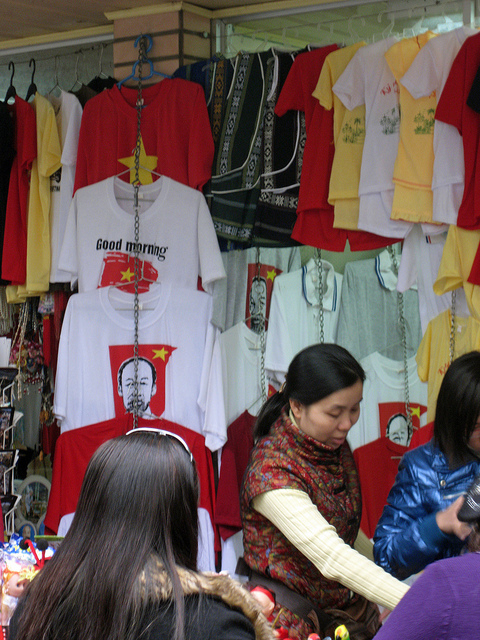
Ho Chi Minh T-Shirt

Visiting Uncle Ho

The first place we visited in Hanoi, Vietnam, was the Ho Chi Minh Mausoleum. Out of all places we planned to visit, this was one that I was a little worried about. From reading guidebooks, I knew they had strict protocol that we would have to follow, and since we’re visiting on our own, I wasn’t quite sure how we would go about even arranging the visit. It seemed that we could just show up, and then go from there, so that’s what we did…

After an unpleasant experience with the taxi ride from our hotel to start the day, we found ourselves outside the Ho Chi Minh complex. It’s clearly the right place, but we were not sure exactly where to go for entrance to the complex. So we decided to just walk around the perimeter of the complex hoping to find any entrance that looked like for visitors. This was the first time I visited a communist country (not really sure what that meant or if there’s anything to worry about for visitors from western country), and knowing that they revered ‘Uncle Ho’ I wanted to make sure we didn’t do anything that could be misunderstood as being disrespectful.

We found an entrance that looked like the place we needed to go through. There were quite many visitors already there, considering it was a Sunday morning. We finally saw some signs in English explaining that we would have to leave our backpacks or any large carry-ons at the gate before entering. It was okay to carry small point and shoot cameras for the photos after the mausoleum, but everything else had to stay. That caused a little bit of concern since I had some expensive photographic equipments in my backpack, and Kristi had an envelope with our cash allowance for the day in hers. The backpacks would need to go through x-ray machine for security check. I don’t think they would do anything with my equipments, but we were worried that if they saw the cash in there, someone dishonest may take the cash and there was nothing much we could do about it. So I told Kristi to split the cash and just pocket them in our wallet rather than leaving them in the backpack. We were given a stub for picking up the backpacks later on (not sure where, but okay, at least there was something we could use to claim them). Then we just followed everyone else in front of us to walk in a line.

Most of the visitors seemed to be local Vietnamese (we didn’t see any westerners until sometime after). We had to walk double file, and everyone seemed to be following the instruction and continued walking in silence. After walking in the complex for some distance, we reached another checkpoint where we were asked if we had point and shoot cameras, and we had to leave them there before continuing towards the mausoleum. Then we continued our walk towards the front of the mausoleum, where we saw armed guards at every corner.

When we reached the entrance, before entering, one of the guards motioned his hands at me. Apparently I had my hands inside my jacket pockets, and our hands were supposed to be on our side as a sign of respect. Thankfully that was it, and we then continued on walking inside the mausoleum. The main room was dark, with the center of the room lighted where the body of Ho Chi Minh laid in state. We had to continue walking slowly while observing and paying respect to ‘Uncle Ho’ as the Vietnamese called Ho Chi Minh affectionally. It was a surreal experience walking past the embalmed body of someone who had been dead for more than forty years. It actually wasn’t as creepy as I had thought; it looked like he was sleeping peacefully there. In few seconds, the whole experience was over and we exited the mausoleum. At that point we saw a counter where we could pick up our point and shoot cameras and continued our visit of the complex.

The photo below was taken from a distance afterwards. You can see the big mausoleum at the center of the Ba Dinh Square, the place where Ho Chi Minh read the Declaration of Independence establishing the Democratic Republic of Vietnam in September 2, 1945. Notice the guard watching the large lawn area in front of the mausoleum to prevent trespassers to go across. In front of the mausoleum you can see the line of visitors walking towards the entrance, and in front of the entrance there were guards in white uniforms.

Ho Chi Minh Mausoleum