Friends

As Cambodia is developing and recovering from the years of destruction due to the Khmer Rouge time and the civil war, there are many foreign and domestic organizations that have been instrumental in making positive changes in the socio-economic condition in the country. These Non-Government Organizations (NGOs) were able to help in ways that allow private donations/funding to have direct impact on their target group of people to help without getting the funds being diverted to potentially corrupt government officials like typically happening in developing countries. The NGOs have different missions, and many encourage foreign visitors coming to Cambodia to help further their missions by either donating, volunteering, or purchasing products or services while the visitors come and visit Cambodia. Some travel guidebooks I read even suggested that doing these would be a better way to help making positive impact to combat poverty in Cambodia rather than giving money to beggars you meet on the street.

One of the NGOs based out of Phnom Penh is an organization called Mith Samlanh (or ‘Friends’ in English). This organization’s mission is to help the Cambodian street children and their families to be independent and be productive members of the society by providing them with education, training, and medical care. They have outreach programs and several businesses that serve as training grounds for the street children. Two of them are restaurants that consistently show up on the list among the best restaurants in Phnom Penh, Friends Restaurant and Romdeng Restaurant. At both places, the street children are given training and experience in the hospitality industry — basically you have restaurants staffed by trainees, and the proceeds from the sales also go towards the program. So, as a guest, when you eat there, not only you would be able to enjoy delicious meal, but you also help support the program that contribute in positive way to local society. We decided to eat dinner at Romdeng on our last night in Phnom Penh.

The photo below was taken as we wrapped up our dinner at Romdeng. Before we left, we were asked to fill out a feedback form to rate our dining experience. It was not a normal way to finish a dining experience, but knowing the importance of the program, I gladly filled out the form and provide the feedback for the excellent experience we had there.

Survey at Romdeng

Driving Around Phnom Penh

The visit to Choeung Ek was the last item on our itinerary for the day trip in Phnom Penh. It was still midafternoon when we were done with our Choeung Ek visit; apparently even though it was a very intense day emotionally and intellectually, we didn’t really spend a long time at each of our destination. Since our driver was available to take us around for the rest of the afternoon, I asked him to drive us around downtown Phnom Penh when we got back to the city. We had not been to the river front area yet, so I thought it would be nice to at least drive past the area to see the part of Phnom Penh that’s usually considered as the popular destination for the foreign tourists.

As we reached the river front area, our driver took us to an area called the Diamond Island. It’s a newly developed area where you could see many new real estate developments in the city. There was a huge convention hall that had been built there. Not far from there, a huge casino called Nagaworld was opened several years back, and it’s billed as one of the largest casinos in Southeast Asia.

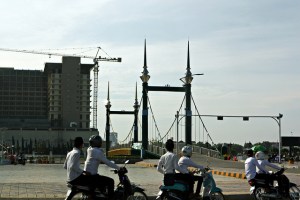
As we were about to leave the Diamond Island, our driver brought our attention to a bridge that we’re about to pass. This bridge was the scene where less than two months before our visit a stampede happened during the Water Festival celebration there, and 395 people died on that bridge. A tragedy that you wish didn’t have to hit a nation that had endured so much. But life moved on — we wouldn’t know that was the site of the tragedy if our driver had not told us.

The area near the river front (Sisowath Quay) was pretty much like what we expected. It was a very dense area, full of choices of services for tourists. There were shops, restaurants, and lodging options for pretty much any budget level. It reminded me somewhat to the Khao San Road area in Bangkok – the main destination for tourists to go especially as the ‘happening place’ to meet other foreign tourists.

We also drove past the Wat Phnom area. Wat Phnom was a temple on the only hill in Phnom Penh area. Legend has it that this was the place where Lady Penh established a temple on top of the hill (thus, the city was named Phnom Penh — Penh’s hill). Our driver asked if we would like to stop there to visit the temple. We were already pretty tired, so we passed on the offer and asked to go back to the hotel instead.

The photo below was taken from our car as we drove through the Diamond Island and about to pass the bridge where Water Festival stampede tragedy happened. As you can see, life went on and it all looked normal.

Water festival stampede bridge

Khmer Rouge Tribunal

After finishing our tour of Choeung Ek and thanking our guide Mr. Chanteng for guiding us, we checked out a small museum on the Choeung Ek grounds that had more display to educate the visitors about the Khmer Rouge atrocities. In the museum, they had a display showing a sampling of tools that the Khmer Rouge used to kill people. There was also an exhibit showing the organization structure of the Khmer Rouge leadership, and some information about the Khmer Rouge tribunal that was still ongoing to put the ex Khmer Rouge leaders on trial for crime against humanity. It’s been more than 30 years since the end of the Khmer Rouge reign, but the tribunal process was still going on.

The tribunal process only put the leadership of Khmer Rouge on trial. The other ex-Khmer Rouge members were re-integrated into the Cambodian society as the organization was disbanded. I asked Mr. Chanteng how people dealt with this. He said most people didn’t really discuss much about it and moved on, so over time you wouldn’t be able to distinguish those who were part of Khmer Rouge in the past anymore. I also asked him if people thought these ex-Khmer Rouge cadres should also be punished for their role in the past atrocities. He said it’s not an easy decision to make, as many of the ex-Khmer Rouge cadres were young, uneducated people who were brainwashed by those in Khmer Rouge leadership, and many joined the Khmer Rouge out of need for survival (either they followed, or they would die themselves). So, the common position is to put the blame on the leaders, and let the others go.

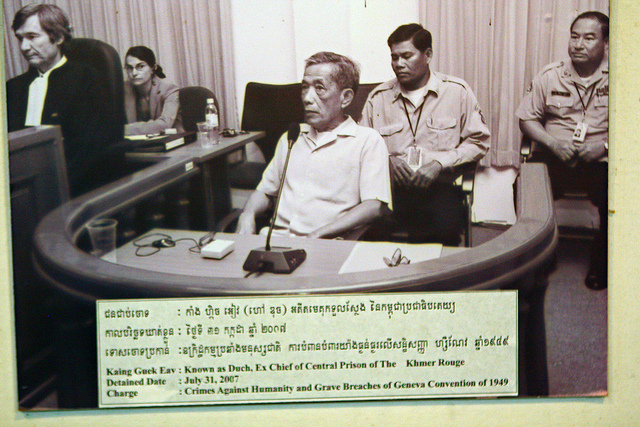
The tribunal process had been going on for several years and had cost more than USD$70 million, and only recently (July 2010) it yielded one guilty verdict (on Duch, the head of Tuol Sleng Prison, who admitted his guilt and was sentenced for 35 years in prison — considered inadequate sentence by many Cambodians). There were five more Khmer Rouge leaders currently waiting for trials — they were already in their 80s in 2010. Some people questioned whether the tribunal was worth doing, given that the large of money spent ended up consumed by a corrupt administration. In the meantime, many of the victims, the Cambodian people, still lived in poverty. Many suggested that the money would be better spent if used to build infrastructure in the country. Again, this was another difficult question that the Cambodians had to wrestle with.

After we’re done checking out the exhibits at the museum, we spent a little bit of time resting outside the museum before we left Choeung Ek. As we sat there, we saw in the distance the tall memorial stupa and a Cambodian flag flying next to it. It felt quite peaceful at that moment — I think it’s a good symbol for what the Cambodians hoped for the future: a peaceful and prosperous Cambodian society that doesn’t forget its past to ensure that the dark history will not be repeated again.

I saw the photo below at the museum in Choeung Ek. It’s a photo taken of Duch during the initial trial that’s mentioned above. One interesting development that happened since then (early this month, February 2012) was that he appealed the conviction under the arguments that he’s only following orders from those above him, but in a surprising turn of events, the appeal was denied, and instead his sentence was changed to life in prison instead.

Duch trial

Mass Graves

After spending few minutes at the memorial stupa at the Choeung Ek Genocidal Center outside Phnom Penh, Cambodia, we followed our guide Mr. Chanteng on a walking tour around the area. Without knowing the story, all you would see around the memorial stupa was what looked like an undeveloped plot of land, covered with grassy areas and some trees around. In the distance, you could also see a river flowing. If you look closer, you would notice that the grassy areas were not flat, but seemed to mounds created after large holes were dug on the ground. That would be the first clue for the horrific events that happened at this place.

Before the Khmer Rouge came into power, the Choeung Ek area was a small village about 15 km southwest of the city of Phnom Penh. The land that became the Killing Field was an old Chinese cemetery near a river. The Khmer Rouge regime decided to use this area as the place where they would exterminate the prisoners from Tuol Sleng because it would allow them to do it in secret and in a place where they could hide the evidence. Most Cambodians were of Chinese descendants, and Chinese typically would bury their dead in a family cemetery. So by burying the killed prisoners at the cemetery ground, no one would find out about the atrocities that took place. Mr. Chanteng showed us some remains of Chinese grave stones that gave us an idea of what it was like there before the place became the Killing Field.

As we walked through the dirt paths, Mr. Chanteng pointed to spots on the ground where we could see what looked like pieces of clothing, and as we looked closer, we could also notice bone and teeth fragments. These were from remains from victims in the mass graves that had not been exhumed yet. During the rainy seasons, heavy rains and floods in the area would bring some of these remains up to the ground surface. In the first few years after the Killing Field was discovered, the river nearby would flood the area during the rainy season. People who lived nearby said that during the first few years, you could smell very bad odor of decaying corpses in the air around the area. That’s just hard to imagine.. Since then, a dam was built near the river to prevent flooding from happening, but the heavy rains would still bring some of these remains up to the surface. It’s yet another surreal experience thinking that we were literally walking among the deads there.

There were several distinct spots at Choeung Ek that were marked to give the visitors idea of what happened there. Most of the mass graves were not marked, except some that had some significance due to what’s found in the grave. One grave was marked as the one with the largest number of victims found, 450 of them. Another one was marked because the victims found in the grave did not have heads, suggesting that they were beheaded before buried there. Another mass grave had only women and children victims, and some of the victims did not have clothes on.

One sign marked the spot where the trucks carrying the prisoners from Tuol Sleng would stop and had the prisoners unloaded. The prisoners were then taken to the place where they would be executed, and some would have to first dig their own mass grave before they were executed. There was a sign marking the place where a shed once stood. It was used to store DDT and some other chemicals. The chemicals were used after the execution had taken place; by pouring the chemicals on the bodies in a mass grave, the smell of decomposing corpse could be masked, and if there were any of the prisoners who were still alive, the chemicals would certainly kill them.

One spot probably summed up the cruelty of the Khmer Rouge the best: a tree named ‘the killing tree.’ It looked like just any other trees in the area, but this particular tree was significant because it was used to kill children and babies. The Khmer Rouge soldiers would take children and babies they wanted to kill there and smashed their heads onto the tree until they died. It was hard to imagine that people could be so cruel, especially to those as helpless as children and babies.

Before we finished our walking tour, I asked Mr. Chanteng about how he was personally impacted by the Khmer Rouge regime. He told us story about what his family went through in the late 1970s. Like many other Cambodians, his family had to leave their village to move to a different part of Cambodia to work on rice fields. At that time, he was only three years old, too young to move, so he was left with his old grandparents in his village as his parents and his two older sisters left for another part of the country. Sometime during the move, his parents survived, but unfortunately his two older sisters did not make it. They died of starvation.

I asked him how he and others in Cambodia could move on with their lives after the horrific past. He said for him, he wanted to make sure people learned about the Khmer Rouge atrocities so it would not happen again in the future. That’s why he became a guide at Choeung Ek – a job he had been doing for more than ten years. He also said that for many Cambodians, it was such a hurtful past that they chose to just not talk about it. Thirty years later, the majority of Cambodians (70-80 percent of the population) were born after the Khmer Rouge time, so they did not experience the horror first hand. They knew that it happened and impacted their parents, but many chose to not talk about it because it’s just too sad of history to discuss. It’s a very difficult situation that these Cambodians had to endure to move on with their lives. We could just hope that whichever path they took to deal with it, the horror of Khmer Rouge atrocities would never happen again.

The photo below was a black-and-white photo we saw at Tuol Sleng Museum. It was a photo taken when the mass graves were uncovered at Choeung Ek after the Khmer Rouge regime’s reign was over.


Mass graves uncovered

The Killing Fields

The next place we visited in Phnom Penh area after a filling lunch during our day trip was a place about 45-minute drive from the city called Choeung Ek, or now also known as the Killing Field. It’s a place where the majority of the prisoners from Tuol Sleng ended up being executed and buried.

After arriving at Choeung Ek, we purchased the tickets to visit the memorial complex. There was a sign indicating that we could also get a tour guide. I inquired for that, and a gentleman at the ticket booth said we could get a guide who could provide a personal tour of the complex and we just had to give a donation as we were willing to give (suggested amount was USD $10). When I said yes, the gentleman actually went with us as our tour guide. His name was Mr. Chanteng.

Mr. Chanteng started his tour by providing some background history on the Khmer Rouge and what the Killing Fields are. Since we’ve just come from Tuol Sleng, he didn’t go to much detail in explaining about Tuol Sleng. He did tell some facts that were staggering. There were more than 10,000 people who were buried in around 130 mass graves at Choeung Ek. Around 9,000 of the victims had been exhumed from 89 of the mass graves. The remaining 43 pits had been left alone. And if those numbers didn’t already overwhelm you, later on I found out that Choeung Ek was only one of close to 400 Killing Fields discovered all throughout Cambodia, with close to 20,000 mass graves that had been identified. The largest of those Killing Fields had the victim count up to 150,000 people. That’s just so mind boggling to think about…

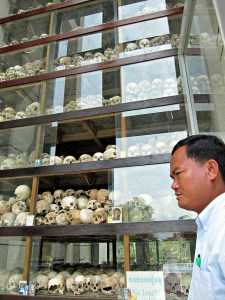
The first place we visited was the memorial stupa that was built to honor the victims found at Choeung Ek. In Buddhist countries like Cambodia, stupas were erected typically as memorial to the dead, as a place where others could pray and wish them well in their afterlife. At Choeung Ek, the memorial stupa contains the skulls and the bones of the victims that had been exhumed. There were 17 tiers of shelves for the skulls, and they were sorted by the age of the victims. When we got closer to the memorial stupa, knowing that this was such a hallowed ground for the Cambodians, I asked our tour guide about what we should or should not do there. In addition to the obvious thing to be reverent in approaching the place, we just had to take off our footwear (a standard practice in entering a Buddhist temple). We were allowed to enter the stupa and observe the shelves of skulls and bones from very close distance, and it was okay to take photos as well. It was definitely a surreal experience to see so many remains of the dead like that. I can’t imagine the horror that some of the Cambodians had to go through to uncover these places, especially knowing that some of the victims might be people they knew closely.

The photo below was taken as we visited the memorial stupa. Here you can see Mr. Chanteng explaining to us what we’re seeing in front of us — the shelves filled with the skulls of the victims found in the mass graves at Choeung Ek.

Mr. Chanteng and the Memorial Stupa