
Whenever you’re traveling to a foreign country, one of the important matters to figure out before the trip is whether you need to obtain a visa to visit the country. This regulation varies country by country, and also it depends on your country of citizenship as well. If you find out that a visa is required, you also need to figure out where to get the visa from and when you need to apply for it — in some countries, this might be a lengthy and involved process that you need to allow enough time in advance before your trip to ensure you have the visa before you go.
To visit Cambodia, most visitors would need to obtain visa from the Cambodian government. They actually have an online site that allows you to obtain the visa conveniently over the Internet. All you need is your valid passport, your digital photo, and a credit card. Very convenient — you just need to make sure you get it close enough to your trip date because the visa is only valid for three months after the issuance. Alternatively, you can also get the visa on arrival. You just need to bring some passport photos that they will collect when you apply for the visa upon your arrival in Cambodia.
When my cousin Kristi and I traveled to Cambodia, we arrived without having the visa already requested because some information we found online indicated that because we’re Indonesian citizens, we wouldn’t need to get visas because there is agreement between the Cambodian government and other ASEAN countries including Indonesia (we knew that was the case for the other countries we visited: Thailand, Vietnam, and Singapore). But we thought to be safe we should still take a couple of passport photos just in case we had incorrect information.
When we arrived in Phnom Penh, we followed other foreigners from our flight from Bangkok to go through the immigration area. Most people who were requesting visa on arrival went straight to the long line to submit their paperwork. We went towards an immigration officer to ask if we needed to get visas. His English wasn’t that good, but after looking at our passports, he pointed us towards the officer who would check the passport and register our visit. We proceeded to that line, only to find out that apparently at that time Indonesian citizens could come without visa, but only for diplomatic purposes, not for tourism. So we had to go back to the end of the line to request for visa on arrival. The process itself was pretty expedient, though it was interesting that after we submitted our passport, paperwork, and photos, they told us to proceed to the next window where everyone else waited, and one by one the officer would call out your name for you to pay and pick up your passport with the visa. So it was interesting to observe and listen to other people getting called out — by the end we kind of learned other passengers’ names…
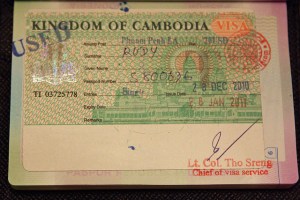
The photo below was the visa page of my passport after the visit. One thing that was interesting, the Cambodians typically write their names as [surname] [given name], in different order compared to typical Western names ([given name] [surname]). So when I got my passport back, the name written on the visa for me was my given name in the place where it’s supposed to be the surname.

 setiawanphoto