Dave and Anna

Sometimes what makes a trip or tour even more memorable is the company you have during that trip. When we did the trek to the villages of Lao Chai and Tavan on our first day in Sapa, Vietnam, we went on a semi-private tour as our tour group consisted our guide May, Kristi and I, and a couple from Australia named Dave and Anna.

Dave and Anna were from Melbourne, Australia. They came to Sapa one day before we arrived. They stayed at another hotel in town which didn’t have tour services, so during their first day in Sapa, they went on their own to Cat Cat village nearby. Dave said that during his younger days he had done backpacking in many countries in South and Southeast Asia — his description reminded me to the British/Australian couple who started Lonely Planet. During our trek Dave and I talked a little bit about various topics — economy, culture, recent news — to compare between the Australia and the United States. I didn’t remember much on the specifics, though I do remember his comment saying that he could recognize my American accent just like I recognized his Australian accent. I didn’t realize that I speak English in American accent…

Later on during the hike I had conversation with Dave’s wife, Anna. Anna mentioned that they were about ready to become empty nesters as their older son was in college while their younger son was close to finish up high school and was ready to continue on to college. Anna also mentioned that she worked for an Australian government agency as a Public Relations person, whose job sometimes is to do ‘damage control’ when someone higher up in her organization said something to the public incorrectly or was facing difficult time dealing with the press. She said her older son seemed to be interested in a similar line of job.

They were both very attentive as well when May gave explanations about the local culture, and they were interested in learning about Indonesia and the United States as well. When we got back to the Sapa Rooms after the tour, we ended up spending a couple of hours hanging out at the hotel’s restaurant to have drinks and enjoy each other’s company. Later that day, they continued their trip back to Hanoi to spend a day in the city before continuing to Ha Long Bay. Before leaving, we shared contact information and they said that if we ever made it to Melbourne, we’re welcomed to stay with them.

The photo below was taken right after we got back from our trek at the Sapa Rooms. These were May, Dave, Anna, Kristi, and me.

Tour group

Hmong Mountain Retreat

After passing the village of Tavan during our trek through the valley near Sapa, Vietnam, we reached the end of our trek. We stopped at a place called the Hmong Mountain Retreat, which was a new venture by the same proprietor of the Sapa Rooms Hotel where we stayed at in Sapa and the one that organized our trek. It looked like they wanted to take us there so we could see this as an alternate accommodation as part of our stay in the area. In the brochure for the hotel that I reviewed before booking, they suggested a mixed stay where guests can stay part at Sapa Rooms and part at Hmong Mountain Retreat to experience both styles of stay.

What makes the Hmong Mountain Retreat different than other accommodation options in Sapa area is that it’s essentially a hotel, but it’s set in the village area away from the town of Sapa so the guests can get away from the crowd and enjoy a simpler, quieter stay in a more traditional accommodation. There were several villas that made up the Hong Mountain Retreat. They were all set up like a traditional homes in the villages so the accommodation inside the villas were quite spartan. I guess this would be somewhere in between staying at a hotel and doing a homestay.

Our guide May showed us around a little bit (I suppose since she worked as a guide for the Sapa Rooms, this was part of her job to promote this new place). We also got to meet several guests who had stayed there the night before, and were waiting for transportation back to Sapa. We huddled around a traditional heater in the middle of the main building in the complex and shared our experiences in the area so far. These guests seemed to enjoy their stay there. After some time, our ride to go back to Sapa arrived, and we took a ride back to the town to end our trek. I guess that was a good thing that they had the van coming to pick us up. Otherwise we would’ve had to trek uphill back to the town.

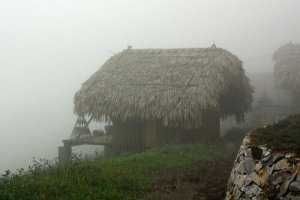
The photo below is one of the villas at the Hmong Mountain Retreat. You can see that it’s pretty rustic, and it may not be for everyone.

Hmong Mountain Retreat

Homestay

One of the activities you can do when visiting Sapa, Vietnam, is to immerse yourself in the local culture by staying with a local family for one or more days. The homestay experience is like a personalized version of staying in a bed & breakfast, though likely it’s more rustic and allow you to see what life in the local village among the ethnic minority group is like.

When we were planning for the trip to Sapa, Kristi and I considered doing the homestay. However, since we only had one night that we could stay in Sapa (the other two nights during the trip were to be spent on the train rides between Hanoi and Sapa), we decided to just stay at a hotel. We did see a Travel Channel program where the host Samantha Brown went to one of the villages near Sapa and stayed with a local family. She got to experience helping the host family with a chore, plowing the rice fields with the buffalo-powered plows, and then relaxing in an herbal bath and having dinner with the host family. That looked like a wonderful cultural experience to try when you have a chance.

When we walked through one of the villages, we saw a couple of homes that had a sign saying that they welcome homestay guests. It looked like this had become a cottage industry — kind of like ‘agriturismo’ in Italy — which I think is pretty nice for the local families to supplement their household incomes while at the same time showing their culture to the guests. One thing to beware, however, is when you try to set up one of these stays through travel agencies. You may want to find out how much of the proceeds actually goes to the host family, as supposed to being skimmed by the travel agency. I read in travel forums that sometimes the family got taken advantage of by the travel agency and you end up making the travel agency richer without helping the welfare of the hosts.

The photo below was taken as we’re about to enter one of the villages. You can see a typical scenery in the village with the small homes off the main street.

Local village

Multi-Purpose Vehicle

When we walked through the villages in the valley near Sapa, Vietnam, we noticed a common type of vehicle that the locals used for many purposes (and it’s an unlikely one), the small cc motorcycles. In Southeast Asia, it’s pretty common to see small cc motorcycles dominating the traffic especially in big, crowded cities like Jakarta, Phnom Penh, Bangkok, or Hanoi. I didn’t expect to see these motorcycles as much in the mountainous region around Sapa, however, since you would think it requires bigger engine to have these motorcycles going on steep climb and descent in some of the area roads, and even going on gravel or dirt roads in the rural area. But since these motorcycles are also quite affordable in comparison to cars, surprisingly you can find many of them around. There are even some people who provide service by giving others ride between Sapa and the nearby villages. In some cases, we saw people carrying heavy loads on the back, or even having three adults riding on one small motorcycles.

I thought it’s interesting to see how people would push the boundaries of the ‘operating conditions’ of these motorcycles. I thought of similar cases in many developing countries where you have to make the best use of what you have, and it’s about necessity, not luxury, to have these vehicles. Back in Indonesia, when I was young, my father owned a Vespa (Italian scooter) that he rode everywhere in Jakarta since even before I was born. He rode the same scooter for more than 20 years, and whenever it broke down, he would find some ingenious local mechanics who figured out how to fix it. You hear similar stories with the 1950s cars in Cuba that are still in use today — people with their ingenuity manage to prolong the life of these vehicles, even when at times the use was beyond the intended ‘operating conditions.’

Compare that to the wealthy countries like the United States. In the US, there are more cars than motorcycles, and when people drive cars here, I think on average the cars are probably around 5 years old or younger. You do see older cars, but a lot of people if they could afford it would look to get new car every several years. And these days most of the newer cars are so complex and sophisticated that you almost need to take it to the authorized dealer service center to figure out using computerized diagnostic tools if there is anything wrong with it. Try to take those cars to places like Sapa; I would be reluctant to do so lest it breaks down and noone knows how to fix it. Also, here I do care about keeping my car in good condition (for its resale value) that I would think twice before driving it to any off road or even unpaved roads since the car is not a 4-wheel drive. I’m sure if I had no choice I would’ve found ways to make it work with what I have.

The photo below was taken as we walked on the main road in the village of Tavan. You see a man riding his small cc motorcycle with ‘wide load’ on his back seat. I’m not sure if this would even be allowed in the United States.

Wide load

School Performance

After we finished our lunch in the village of Lao Chai, we continued our trek to the village of Tavan, which was located about 3 km away from Lao Chai, also in the valley near Sapa, Vietnam. The walk between the two villages was pretty flat; we spent the time chatting with our guide May talking about her life experience living in the nearby village and about the local culture.

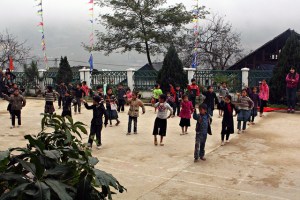
When we arrived in Tavan, we stopped at a local elementary school, where at the schoolyard there was a dance performance by the students shown for the tourists who came to visit. It was pretty cute to see these little kids — mostly between 5 and 8 years old, performing the coreographed dance to the tune of music playing on a boombox. Their teacher was watching them performing. Many of the tourists including myself got closer to the performing kids so we could take photos of them during the performance.

We stayed there for a little bit to watch the performance, then continued our trek. One thing interesting however was May’s comments to us as we left the school. She said that the school was opened by the Vietnamese government to educate the local children, mostly from the minority tribes (you could tell the government influence as there was a picture of Ho Chi Minh prominently on display at the front of the school). While undoubtedly the children received education, with the increasing popularity of tourism coming to the area, now the teachers tried to charm the visitors with the performances by the children to encourage the visitors to give donation to the school to help the poor children. This is well intentioned, but at times there are occasions when it seemed that in some schools the money donated never actually made it to the children, but instead were taken by the teachers. When you have teachers in remote area like this with likely pretty low salary, it’s not surprising that such corruption may happen. A better way to donate to the local community was by bringing in some school supplies that the students could use.

The photo below was taken during the performance by the school children. You can see them performing while their teacher was watching on the side, and the tourists were watching from the background.

School performance