Safety Issues

When visiting a foreign country, one thing to consider is the issue of personal safety. Prior to our trip to Cambodia, I did some readings on the safety issue for visitors there, and tried to be knowledgeable and prepared. One important thing to get prior to an international travel like this is a travel insurance, which for a reasonable price could cover potential cost in the event of emergencies (like health issues, theft, etc.). I think regardless where you go, that should be something you should have for your peace of mind.

Specifically on Cambodia, some concerns/risks typically mentioned are: crime (especially in big cities like Phnom Penh), malaria (in rural areas), and landmines (leftover from the war time, but still present especially in rural areas). For us, we were not worried about malaria as we’re only visiting for a few days, and we’re mostly in Phnom Penh and Siem Reap. The landmines risk was not a concern either as we’re traveling with tour guide and on well-traveled path (not going to the jungle on our own). As for crime, I wasn’t too worried initially, but I did have quite expensive photographic equipment in my backpack that might be of a risk for theft. One of the guidebooks I read even said to be careful carrying expensive camera in Phnom Penh as there had been reports of people getting their camera snatched by people on motorbike while walking on the sidewalk.

I asked our tour guide Vanna about that, whether we need to worry about theft. Vanna said that he thought Siem Reap area in general was a safe place to be; we need not worry about getting mugged or anything like that. He said generally when things were lost, people were pretty honest and items were found or returned, though if you have cash in a wallet, for example, those might not be recoverable.

I didn’t think much about this, until after our trip to Banteay Srei. After we visited the temple, we stopped near the public restroom area as Kristi needed to use the restroom. Vanna and I waited for her outside, and we had pretty good discussions about some things. After Kristi was done, we went to our van to continue our day trip. We had been driving away for about 15 minutes or so when I realized that I didn’t have my DSLR with me. I looked around my seat in the van, and couldn’t locate it. So we immediately took a U turn and rushed back to Banteay Srei. The restroom area was the last place I remembered having the camera with me.

When we reached Banteay Srei, Vanna and I ran to the restroom area, and when we got there we saw a local Cambodian family holding my camera, and trying to figure out who the owner of it was. I went to them and use hand gestures to told them that it’s mine, and then showed them a couple of photos on the camera that had my photo on it to prove that it was mine. I thanked them for keeping the camera, and we left Banteay Srei to continue our trip.

Vanna said that I was very fortunate that we got back in time to retrieve the camera, and that there were these honest people there who ‘kept’ the camera until the time we came and retrieved it almost half an hour after we left there. Afterwards, I thought about the whole situation, and I wondered how I would’ve felt had I lost my camera. Though obviously there would be the monetary lost — the lens on the camera was more expensive than everything else I carried during that trip combined — I think what I would’ve lost even more were the shots I had in the memory card that couldn’t be replaced. So I would agree with Vanna — I was very fortunate — and it also taught me some lessons: 1) always back up your memory cards, 2) you should have travel insurance in case the unfortunate event happened to you, 3) if you’re not careful with your belongings, you can lose it, no matter where you are, and 4) there are honest people everywhere and don’t have stereotype or assumption that because you’re going to a developing country, people are after your expensive belongings.

The photo below was taken that morning at Banteay Srei as we entered the temple. The crowd size was still pretty reasonable in the morning — there were more people coming later in the day.
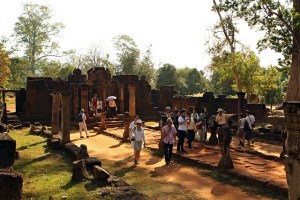
Crowd at Banteay Srei

Banteay Srei

Banteay Srei is a temple located about 25 km north east of the main temple complex of Angkor Thom in the Angkor Archaeological Park area near Siem Reap, Cambodia. The temple was built in 10th century and it was dedicated primarily to the Hindu god Shiva. The temple was built largely of red sandstone, a medium that allowed for very elaborate wall carvings that are still observable today. Even though the size of the temple is much smaller compared to others in the Angkor area, because of its intricate details it is popular among tourists to visit. The name Banteay Srei means ‘the citadel of women’ or ‘the citadel of beauty’, supposedly referring to the intricate details in the temple and the many devata (female deity) figures carved into the wall of the buildings.

We went to Banteay Srei as our first destination to visit during our day trip in Angkor Archaeological Park after the sunrise viewing at Angkor Wat and breakfast at nearby restaurant following that. Our tour guide Vanna suggested to go to Banteay Srei first and then work our way back closer to Siem Reap during the day. We hoped to beat the crowd there by going in the morning.

The drive to Banteay Srei from Angkor Wat took us through the Angkor Thom complex. We got a glimpse of the many temples that made up this ancient city. After passing Angkor Thom, we drove through several villages on the way to Banteay Srei. Vanna explained that the typical houses in the villages were built on stilts above the ground to provide clearance for the times in the rainy season when the area might get flooded. It also provides protection for the pets from wild animals, and practically, it provides some shade during the hot sunny day.

When we arrived at the temple, there were already a lot of other visitors there coming before us. We had our entrance passes checked before entering the temple, and then spent some time inside observing the intricate details of the temple. Since the size of the temple is smaller compared to other temples in Angkor area, there were many areas where we had to took turns with others to get closer and take photos. That’s why Vanna wanted to get there as early as we could so we didn’t have to contend with bigger crowd.

Vanna also told us again about the stories and myths behind the Hindu gods. Again, after a while things got blurred in my head — all I remembered was that Shiva and Vishnu were the two gods that seemed to be prominently represented in many of the temples, and Vanna said Vishnu was his favorite one given his role as the one who provides sustenance to the world.

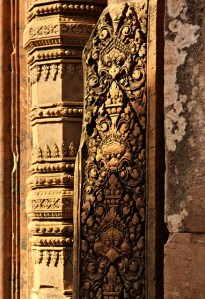
The photo below was taken as we toured inside Banteay Srei. You can see the intricate details of the wall carvings. The morning visit was also nice from photography perspective as the light was not too harsh.

Intricate details

Bobor

After viewing the sunrise at Angkor Wat, we continued our day trip in Angkor Archaeological Park near Siem Reap, Cambodia. Breakfast at the Kool Hotel’s restaurant was included in our stay there, so we could go back there for breakfast and taking some rest before continuing our day again. But since our tour is a private tour (which means we could change the itinerary if we like since we have the tour guide and driver with us already for the whole day), our tour guide Vanna suggested an alternative of getting the breakfast at one of the restaurants near Angkor Wat, and then continued our trip for the day from there. That would save some time by not going back to the hotel first. We thought that was a good idea. It did mean spending extra money for the breakfast, but it also allowed us chance to get a variety in our meals there as we already had one at the hotel’s restaurant the day before.

There were several restaurants located in the area right across from the entrance gate to the Angkor Wat complex. Given their strategic location, they cater mostly to tourists and I’m sure the price was higher than what you would get at restaurants in Siem Reap. We decided to go with one that served more local flavors, traditional Khmer breakfast dishes. Particularly, I was interested in trying out the Khmer’s version of rice porridge called bobor. I read about it in the guidebooks, and it was particularly intriguing because the word bobor sounded very much like the Indonesian word for rice porridge, bubur. Vanna knew of one of the restaurants that had the dish on the menu, so that’s the one we went to.

As we walked into the restaurant, a young Cambodian boy, must be around seven to ten years old, approached us with a bag full of bootlegged guidebooks to offer to us. He said, ‘Guidebooks, sir? I have several.. on Angkor Wat… Lonely Planet…’ I looked at him and politely said ‘No, thanks’ while shaking my head. He then smiled and said, ‘If you change your mind, come and buy from me, ok? Have a good breakfast…’ I said thanks and we continued entering the restaurant.

We ordered our breakfast and then waited for the food to be prepared. There were several other groups of tourists and locals in the restaurant. They seemed to enjoy the food. When I looked outside the restaurant, I saw the bookseller boy outside hanging out with some of his friends waiting for other tourists to come. Coming from Jakarta, that wasn’t a new experience of being offered goods at the parking lot by people on the way to restaurants. But I thought it was interesting that this Cambodian kid at such a young age already learned English quite well to conduct business (and very likely that was not learnt from taking formal language classes), and the gentle and positive mannerism I think well represented the Cambodian culture as ‘the land of smiles’, and it’s a good technique for someone in sales / business. I just hoped that the boy would have a chance to go to school and get educated, and not getting stuck to working from such a young age.

Our food finally arrived. I ordered a bowl of bobor with salted fish, omelet, and pickled vegetables as toppings. Kristi ordered a rice noodle dish with seafood. My bobor came with the toppings served on a separate plate from the bowl of rice porridge. The rice porridge was a bit on the watery side; it was closer to what I had in Indonesia (bubur) than the thicker ones I had in the US (Chinese congee). And the toppings are very much similar to what we would use in homemade bubur in Indonesia, so the taste of this dish was so familiar to me.

Kristi’s rice noodle soup was somewhat similar to the ‘bun’ dish in Vietnamese cuisine. Given its location in between Thailand and Vietnam, I think that’s one of the unsurprising thing we learned about the Khmer cuisine. There are some similarities with the cuisine from the neighboring countries, but there are also some things that make it unique.

The photo below is my bowl of bobor with the toppings already added to it. Our table was very close to the entrance, and we had natural lighting from outside, which made it great to do food photography.

Bobor

Sunrise at Angkor Wat

After a good night rest following a long day that started with a trip from Phnom Penh to Siem Reap, followed by a visit to Angkor Wat and Phnom Bakheng, and completed with attending an apsara dance performance over dinner, we’re ready for another day full of activity in Siem Reap area. We started very early in the morning, leaving our hotel around 6 am when it’s still dark. The first activity of the day, back to Angkor Wat to watch the last sunrise of year 2010.

This activity was as popular among tourists as going to Phnom Bakheng to watch the sunset. It was still dark when we arrived at the entrance gate to the Angkor Archaeological Park, but we could tell that it would be quite a crowd judging from the line of cars waiting to get the entrance passes checked by the officials.

When we arrived inside the Angkor Wat complex, there were already many people in there, mostly waiting near the pond in between the library and the main temple building. That seemed to be a popular spot to wait for the sunrise as from there you could see the silhouette of the temple with the sun rising behind it, and the temple reflected on the pond.

The area near the pond was already full of people, so I decided to set up my camera and tripod a little bit further to the side so I had room to capture the image with long exposure at low light with the tripod support. It worked pretty well, though there were several takes that had to be redone because I had people walking in front of my camera setup as they didn’t realize I was taking photos there.

After a little while, the sun had been rising for a few minutes and it’s getting brighter. Many people had left the pond area, so Kristi and I decided to get closer there to take photos of the temple reflected on the pond. I was able to still get the effect of sun rising by changing my shutter speed to be very high. That allowed me to take some photos like one below without the aid of tripod — very helpful as there were people around me that made it difficult to do any set up at all that require space. It was a great experience, and I was glad that it was a nice, clear sky and we could see the sunrise nicely as we hoped for.

Sunrise at Angkor Wat

Apsara Dance

The apsara dance or the royal ballet of Cambodia is a form of performing arts established in the royal courts of Cambodia. Traditionally it was performed only on special occassions and ceremonies. Like many other forms of art in Cambodia, this traditional dance was almost lost during the repression of the Khmer Rouge. Fortunately it became popular again in 1980s and 1990s. Today when you’re visiting Cambodia you can find dance performances at places in Siem Reap and Phnom Penh.

After visiting Angkor Wat and Phnom Bakheng, we closed our day with a dinner show arranged by our tour company. We went to a restaurant with a large dining hall with a stage at one end, serving international-style buffet dinner. After most people got their dinners, a dance troupe performed several dance routines on the stage, a combination of classical and folk dances. Kristi and I were seated at a table not far from the stage, so we were able to enjoy the dance performances from a pretty good distance.

The dance performance was quite good, and at the beginning of each routine, a narrator provided us with a little description of the dance routine we’re about to see. Thought personally I’m usually not that interested in watching dance performances, I thought this was a good experience nevertheless since I had never seen it before, and they did very good job performing it. Later on Vanna said that these dancers went through quite rigorous training and selection process, so those who actually made it to the troupe are usually very good.

The photo below was taken during one of the dance routines. I used my 24-70 mm f/2.8 lens, taking the photo from my seat without the flash firing with the camera set with shutter priority at 1/125. It turned out pretty well and I was quite happy with the result.

Apsara dance