Sunday Morning in Chinatown

When traveling, sometimes you can learn and appreciate the local culture simply by observing the locals go about their daily lives and compare what you see with what you know from your own culture or background.

It was still quite early on Sunday morning in Chinatown Singapore when we walked around to explore the neighborhood. Many of the stores were still closed, but there were some people already walking around. Some were tourists as we could tell from their cameras and backpacks that they carried (just like us). But others you could tell were locals — some looked like they lived in the neighborhood and simply were going out for a walk in the neighborhood.

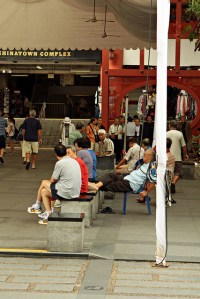
As I was waiting for Kristi to go to restroom at one place, I noticed several elderly Singaporeans sitting around on the bench in front of a shopping building. Some were dressed like they were out for exercising (in shorts, polo shirt, and wearing sneakers). Others were simply wearing casual clothes and sandals, very relaxed. This scenery reminded me to home in Indonesia, specifically to my late grandfather, my dad, and my uncle, who would go out for a morning walk in the neighborhood or get up early to join a group doing some exercise program. It’s partly to start the day right with some healthy activities, but it’s also to socialize and meet friends or neighbors. I thought it’s interesting to compare this to other cultures — elsewhere people would get together frequently to play games, having coffee or meal together, or simply just hanging out and watch life goes by; different activities, but with the common idea of sharing life with friends. In a way, it’s a nice change of pace from the hustle and bustle of living in cities.

Chillin on Sunday morning

Singapore’s Chinatown

Singapore’s Chinatown is different than a typical Chinatown area in other world’s cities. Usually Chinatown exists in a city where the Chinese community is the minority. In Singapore, that’s not the case; the Chinese ethnic group is among the major ethnic groups in Singapore. The Chinatown area near the CBD (known to locals as Kreta Ayer) is historically the area for the Chinese to live designated by the ruling government when Singapore was a British colony (similar areas were designated for other ethnic groups like the Malays, Indians, and Arabs). Today the Chinese live throughout the island of Singapore, but the Chinatown area remains to be the centre of Chinese culture activities. It is also a popular place to visit in Singapore for foreign tourists who want to experience and learn about Singapore’s Chinese heritage.

We walked around the streets of Chinatown after breakfast at the Maxwell Road Hawker Centre. It was still pretty early in a weekend morning, so many of the stores were still closed and the foot traffic was still pretty light. But we did get a glimpse of what the area was like — many buildings built in old architectural style, juxtaposed against tall skyscrapers in the background. Aside from the obvious tourists like us, there were also many locals who went about their normal weekend morning.

The photo below was taken from the corner section of the neighborhood. The big building in front is a Buddhist temple, and next to it is the start of the Chinatown neighborhood with its distinct architectural style. The neighborhood consists of several blocks with narrow streets and alleys that you can explore by foot.

Singapore Chinatown

Breakfast at the Hawker Centre

We reached the last day of our Southeast Asia trip. We wanted to make the best of the remaining time we had in Singapore before our flight back to Indonesia. However, when we checked our flight schedule, we found out that there was a change in schedule for our flight to Jakarta; it was moved up by a couple of hours. So that means we had two hours less than what initially thought to spend in Singapore.

What could we do in 2-3 hours before we had to head to the airport? Initially we were hoping to go to Singapore’s Chinatown area in the morning, and then go to Little India area for lunch before heading to the airport. We decided to modify the plan to forego the Little India part, and to focus only on Chinatown.

We left our hotel around 7:30 am. There was breakfast offered at the hotel’s restaurant, but we decided to head to get something better — breakfast at one of the many Singapore hawker centres. Since we’re heading to Chinatown, we decided to pick Maxwell Road Hawker Centre. This particular Hawker Centre is located right across the street from the Chinatown area, so that would minimize the travel time.

We took a taxi to the Chinatown area. When we arrived at the Maxwell Road Hawker Centre, the place was still pretty empty as the day had just started and many of the stalls were not open yet. It was also a Sunday morning, so that might have something to do as well. There were a couple of stalls already open, however. There was one that actually already had quite a long line of people waiting to order. We looked closer, and found that the place sold congee (rice porridge). It looked pretty good, but we didn’t want to spend too much time waiting in line. So instead we looked around, and found another stall that also sold congee, but with shorter line. There were some folks who went there, so we thought it might be good enough.

Kristi and I both ordered rice porridge, but with different meats. She ordered with fish, while I ordered with thousand-year old egg. We also ordered a dish simply called ‘homemade tofu’ after seeing other people ordering that. The rice porridge was good; nothing spectacular but quite tasty and a nice meal to have to start the day. The homemade tofu, however, was something else. Somehow it was crispy on the outside, and very soft in the inside. It was served with light soy sauce. The taste was just perfect; I thought it was among the best preparation of tofu I had ever tasted.

We also found a stall that sold soybean milk. That was a nice drink to have to complement the breakfast. We were filled and ready to continue on to explore the area.

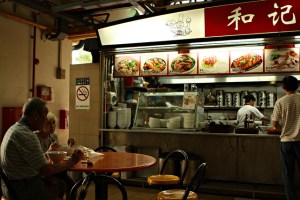
The photo below was taken from our table at the hawker centre. This was the stall where we ordered our breakfast. You can see an elderly couple at the next table, also enjoying the rice porridge. They looked like locals who come here frequently to have breakfast. It reminded me to some places near my home in Indonesia where we would go early in the morning for breakfast.

Breakfast at hawker centre

Strolling Through Downtown Singapore

After having our seafood dinner, we continued our night in Singapore with some sightseeing. When we got into a taxi cab, the driver asked us where we wanted to go. I told him that we wanted to go the Central Business District area, near where the Merlion Statue is located. He mentioned One Fullerton, and I said sure. I didn’t know where or what One Fullerton was, but I figured if it’s in the CBD area, it’s hopefully close enough that we could walk around and explore.

The taxi took us downtown, and when I saw The Fullerton Hotel on the right and the Merlion Statue on the left, I was glad that this time the taxi took us exactly where we wanted to go. The Merlion Statue that is the mascot of Singapore stood tall near the waterfront at the Merlion Park, facing the Marina Bay. It was a nice weekend night, and there were a good number of tourists at the Merlion Park taking photo of the illuminated statue. In the background there were the skyscrapers in the Central Business District area, and right behind the Merlion Statue there was The Fullerton Hotel, a five-star hotel that had earned recognition among the best hotels in Singapore and in Asia.

The name One Fullerton that the taxi driver mentioned referred to the two-story waterfront development right next to the Merlion Park. We walked there briefly to check out what’s there, and it looked like it was filled with restaurants, lounges, and clubs with a nice view of the Marina Bay. The patrons were mixed between locals and expats. That made sense given its location near the CBD and the touristy area of downtown Singapore. The view across the Marina Bay from there was very nice. In the eastern side you could see the Esplanade complex with its durian-shaped main building. The Esplanade is the main facility in Singapore for performance arts where you can attend concerts, theatre performances, operas, etc. It also had an outdoor pavilion, and that night we could hear the sound of music playing from there; it seemed that a concert was going on.

On the southeast part of the Marina Bay, we could see a newer landmark in Singapore, the Marina Bay Sands resort hotel. It’s shaped like a ship sitting on top of three towers. It was billed as the world’s most expensive standalone casino property at S$8 billion (including the prime real estate where it is located). I remembered watching a special reality show on the Food Network a couple of years back about the preparation and opening of a restaurant / night club called Ku De Ta, which was located at the top of the Marina Bay Sands. It had amazing view of Singapore, but it also looked like a very expensive place and you need to be ready to shell out some cash to go there — not what we had in mind for our short trip in Singapore.

After spending time in the Marina Bay area, we decided to follow the map that we took from our hotel to walk towards our hotel. It would be quite a hike, but we thought we would just walk roughly close to the MRT route, so if we got tired, we could either take the MRT or get a taxi to finish the trip back to the hotel. We ended up walking all the way back to our hotel in the Lavender area. Along the way, we passed the historic Raffles Hotel, the Bugis area with its shopping malls and the Arab Street area that looked like an interesting neighborhood of Arab immigrant stores to check out during the day (it was pretty dead at night). We made it back to our hotel after about an hour or so strolling, ready to hit the sack after a long day that started in Hanoi.

The photo below was taken from the One Fullerton area. This is the Marina Bay Sands resort hotel, with its ship-like platform at the top supported by the three towers.
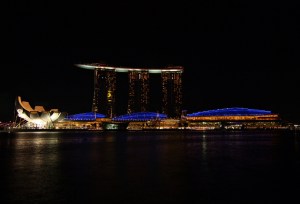
Marina Bay Sands, Singapore

Looking for Chili Crab

After settling in our hotel room in Singapore, we were ready to explore the city during our short stay there. It was almost dinner time, and we were ready for our first meal in the city known for having great foods.

There are so many choices of places to go for great food in Singapore, and even for a particular dish you can ask the Singaporeans for their favorite place and you may get different suggestions. Before leaving for the trip, we decided to use the recommendation from the Anthony Bourdain’s No Reservations Singapore episode to select the places to visit for this short visit to Singapore. The dinner was one that I had been looking forward to; we wanted to go to the place where Bourdain went with his Singaporean friend to have the Singaporean national dish, chili crab. They went to a restaurant called Tian Jin Hai Seafood. What made the segment of the show memorable was one special dish they had there, steamed shark’s head. The chef found a way to make an extraordinary dish from a typically discarded part of the fish. Andrew Zimmern in his Bizarre Foods Singapore episode also tried the same dish, and also said it was good.

So I looked online for information regarding Tian Jin Hai, and found that since the No Reservations visit, they had moved from a hawker center to a location in the northeast part of Singapore called Punggol that was pretty remote and not easily reachable by public transportation. We decided to give it a try anyway, and took a taxi to go there.

We reached the Punggol Marina Country Club address after quite a long drive from our hotel. It was a little shopping centre with some stores and several restaurants. The address was correct, but when we looked for Tian Jin Hai on the directory, it was nowhere to be found. We walked around to look for it, and couldn’t find the place. Finally we decided to ask some locals for the place. After getting puzzled look from some people, finally we found out that the restaurant had moved out elsewhere. Disappointed, we tried to figure out what to do as alternative then. We’re out in a remote location, and we didn’t really think of alternate place to go. So we decided to look for the restaurant options at the Punggol Marina, and found one seafood restaurant called Ponggol Seafood Restaurant that seemed to have pretty good crowd eating there.

The restaurant had the chili crab dish on the menu, so we ordered the dish. The chili crab came served with fried mantou buns, perfect to dip in the spicy chili sauce of the crab. We also ordered a steamed fish dish along with the crab. Unfortunately they did not have the steamed shark head dish on the menu.

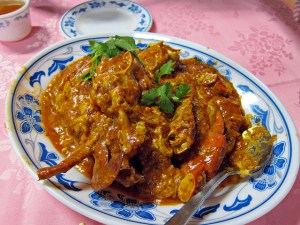
Here was the chili crab dish that we had for dinner. I was a little disappointed we didn’t find the steamed shark’s head dish, but at least we did have pretty good taste of the Singaporean national dish.

Chili crab