Gyeongbokgung Palace

The first place we visited during the Seoul City Tour was the Gyeongbokgung Palace. The palace is located in the northern part of Seoul. It was first constructed in the 14th century and reconstructed in the 19th century, and it was once the residence of the royal family. The palace complex was nearly destroyed by the Japanese in the early 20th century; the buildings are slowly being restored and as of 2009 nearly 40 percent of the original palace buildings still stood or had been reconstructed.

During my visit to the palace, we first saw the changing of the guard ceremony at the Gwanghwamun, the main entrance to the palace. After entering the palace, we spent time touring around and visited many buildings that made up the palace. Our tour guide provided us with some explanations of the functions of the various buildings inside the palace.

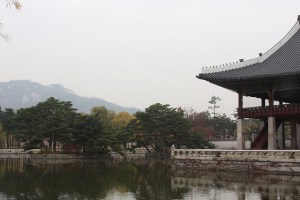
The building in the photo below is the Gyeonghoeru Pavilion. It is the Royal Banquet Hall that with a pond and landscaping around looked quite nice especially in the autumn.

Gyeonghoeru Pavilion

Airport Transit Tour

If you have several hours of layover at the Incheon International Airport in South Korea, what would you do with your time in transit? You could wait at the gate for your next flight, window shopping at the various stores in the terminal, or — if you’re adventurous — go on a transit tour.

When I walked around the airport on the way to find out about my hotel assignment during the 22-hour layover, I saw billboards advertising the transit tours. I went straight to the hotel after receiving my hotel assignment, but the idea of taking a tour sounded interesting to me, especially considering on the following day my flight to Jakarta was not scheduled to leave until 3 pm in the afternoon. When I arrived at the hotel, I asked the hotel receptionist about the transit tour, and he said that’s a great idea and I should consider going back to the airport early on the next day and find out about the tour availability.

I went to the airport on the 8 am shuttle, and waited until the transit tour information desk opened at 9 am. Initially I was thinking about taking one of their shorter options (either 1-hr or 2-hr tour), but when the lady at the tour booth found out that my flight was not until 3 pm, she suggested that I consider joining the 5-hr Seoul City Tour that includes a traditional Korean lunch. She assured me that I would be back in time for my flight.

The Seoul City Tour took us to several locations within the city of Seoul. The city itself is about 45-minute drive from Incheon. We visited the Gyeongbokgung Palace and the nearby National Folk Museum, and then continued on to spend some time walking on the street of Insa-dong, an area full of stores selling arts and crafts. We also stopped by at the Cheong Gye Cheon, a man-made stream with walking path that cuts through downtown Seoul. We finished up the tour with a lunch at a traditional Korean restaurant. It’s quite a packed program for a 5-hour period. I made it back the airport with just enough time to go through security and find my departure gate.

Depending on your time availability, you can also consider other tours that are either shorter or longer in duration. One thing you have to consider is that you would need to go through immigration first and get a visitor visa before you can go on the tour. Depending on the time of the day, this may take an extra 30 minutes to 1 hour. I do think it’s worth the hassle. It gives you a much more memorable experience than just sitting at the waiting area near your departure gate.

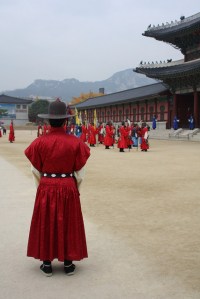
The photo below was taken at the front of the Gyeongbokgung Palace. There was a changing of the guard ceremony going on when we arrived at the palace.

Guard at the Gyeongbokgung Palace

Incheon

I would consider myself a seasoned traveler since I traveled very frequently for my old job. At least that was the case within the United States. Even when visiting new cities in the US, the routine was typically the same: finding the baggage claim / ground transportation area, getting to the car rental place, and following GPS or printed map to get to my destination. Well, when you’re traveling internationally, it’s completely a different story. Faced with an unfamiliar protocol / routine in a different culture with its own language / script, and I felt like a rookie traveler again.

When I landed at Incheon after the first leg of my trip between Washington, DC, and Jakarta, all I knew from my itinerary was that I had a 22-hour layover before my next leg of the trip, and I was going to get a hotel room for the night. After what seemed like a scavenger hunt to find the Korean Air staff who had the hotel assignments, I found myself in a little minivan with three other passengers being driven off the airport to a nearby area called the Airport Town Square. We were dropped off at our designated hotel, Hotel June. The driver spoke very little English, and motioned us to go to the hotel receptionist desk. Fortunately the receptionist spoke English pretty well, and explained to me and the other passengers about our meal coupons that we could use for dinner that night and breakfast and lunch on the following day, all served at the hotel’s restaurant. Apparently there is shuttle bus going to the airport every so often, so depending on when our next flight was, we could tell them which one to go on.

When I got to my hotel room, it was yet another new experience. I had a Platinum Elite status with Marriott Rewards at that time since I stayed so much time on the road at Marriott hotels in the United States, so you would think I could easily adjust and make myself home at any hotel room. Here, I was like someone discovering a hotel room for the first time. It started with learning how to use the room key as the main switch to turn on electricity in the room. Then more discovery on how things work in the room: figuring out the light switch with labels in Korean, using the sophisticated toilet and shower in the bathroom, and using a PC with Microsoft Windows with Korean language/encoding and Korean keyboard to browse the Web. It was very much unlike anything I had ever seen in any hotel in the United States.

I also ventured outside the hotel to walk around the neighborhood. The area was full of transit hotels like Hotel June, and there were many restaurants around. I like Korean food, and there were many of those places that looked like they had really good food, but I was deterred by the fear of not being able to communicate, especially after seeing the signs and menus all in Korean with very little, if any, English translation. And I didn’t know how much things typically cost, so I was worried that I might get ripped off if I didn’t know what to expect. But simply wandering around the neighborhood several blocks from the hotel was a good experience to observe a new culture.

The photo below was taken during the night walk through the neighborhood. Note that there was practically no English on any of the signs.

Incheon Airport Town Square

Korean Air

The first part of my long trip from Washington, DC, to Jakarta was a 14-hour flight from DC to Seoul. Looking back and thinking about what I remembered about the experience made me think of some things that make me look forward to experiencing an international flight (in comparison to typical domestic, shorter distance flights).

When you think of international flights, two things that come to mind are typically the long distance and the time it takes to complete the flight. As such, the obvious emphasis from the airline perspective is to ensure that the flight is as comfortable and enjoyable as possible for the passengers. This means wider seats, longer leg room, selections of in-flight entertainment, and good food/refreshments. Very different than shorter distance flight where typically the passengers care more about getting to the destination as fast as possible, and the airlines try to maximize the load and have expedient turnaround.

Another aspect with international flights that sometimes become the differentiator for the airlines is the cultural/national influence of the carrier’s country of origin. For some of them, the airline and the service it provides represent their country/culture, so they would take it seriously and serve with pride (I don’t think you would see this from any of the US-based carriers). For me personally, this aspect I think makes a big difference between a flight experience that is simply good to the one that is memorable. I think my first flight experience on Korean Air was an example of that.

The first impression on the aircraft was good with modern, clean, and spacious cabin of their Boeing 777. The boarding process was efficient, the flight attendants were welcoming with smiles, and as the result the passengers seemed to be happy to start their journey. Then there was the Audio Video On Demand (AVOD) system, which has the job of occupying the passengers mind during the flight to make the long flight seems to pass quicker. It did a good job for me, as I was able to find a couple of movies I had not seen, and found all kinds of music from various Asian countries to listen to.

Then there was the food. On a 14-hour flight, we went through some snacks and several meals. So there were several occasions where they needed to provide good variety of food that the passengers would enjoy. With Korean Air (and similarly, with some other Asian carriers), they would provide options for either western-style menu or Korean-style menu. This is to address both the westerners who don’t really care for trying Korean food and also the Korean nationals and others who actually are looking forward to having their national dishes. I think this part was one of the highlights of these international flights, as you get to try something that’s unusual for American experience.

Lastly, another factor that may make an international flight memorable are the passengers themselves. Depending on the flight route, you can expect different demographics making up the list of passengers. For example, going from DC to Seoul, you can expect to find a majority of the passengers being Koreans who are going to their home country. It was interesting to people watch and see how people from different cultures behave.

I took the photo below just before we took off. There were two mothers traveling in this long flight with their young children. They were given the bulkhead seats as the Korean Air flight provided the bassinet to place their little children in so they’re comfortable during the flight. These two little kids did very well during the flight and didn’t cry or got upset at all. And they made for a fun source of entertainment from watching them play and make facial expressions.
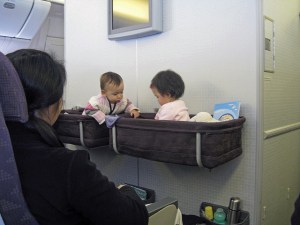
Little kids in Korean Air flight

South Korea

When you travel internationally, often times it is unavoidable that you have to take long international flights. This part of the trip could be a drag.. or it could be an adventure in itself.

Several years ago, I had a family emergency that required me to travel from the United States to Indonesia within a short notice. Given the last-minute nature of the trip, I had to take the flight option that would get me there the earliest possible, even if it meant inconvenient routing. The flight I ended up taking was on Korean Air, and the itinerary was as follows: 14-hr flight from DC to Seoul, followed by 22-hr layover, and then another 7-hr flight from Seoul to Jakarta. It would’ve been the longest air travel I had ever experienced in my life.

I usually plan ahead for any of the trips that I take. In this trip, however, I didn’t have time to plan, so I pretty much just played it by ear along the way. I had never traveled on Korean Air, nor had I been in South Korea before. So it was completely a new experience. In the next few days, I will post some entries highlighting my experience during this trip. But if you don’t want to wait for the postings, you can also check out my flickr photo album that tells the story about this experience in images.

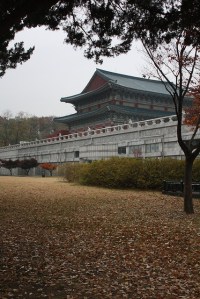
The photo below was taken at the National Folk Museum in Seoul, South Korea. The building had a nice, elegant architecture, and it was autumn, so there were colorful leaves on the trees and on the ground. How did I end up at the Museum during this trip, you might ask? Well, check out the flickr album, or stay tuned for more on this adventure..

National Folk Museum in Seoul, South Korea