Mystic Seaport

The last stop during my New England road trip was the Mystic Seaport in Mystic, Connecticut. The Mystic Seaport is a maritime museum with collection of sailing ships and boats, some were more than 100 years old. It also has a replica of a 19th century seafaring village, portraying what life was like back then in a coastal community.

It was already mid-afternoon when I arrived at the Mystic Seaport, so many of the programs for the day were already finished. I spent most of my time there checking out the ships and boats, big and small, that were docked at the port. There was also one big ship called Charles W. Morgan that had been at the Mystic Seaport since 1941, and was in the middle of restoration process at the shipyard to make it seaworthy again. Visitors could climb up into the ship to see what the interior was like. And there was also Schooner Amistad, which was used in filming Steven Spielberg’s movie Amistad.

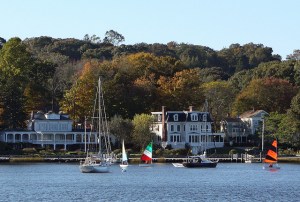
The photo below was the scenery on the Mystic River that I saw from the seaport. It was a nice fall afternoon, and some people were cruising in their sailboats on the river. In the background, there were some nice homes with riverfront view.

Sailing on the Mystic River

The Breakers

I started the last day of my New England road trip with a visit to The Breakers, a mansion in Newport, Rhode Island, owned by the Vanderbilt family.

In the late 19th century, the Newport, RI, area became a summer destination for the wealthy Americans. There are several of those mansions that today became museums that you can visit. But one that is definite a ‘must visit’ is The Breakers, a 70-room mansion built by Cornelius Vanderbilt II (who was among the wealthiest persons in the United States at the time). He spared no expense in building this mansion. The home was constructed between 1893 and 1895 at a cost of more than $12 million (approximately $316 million in today’s dollars adjusted for inflation).

During the visit there, as part of the admission you get a headset/handheld player for a self-guided audio tour of the home. So you can spend as much or as little time on any part of the home. You’re not allowed to take photos inside the home, but you’re allowed to do so at the balcony outside and at the grounds around the home.

Here are some of my thoughts from my visit to this huge mansion. The home was definitely impressive and opulent, though it’s not my style preference (I like the modern style of interior design, more minimalist and clean style rather than the ornate). It’s mindboggling to think that this was only a vacation home for the Vanderbilt family, not their primary residence. The sad part of the story was that Mr. Vanderbilt could only enjoy the home that he built for four years, as he died due to a stroke in 1899. And it seemed that none of the Vanderbilt children except their youngest one, Countess Gladys Széchenyi, liked the property (she ended up inheriting it from her mother). Today it is preserved and opened up as a museum that provides a view to the life of the American rich and famous from the 19th century.

The photo below was taken at the balcony of the home’s second floor. Personally I thought the balcony was my favorite space in this home as it felt like a getaway from the heavily decorated rooms inside the home, and the ocean view facing the east was awesome and peaceful.

Balcony at The Breakers

Freedom Trail

If you’re visiting Boston for the first time, and you only have a few hours to spend, what could you do to get the most from your visit? One suggestion is to go downtown and take a walking tour on the Freedom Trail.

After visiting Acadia National Park in Maine, I continued my New England road trip south bound through Massachusetts. I planned on stopping for the night near Newport, RI, but on the way, I wanted to stop somewhere in Massachusetts. I thought one place I couldn’t miss is the biggest city in New England, Boston. I had been to Boston a couple of times before for business trips, but never for leisure. So I thought at least I should stop there as it was on the way to my next destination. As I looked for activity that I could do in a few hours there, I found out about the Freedom Trail. The Freedom Trail is a 2.5-mile walking path in downtown Boston that takes you to several historical landmarks where some key events in the American Revolution occurred. The path is marked with redbrick line that you can trace starting at the Boston Common. You can get a map at the Information Center and do a self-guided tour, or like I did, join a 90-minute guided walking tour that starts at the Information Center in the Boston Common area and ends at the Faneuil Hall. The tour runs every hour, rain or shine, led by a tour guide dressed in the period attire (and typical role play an important historical figure).

During the tour, you get to learn about the historical landmarks and some of the key figures in the American Revolution (people like Paul Revere, John Hancock, and Samuel Adams). I think doing the tour is definitely worth the time and cost as it allows you to learn more than simply looking at the sights and reading printed materials. You can ask questions about the city history that you probably won’t find in any guide books. For example, why are the streets in downtown Boston laid out in somewhat confusing pattern? (It’s because those streets started as walking paths created by farmers herding their cattle). And you get more in short time if you have time constraints like I did.

Near the end of the tour at Faneuil Hall, if you’re hungry, you can check out another historic landmark, the Union Oyster House. The restaurant was established in 1826, earning it the distinction as the oldest operating restaurant in the United States. There you can get some traditional New England fare like clam chowder or broiled scrod. The food might be a little bit on expensive side, but I think it’s worth it for the experience.

The photo below was taken as we started our walking tour at the Boston Common. You can see the redbrick line on the trail and our guide leading the group at the front walking in the rain (by the end of the tour, the rain actually turned to snow). The building with the golden dome in front of us was the Massachusetts State House. The photo was nothing spectacular, but I think it conveys the sense of place and captures the experience of being part of the walking tour. This is an example of one point to keep in mind in recording a travel experience. Sometimes you have situations where it’s less than ideal to take photographs with DSLR (like in this case, we were walking in the rain, and one of my hands was holding an umbrella). In such situations, it’s helpful to have a backup plan like carrying a small point-and-shoot camera, and it’s better to take photos anyway even in less than ideal situation so you would still have a record of your experience.

Freedom Trail

Mount Desert Island

When most visitors come to Mount Desert Island, the primary destinations are usually the Acadia National Park, which occupies a large portion of the island, and Bar Harbor, a town closest to the park where you find accommodations during the visit to the area. The island is actually more than just these two places; if you have a car (or a bike), you can also tour the island and visit many little towns there. In the last few posts, I mentioned about a couple of those places, Northeast Harbor with its beautiful Asticou Azalea and Thuya Gardens, and Bass Harbor with its famous light house. There are other towns around that may not necessarily have any particular landmark to visit, but are good representations of small Maine / New England coastal villages.

And not to be missed when you’re in Maine is a visit to one of the local lobster pounds where you could get the local product fresh from the fishing boat and at very reasonable price. These places may not have the nice decor as some fancy restaurants you find in Bar Harbor, but if you’re looking for lobster, I think this is the best way to get it. I went to Thurston Lobster Pound in Bernard, and had a wonderful feast of lobsters with side dishes and desert that was pretty easy on my budget but also very memorable experience.

The photo below was taken in a little town called Somesville. It’s located right in the middle of the island; you would pass it if you drive around the island between some of its harbor towns. There was a beautiful footbridge over a pond there that is very picturesque, especially in the autumn. I stopped there to take photos of the footbridge and the pond, but as I turned around, I saw this wonderful scenery of a home near the inlet with a gorgeous tree next to it. This is an example of one of good photography lessons I learned — be aware of your surroundings when looking for interesting scenery to photograph; sometimes you can find more interesting subjects beyond your initial one by simply turning around and look what is behind you. You can find more sights on Mount Desert Island in my flickr photo album.

Fall morning in Somesville, ME

New England

After finishing the coast-to-coast road trip from Santa Monica, CA, to Brooklyn, NY, I continued on up north to the New England area. Our coast-to-coast road trip took place in early October, and since I already took several days off from work, and I was already in New York City, I thought why not continuing the trip to visit New England during its peak fall foliage time. Prior to this trip, I had only visited Boston, MA, for business trip. I had never been to the other New England states. So this was a good opportunity to do it, and I decided to ‘sample’ all of the New England states in one extended weekend.

The route for the trip was quite an ambitious one, covering Vermont, New Hampshire, Maine, Massachusetts, Rhode Island, and Connecticut in only four days. But since I was traveling alone (initially I invited my brother to come along, but he had some events to prepare for immediately after getting back to New York), my schedule was somewhat flexible and I could push it as far as I could personally take. The trip ended up to be a wonderful one as I got to experience many things unique to the region — fall foliage, maple syrup, lobster, history — capping the longest road trip I had ever undertaken, around 5,300 miles covering 22 states from California to Maine in 10 days.

The photo below was taken on the Park Loop Road in the Acadia National Park, ME. I had purchased the car about one month before the trip, and this trip was its first road trip outside the DC metro area. On a morning drive through the gorgeous drive, I noticed this stretch of the road that was lined with colorful trees, and the road had a nice S curve. It was early enough that there was no traffic for few minutes, so I ‘staged’ my car and took the photo.

Fall drive in Acadia