The Killing Fields

The next place we visited in Phnom Penh area after a filling lunch during our day trip was a place about 45-minute drive from the city called Choeung Ek, or now also known as the Killing Field. It’s a place where the majority of the prisoners from Tuol Sleng ended up being executed and buried.

After arriving at Choeung Ek, we purchased the tickets to visit the memorial complex. There was a sign indicating that we could also get a tour guide. I inquired for that, and a gentleman at the ticket booth said we could get a guide who could provide a personal tour of the complex and we just had to give a donation as we were willing to give (suggested amount was USD $10). When I said yes, the gentleman actually went with us as our tour guide. His name was Mr. Chanteng.

Mr. Chanteng started his tour by providing some background history on the Khmer Rouge and what the Killing Fields are. Since we’ve just come from Tuol Sleng, he didn’t go to much detail in explaining about Tuol Sleng. He did tell some facts that were staggering. There were more than 10,000 people who were buried in around 130 mass graves at Choeung Ek. Around 9,000 of the victims had been exhumed from 89 of the mass graves. The remaining 43 pits had been left alone. And if those numbers didn’t already overwhelm you, later on I found out that Choeung Ek was only one of close to 400 Killing Fields discovered all throughout Cambodia, with close to 20,000 mass graves that had been identified. The largest of those Killing Fields had the victim count up to 150,000 people. That’s just so mind boggling to think about…

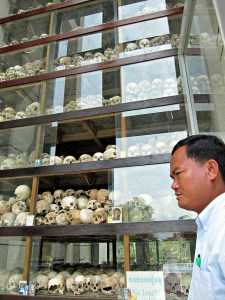
The first place we visited was the memorial stupa that was built to honor the victims found at Choeung Ek. In Buddhist countries like Cambodia, stupas were erected typically as memorial to the dead, as a place where others could pray and wish them well in their afterlife. At Choeung Ek, the memorial stupa contains the skulls and the bones of the victims that had been exhumed. There were 17 tiers of shelves for the skulls, and they were sorted by the age of the victims. When we got closer to the memorial stupa, knowing that this was such a hallowed ground for the Cambodians, I asked our tour guide about what we should or should not do there. In addition to the obvious thing to be reverent in approaching the place, we just had to take off our footwear (a standard practice in entering a Buddhist temple). We were allowed to enter the stupa and observe the shelves of skulls and bones from very close distance, and it was okay to take photos as well. It was definitely a surreal experience to see so many remains of the dead like that. I can’t imagine the horror that some of the Cambodians had to go through to uncover these places, especially knowing that some of the victims might be people they knew closely.

The photo below was taken as we visited the memorial stupa. Here you can see Mr. Chanteng explaining to us what we’re seeing in front of us — the shelves filled with the skulls of the victims found in the mass graves at Choeung Ek.
Mr. Chanteng and the Memorial Stupa

Lunch with Our Driver

After visiting the Tuol Sleng Genocide Museum in Phnom Penh, Cambodia, our next destination was Choeung Ek, the Killing Field. It’s been pretty intense experience learning about the Khmer Rouge atrocities, and before continuing to the Killing Fields, a lunch break was definitely a good idea. Our driver asked us where we wanted to go for lunch. We told him that we didn’t have any particular restaurant in mind, and asked him for suggestion for a good, local Cambodian restaurant — a place that he would go himself to eat. He suggested a place near our next destination, Choeung Ek Killing Fields, where he liked to go when he took guests there.

The drive to Choeung Ek area took about 45 minutes. The restaurant was located only about five minutes before we reached Choeung Ek. Our driver said that this restaurant was a favorite of his and other drivers. They would go here for lunch break while waiting for their passengers visiting the nearby Choeung Ek.

When we got to the restaurant, we were the only customers there. There were several items on the menu, and they were already prepared and laid out on a long serving table. Our driver and the lady serving at the restaurant went over each of the dishes with us. Since the restaurant lady didn’t speak English, we asked our driver to do the ordering for us. We sat down at one of the few tables at the restaurant, and the lady served us a sampler of what they had: tom yum soup, deep fried fish, duck curry, and pickled sour mustard with pork. I initially felt a bit apprehensive, but after tasting each of the dishes and found out that they tasted similar to dishes I had in Indonesia, it was like eating homemade dishes at someone’s house.

While eating lunch, we also had a chance to chat with our driver. We found out that he grew up and had lived in Phnom Penh all his life, and he’s seen the city changing a lot in the last few years as Cambodia opened up to foreign visitors again. I asked him about his family, and learned that he had four children, all under the age of ten. He smiled when talking about his children — just what you would expect from any proud and loving parent. One subject I didn’t ask was about the impact of Khmer Rouge on him personally; I didn’t know if that would be something I should ask.

Next to our table, we saw a group of young Cambodians in their 20s, mostly in light blue long-sleeve shirts coming and having lunch. I was curious, since I noticed a lot of people in Phnom Penh wearing similar outfit. I asked our driver about that, and he said these folks were likely office workers who were taking their lunch break. Later on I learned that many employers in Cambodia follow similar dress code of requiring their employees to wear the light blue uniform so that became the equalizer and avoid any socio-economic issues that might come when the have’s and have not’s wear different outfit. That reminded me to similar policy we had in Indonesia for school students where we had to wear standard uniform regardless which school we went to. That worked pretty well in Indonesia, and since there was quite a wide adoption in Cambodia, that seemed to work there too.

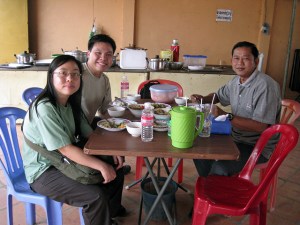
The photo below was taken before we dug into our lunch. You could see us with the table full of food to share and enjoy, and in the background is the long table with the big pots where the dishes for the day were already prepared ahead of time and ready to serve to hungry guests like us.

Lunch with our driver

Aftermath

The last building we visited at the Tuol Sleng Genocide Museum in Phnom Penh, Cambodia, is called Building D. This building had a display of torture devices used at Tuol Sleng and some paintings to illustrate how they were used, done by Vann Nath, one of only seven survivors out of almost 20,000 people who were imprisoned at Tuol Sleng. The paintings were done based on his recollection of what he saw and heard during his time at Tuol Sleng — showing various ways prisoners were tortured. This was also very difficult to see. It’s hard to imagine how people could be so cruel and treated others like that.

On the upper floor of Building D, there were two interesting exhibits that covered the impact of Tuol Sleng on people years after the prison was discovered. One exhibit told stories from people who lost their family members to Khmer Rouge atrocities. These stories told about people being betrayed, their families remembering vividly the last time they saw them before the Khmer Rouge took them away, and how they were remembered. Very heart wrenching.

Another exhibit showed the ‘then’ and ‘now’ of some ex-Khmer Rouge cadres who worked at Tuol Sleng and were still alive years later. It’s interesting to read their testimonies. Some said they did their job out of fear of their own lives. Some pointed to the leaders of Khmer Rouge to blame instead of the lower-level cadres since the leaders were the ones setting the direction. There was also an interesting text that mentioned how in genocide situation like what happened in Cambodia, the perpetrators might actually be victims themselves as studies showed that many would show symptoms of psychological problems like depression, recurring nightmares, and trouble concentrating or sleeping, years after.

I think the takeaway from seeing these exhibits is that it’s a very complex situation to move on from such dark times, as every single person was impacted in unique way, and each handles the situation differently.

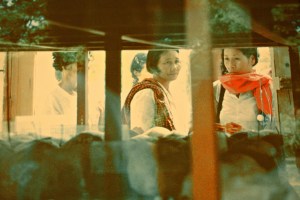
The photo below was one of the photographs on the display at the museum. It showed people observing a cabinet full of skulls of the victims excavated from the mass graves. You could see the sadness in the face of the lady in the middle — I wonder if she’s remembering anyone close to her who lost their lives in the hands of the Khmer Rouge.

Sadness

Prison Cells

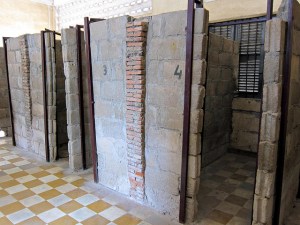
Building C at the Tuol Sleng Genocide Museum in Phnom Penh, Cambodia, was filled with classrooms that were converted into prison. Makeshift cells, each about 2′ x 6′ in size were created using bricks and metal support on the ground floor, and wooden panels on the second floor. There were chains cemented to the floor used to tie the prisoners. A prisoner had to stay quiet within their cell; if they made any noise, the prison guards would come and beat them up. The exterior of Building C was covered with barbed wire, to prevent any of the prisoners to attempt suicide by jumping from the higher floors.

Looking at these small cells, with the chain on the ground and only small amount of sunlight coming through from the outside, I wondered what a prisoner would be thinking when locked up in there.. Remembering the past when they were free? Fear of the guards outside? What to say when the interrogators asked questions about one’s background? Anxiety in anticipating execution? All of the above? It was very difficult to think how thousands of people went through the horror there.

The photo below was taken at one of those classrooms in Building C. You can see the makeshift prison cells built with cinder blocks.

Makeshift prison cells

Faces of Tuol Sleng

Building B of the Tuol Sleng Genocide Museum in Phnom Penh, Cambodia, contained photo displays, most were from the documentation archive that the Khmer Rouge meticulously kept during their reign. The first part of the photo displays showed photos from around the time the Khmer Rouge took over Cambodia. The Khmer Rouge regime had the goal of converting Cambodia into an agrarian Marxist country. To do so, right after they gained power in Cambodia, they essentially ‘hit the reset button’ on the life in Cambodia to start a new one. The start of the Khmer Rouge regime was called ‘Year Zero’; all culture and traditions in Cambodia as they knew it were destroyed or discarded, so a new one could be started. Monetary system was abolished. Most Cambodians were forced to relocate to the rural areas to work in the rice fields that were to become the base of the new Cambodian culture.

The Khmer Rouge regime recruited young Cambodians, mostly uneducated, to be part of their army to enforce their ideology. These recruits were essentially brainwashed and they became the feared army and prison guards in places like Tuol Sleng. The photo display included rows of mug shots of these Khmer Rouge cadres. From looking at the photos, you could tell that they were all very young, and given that they were mostly uneducated, they were possibly easy to influence.

To avoid any opposition, the Khmer Rouge regime arrested and executed those who they viewed as potentially dangerous, such as any educated people or community leaders that didn’t agree with the Khmer Rouge ideology. These were the people that were brought to prisons like Tuol Sleng (there were 196 of them all throughout Cambodia). When they arrived at the prison, they were forced to write an autobiographical account of their lives from their childhood to the time they were arrested. They were also forced to give the names of any relatives or friends, which subsequently were arrested as well.

The second part of the photo displays moved on to show the photos of the prisoners at Tuol Sleng. Each person was photographed at the time of their arrival, and each had a number pinned to their shirts. From the expressions on the faces, you could see the fear and hopeless feeling that these prisoners had.

The last part of the photo displays was very difficult to see as they showed some of the prisoners after they were being interrogated and tortured. The Khmer Rouge photo documenter took these photos as if they were used to show to their superior that they had done their job in the interrogation process. There were some photos that were so graphic that would make most visitors very disturbed leaving the place.

The photo below was one of the many Tuol Sleng prisoners that I saw lining up the walls of the Building B. This particular one captured my attention as it showed a young girl that’s clearly not a prisoner that was arrested because of what she knew, but very likely because she was associated to someone whom the Khmer Rouge considered as potentially a threat to their regime (e.g., someone educated/intellectual, or a leader in the community that might oppose the regime). You could see that she was perhaps scared, confused, or afraid of what’s about to happen to her after this photo was taken. Very likely she was one of the victims who ended up buried in one of the mass graves at the Choeung Ek Killing Fields outside Phnom Penh.

Tuol Sleng victim